What’s going on? Mike Nelson here. Welcome back to the Flex Diet Podcast. On this podcast, we talk about all things to improve body composition,
add more muscle, improve performance, do all of it without destroying your health in a flexible framework.
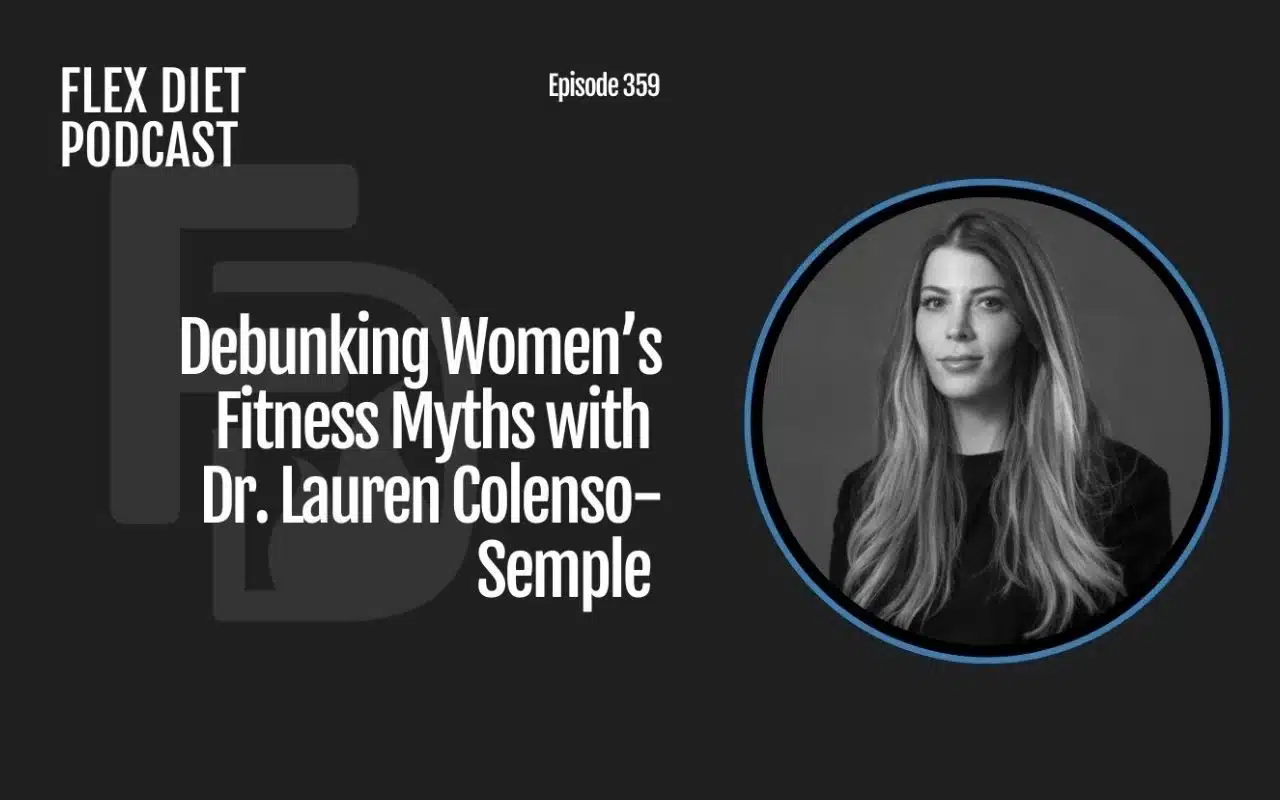
Today on the program, we’ve got Dr. Lauren Hun, simple, and we’re talking all about.
Common myths and misinformation about women’s fitness.
I think you will really enjoy this, uh, podcast. So we talk about everything from how do some of these misconceptions
show up in women’s fitness? What are some of the challenges with over complicated fitness programs
debunking the fasted training, miss understanding issues that are real
issues such as low energy availability. Then we talk about a wide range of topics such as cold water
immersion and cortisol concerns. Uh, what are some of the different physiologic aspects of cold water
exposure, recovery modalities training versus recovery? How do you find the right balance?
Um, are there true sex-based differences in training? Even talk a little bit about the challenges in women’s
research and, uh, supplementation regarding women versus men.
So I think you’ll really enjoy this podcast. I had a ton of fun, uh, talking about this.
Uh, just appears like there’s a lot of good stuff related to women’s fitness online and.
There’s a lot of pretty darn horrible information, I would say. Um, so it’s nice to talk to someone who is a researcher in this field
who’s very familiar with the research. And it’s also fun for myself to compare notes since.
Ironically, I, my writing style is geared more to guys, but historically
70% of the one-on-one online clients I have, um, are actually women.
And so we discuss that and compare notes about training and nutrition research
versus what people do in the real world. So sponsors of this podcast, I’m drinking some, what is today, watermelon.
Element, which is still one of my favorite electrolyte drinks. I’ll put a link down below. You can, uh, check out those guys there.
And then in regards to training, uh, check out my friends over at Beyond Power for the VUL Ultra One device.
I’m back at home again and was able to use this in the gym literally yesterday.
And one of my favorite exercises on it is to do seated cable rows.
Then slowly increase the eccentric component over time.
So what’s great about the Vulture one device is you can add eccentric, you can add a chains mode, and it’ll automatically change it.
So as you’re doing a seated cable roll, for example, I was doing that concentric. So pulling it back at a hundred pounds.
And then for my first set, I just added 10% more eccentric. So when it is pulling it back to the machine, it’s 110 pounds.
Since most of us are stronger on the eccentric, um, component. And then over time I have clients work up to even, you know, maybe 40
or 50% on the eccentric load again, you know, take your time on that. Um, but I found that, you know, strength increases and overall it’s great
to be able to do it with the device because you literally just program in how much of the eccentric load you want, how much of the concentric.
And after the first rep, it’ll auto detect and it’ll change it with each and every rep. So in my case, then I will auto-regulate that.
If you can’t hold the eccentric slow for four to six seconds, and it’s probably a little bit too heavy for that rep range.
Uh, so I’m an affiliate for Beyond Power. Uh, really impressed with the device. I’ve had a couple friends pick up the device so far, and.
Uh, all the feedback on it. It’s been amazing. Like they’ve all loved it and sent me notes on how they were, uh,
excited that they are able to use it. So check that out. Balu and then also my newsletter.
So I write daily for the insider [email protected]. Go to the top, go to newsletter and you can hop on for free.
I’ll send you all sorts of great information. Uh, completely free.
So thank you so much to Dr. Lauren and enjoy this podcast
all about debunking fitness.
Hello. How are you? Good. How’s it going? Oh, What are your, kinda, if you were to pick one, I know there’s probably many.
What is like your biggest pet peeve that you hear about? Women’s fitness now that just drives you nuts.
The theme is that it’s way more complicated for women and
that it’s drastically different for women than it is for men. And so we can certainly go through the specifics of, zone, heart rate
zone training or fasted training or sprint interval training,
or jumping or, nutrient timing. There’s tons, but the overarching theme is that because you are a
woman or, and or because you are a perimenopausal, a postmenopausal
woman, everything is different for you and much, much more complicated. There are so many more things that you need to worry about.
Yeah. Before we hop into some of those, like what would you say are.
The basics that we have pretty good data that, probably both men, especially women should focus on, and then we’ll get into maybe some of
the other more specifics after that. What comes to my mind is I’ve seen things on online or even had just one off consult
clients of this poor woman’s program was so complicated that she was trying
to train at around her, specific cycle. And I just asked her, I said, well, I said, no offense, but like
what are you, like, what are you doing for exercise like right now? And she’s like, well, I just gave up because it got to be so complicated.
I tried to do it and I couldn’t follow through it Exactly. And I’m like, oh, well, we know we have lots of data showing exercise is still
very helpful for women, but I get that it gets easy to get lost in the weeds and
people generally are a all or nothing. And then they’re like, well, I can’t really do it air quotes correctly, so I’m just going to, it just doesn’t seem to get done.
I think historically women have been sold ineffective exercise programs
that encourage a lot of inconsistency. Right? Like Monday I’m gonna do yoga, and then Wednesday I am gonna do a cycling class.
And then Friday I am, maybe I’ll do I’ll lift weights or, but there is,
it’s always or for six weeks I’m gonna do Barry’s bootcamp ’cause it’s really trending and then I’m over it.
And so I’m onto the next thing, like hot yoga Pilates or something. And so then we never are really actually addressing the goal.
And so you don’t make progress and then you get frustrated because
you’re not changing your body composition or improving your strength or whatever the goal is. It’s there’s no initial discussion as any good trainer would have with a client
about why are we here, what are we looking to improve and what looks like success?
Yeah, I mean I, this is probably the most male clients I’ve ever had, even though I write to dude bros in like their thirties to fifties, like most of my
one-on-one clients are actually women. And one of the questions I get all the time is like, do I specifically
train them any different? And I’d be curious on your thoughts on this is yes, but it’s per individual.
I haven’t, I would say, found one particular thing that is vastly different between genders.
I could make some associations where, women probably could lift a little bit heavier. They probably could rest a little bit more, things like that.
But at least based on the literature and my personal experience, I haven’t found.
These massive, huge differences where I have found that depending upon, well, what is their specific goal? What do they want to do?
What are their constraints? What is their schedule? What is their outside stress like? To me, a lot of those things that you would take into to customize a program are
still at the kind of the top of the list. I completely agree, and I think if we go through the list of initial questions
that you would ask a client or the key considerations that, that you might have, it would be, initial fitness level.
What is their background, what is their skillset? Certainly what are their goals? How many days a week do they wanna.
Train. What are their preferences? What kind of access to equipment do they have? What are their past injuries?
What exercises do they hate and love? And all of those things are, and then once you start working with
someone, maybe you find that this person can handle a lot of volume. Wow.
Mm-hmm. This person can squat three times a week. Like, that’ll never be me. But that is some people, and that’s what you get when you
actually work with an individual. But making these kind of broad generalizations based on sex I
think, don’t get us anywhere. And they just ignore what we know about the foundations of
good coaching, good coach, client communication, and just the basics of a solid training program we need.
Consistency. We need progression over time. We need to do things with good form. We need to make sure we’re challenging ourselves appropriately.
And so insert something like cycle sinking.
Well, even if there were a physiological rationale for doing that, which there
isn’t, but even if there were implementing any program where you’re drastically
switching things up one week to the next would never make any sense for any goal.
And so I think we, that gets really lost in these conversations because as soon as you start talking about hormones, you lose the conversation
about exercise adaptation. It’s like well established like things that nobody is debating about what
we need for exercise adaptations. Yeah. And many years ago I did have some female clients that.
I tried the cycle thinking thing with and thought, well, eh, maybe it was more or less kind of their idea.
And I’m like, okay, I’ll go along with it. Let’s try it. And it was a disaster to be honest, because every discussion revolved
around what part of their cycle, where they’re in, they felt like they were not doing it correctly. And at the end of the day, I ended up abandoning it because,
and part of it was my fault too. I probably didn’t do the best job coaching them through it
and got diverted into the weeds. And when I went back and looked at it, it’s like, oh, well you’ve
missed 50% of your sessions. We’re only doing two strength training sessions. We’re only doing one cardiovascular.
Like all the big things that I had in like everybody else’s program. For one reason or another might have been programmed, but at the
end of the day did not get executed. And then every conversation when I went back and reviewed it was,
oh, okay, it’s this time of the week I did this temperature. Here’s how I’m feeling. I’m gonna change this or change that. And then something happened and it never, it didn’t really get done.
So I ended up abandoning it because I realized I was doing people a disservice by getting them a worse result by unnecessarily complicating something that
probably didn’t need to be complicated. Yeah, and I’ll add two things. Having measured hormones and ovulation timing in so many people, it just
never looks like these, this clean four week, your hormones are very
rarely that I so ma and many people ovulate much earlier than mid cycle
and many people ovulate much later. Meaning you have these unequal phase lengths, which makes the whole thing
that much more complex and, inappropriate for a lot of those individuals.
And then of course it takes the autonomy away from, can’t we just wake
up and get to the gym and then decide? I, am I feeling good?
Do I wanna push it today? And have that conversation with ourselves because certainly with the cycle sinking and also with a a lot of the wearables, well, it told
me I didn’t sleep well last night. Yeah. So therefore I’m not gonna, and when we start to lose that level of, Hey, I’m able
to decide how I feel and key into how I feel and then make decisions accordingly,
or be okay with having a workout that is a, B or a C and not an a plus.
Like, that’s okay too. Doesn’t mean it was worthless. Yeah. I like the Dan John.
Okay. Most days are just because like punch the clock workouts. Like you show up, you do the thing, like you do the best you can.
You try to do high quality work, maybe you rest a little bit longer to make up for it, try to keep performance the main thing, but.
I think maybe social media or whatever has people thinking that every workout they do has to be the most amazing thing under the sun.
And you talk to people who’ve done it for a long time. Even people at an extremely high level lead athletes, most of their
sessions, shocker, are just, yeah, I got to the gym, I got the work done. I did the best I could.
Obviously things are trending down, you’re gonna make changes. But most of it is, like you said, it’s like a B or a C. It’s average
or just a little bit above. If you do that with violent consistency day in and day out, like shocker, you
can make a lot of really good progress. And I find so many of the people who are worrying about all of this quote
unquote optimization, are not the folks that should be concerned about
that because they are, yeah, they haven’t been doing it for long enough. They’re not, they don’t have the basics nailed down.
And so you have people who are worried about really insignificant things
that maybe if you have an abundance of resources or you are an elite athlete and you really need that, last 2%, then okay, let’s do those things.
But otherwise you’d get a lot further if you just did the thing and stopped
worrying about all of these nuances that at the end of the day, aren’t really going to move the needle one way or another.
Yeah, I do a lot of heart rate variability and I really like wearables, but the two things that stand out to me are, like you said it was probably a while
ago now, conversation on a consult, and I could not get through to the guy of
like, how did you feel when you woke up? Well, I looked at my aura and my Aura score said this. I’m like no, but like, just do me a favor next time you get up tomorrow morning.
Don’t look at any metrics, don’t look at anything. Write down a note, just a one to 10 scale, like how you felt.
Do that for a week. Then by all means, look at your scores, whatever. I’ll do another consult for free.
We’ll review your data and compare how you felt to what your data was, because
it, as like if you’ve been monitoring this data long enough, no matter what data it is, there’s no one single marker that’s gonna tell you everything.
As much as I love heart rate variability, I love other markers, and even then over time.
I’ve had clients do really good sessions on what would be horrible looking metrics,
right? But again, that was a one-off day, that was an acute thing. All their chronic measurements, everything were fine.
Usually we’ve done something similar this to the past. We have an idea of how they’re gonna respond but there’s no, just
one number is gonna tell me exactly how I’m gonna perform and feel. We’re unfortunately, so far away from that.
Yeah. And I think it’s also, we’re not robots, right? We’re people. No.
So even if everything was perfect on these wearables, what happens when you have a
life stressor that can’t be controlled? And we don’t wanna just throw away the opportunity to move forward in some
way because of life things that happen. And for the vast majority of us, that those things do happen often, every month.
So it, it isn’t like we can pretend that we don’t have these sort of life stressors
or preferences or just we change our mind about things, or we’re not as enthusiastic
or motivated for whatever reason. And all of those things are going to just factor into the human side of training.
Yeah, I don’t know if your experience was similar, but if doing my PhD, if I only exercised when my metrics were even okay to good, I don’t think I
would’ve done shit for seven years. It’s just like I, at some point you have to be like, okay, this is
the base I’m not gonna go below. And yes, it is a stressor, but if I do F all, nothing that’s gonna be way worse
than this acute stressor from exercise or cardiovascular training, et cetera.
There were large periods of time where I was like, I am walking back and forth from the wet lab to the hospital, and so I’m, at least I’m doing something today.
And that’s like, that’s as good as it’s gonna get. And that’s okay too, right? Because I’ve personally been lifting for long enough that I know I’ll get
back to it, but you just accept that phase where it can’t be a priority.
Or other things are, have to be a priority for my, your sanity. And then you come out the other side and you can prioritize exercise again.
Yeah. I had a membership on campus. I had a punch pass at another gym. I worked part-time for a med tech company.
They had a gym. I had another gym membership and I started converting my garage to a gym
and I kept a kettle bill under my desk at the University of Minnesota just to do.
Maybe two and a half very average sessions a week at, on a good week.
Yeah. Because I literally did not have physical time to go to the gym that
was more than five minutes away. It just physically was just not possible. So, yeah, I agree.
And related to back to the female training, what are your thoughts about
all the stuff about fasted training? I’ve seen everything from, women maybe should do more fasted training.
’cause there’s some old literature I’m sure you’re familiar with, showing that as a percentage, maybe women do use fat a little bit better.
I question some of that literature and how it was actually performed. Versus, oh my god, fast attorney.
That is the worst thing a woman should ever do. Like, it’s extremely catabolic. Don’t do it. You’re gonna destroy all your gains.
Yeah it’s an interesting. Journey that we’ve gone on with fasted training.
Because I remember when people were so excited about it because, oh, acutely you’re gonna use more fat as fuel and so therefore it’s going to help with
long-term fat loss and therefore we should all be doing fasted cardio. And then we learned, eh, that’s actually not the case.
’cause those acute fat oxidation measures don’t translate to long-term fat loss.
So now I don’t really understand why they, or where this fearmongering about
fasted training for women came from. I don’t think, I know there is really no merit to it because we
have data in women doing fasted training, long term, short term.
They, their body composition changes are the same. They gain lean mass at the same, regardless of whether
they do fed or fasted training. I think certainly if you’re doing, maybe a multi-hour long session or a really
high intensity training, or two a days or like for performance purposes, you
could say, okay, maybe’s something. They really pushed in the envelope. But that’s not a, that’s not for women, that’s just in general
for athletes across the board. So I think this is, it’s damaging because it’s misinformation.
It, it acts like when you wake up in the morning, your body just completely reset overnight.
Like you’re empty. You didn’t eat the dinner the night before. There is no stored glycogen. We have no energy at all.
And for people who wanna train early in the morning, then some people don’t want to eat breakfast first.
Yeah. Some people have GI issues if they eat and then go straight to the gym and all of that is fine.
And so I don’t know why people are putting this message out
there when it just adds that one. Additional barrier when what we want to do is decrease the barriers
for people to go to the gym. Yeah, I mean I, I do think that, my biased opinion is if you can do fasted low to
moderate intensity training, I, my bias is I would have people do that for a little bit more fat oxidation knowing.
Is that the be all end all for fat loss? No. I think just training that system is probably better.
Having said that, doing whatever exercise session you’re gonna do is by far and away, like the biggest thing.
And like you said, like you’re still gonna have stored muscle glycogen overnight, like your body, unless you’re did too much abient and you’re running laps around
your house in the middle of the night or something like you’re not doing a lot of muscular work at night, you’re gonna burn through all your muscle glycogen.
Like I have many clients who just get up in the morning, the only time they can physically do any training, even lifting and high intensity
interval training is in the morning. So, shock. If they do in the morning, maybe they have some coffee, maybe we
give ’em some essential amino acids. Maybe they don’t, again, is that session is gonna be far superior
than a session that they missed. And we can debate of all the little minor things at the end.
But I agree that just the making everyone afraid that their body is so fragile
that it’s gonna completely fall apart if they don’t have the perfect conditions, just, I think is very demotivating and gets people to not do the things that
we know are like incredibly beneficial. I think there’s also a lot of confusion with effects of low energy
availability and training fasted, or not eating immediately post-workout
because the narrative really sounds like, muscle loss or menstrual cycle
dysfunction or things that are. True in a true state of low energy availability long
term or red s type situation. But very much not true when we’re talking about one workout and a couple
of hours a, around nutrient timing. And so it’s unfortunate that I feel like there’s this, I don’t know if it’s
intentional or not, but there seems like the, it’s blended where you take a truth and twist it into something that really isn’t relevant in the context of
the conversation around nutrient timing. Yeah. And explain real low energy availability because that’s something I don’t
see it as much in clients now as I did maybe 10, 12 ish years ago. But I still see it a fair amount.
So do you wanna explain a little bit of what that is? What are some of the hallmarks, what people should watch out for?
Yeah. So when we look at it, at least in the literature, it’s quantified as
how much you’re taking in versus the energy you’re expending from
exercise relative to your lean mass. It’s a little, it’s a little bit complicated.
But, so it’s not just being in a calorie deficit, right? It’s really how much exercise activity are we doing, and then are
we fueling a properly to support that? Unfortunately, those equations don’t take habitual like
non-exercise activity into account. Yeah. And they should, they would be improved if they did. That said, if you think about.
An athlete who has pretty low body fat, either for athletic performance
reasons or for like physique reasons. If you think about cyclists, gymnasts, figure skaters, dancers,
these types of activities are women are more susceptible as well.
Because you’re, in some cases talking about people with not a lot of lean mass who are potentially under fueling in order to stay at a low body weight
or low body fat level and probably are not prioritizing lifting because
their sport doesn’t really encourage it even though probably everybody should.
But historically for female athletes, it certainly, it’s not as though
you aren’t strong and muscular as a gymnast, but you are trying to maintain
a really low level of body fat. And there’s a cultural history there of weighing the athletes and
a lot of toxic body image stuff. And the same goes with we think, long distance runners or cyclists.
Then there’s this advantage of being lighter because you perform better. So these are the people who are typically susceptible to this and it’s long term.
It does have health decrements in all sorts of ways. It can affect all of your physiological systems.
So you’ll probably have trouble maintaining lean mass. You can see loss of menstrual cycle.
You can see just general interruptions to things like immune function. So that’s not good.
We don’t wanna be there. But this is not a widespread problem for the average exerciser, I would say.
Yeah. I think of it as similar to overreaching or over training syndrome,
which are two different things. Like for a while over training comes up as this like big bugaboo, like,
oh my God, watch out for this thing. And then you’ve got, camps are like, it doesn’t exist to like, oh, if you
train four sessions a week, you’re gonna get over training syndrome. And the reality is it’s a real thing, but it’s also relatively rare.
If you have it, you’re probably lying on the couch, drooling on yourself and not really doing much of anything.
Like you may be overreached, you may have high levels of fatigue, you may not be recovering properly.
But I think it’s similar to that. I think now we’ve almost gone so far to the other extreme where we think that, oh,
I had a low calorie day, or I did fasting. Oh my God, my energy availability is going out the window when.
That’s looking more at a chronic thing that’s happening over time, not these short acute bouts of stressors.
Yeah, and I think, so sometimes it becomes good it’s good to discuss these
things, to increase awareness for sure. And so that was definitely true for kind of the overreaching stuff
or high end volumes and true for low energy availability, true for
menstrual cycle and menopause. It’s good to have these discussions and be really open about this and
increase awareness, but with that allows people to introduce all of this
fear or try to sell you something you don’t need or make something that’s like a unique problem or convince you that everybody has this problem.
So that’s it. That’s the unfortunate double-edged sword between saying, Hey, we should
all be aware of this and talk about it. And then also not do it appropriately in context and say, and this
is who needs to worry about this, and this is, who doesn’t? Yeah, and it feels like everything online keeps getting shorter and shorter down
to a ten second freaking TikTok video. And nobody wants to talk about any context.
So even when you’re trying to get some information out a about it, like the
bandwidth feels like it’s very short. So context is the first thing that just gets like thrown out the window.
Then it’s really hard because when you do try to provide that, then nobody looks at it.
Yeah. So, If you want a post that people pay attention to, it has to be suitable
to our short attention spans. Yeah. Speaking of suitable to short attention spans, I’ve heard now that women are
not supposed to do cold water immersion, and I don’t know if you have any thoughts on that or I can’t find any.
Data that it’s based on. It seems to be back to this cortisol is this big bugaboo thing and the women are
so susceptible to cortisol, and again, I can’t find any data on that either.
Yeah. I think cortisol is another example of taking something that is a problem
chronically low, chronically high. Sure. They, these are health conditions, usually a symptom of a underlying
condition that needs to be addressed. But that, and it’s true that there are a host of issues that you might
have if you do have chronically high cortisol, but that has been twisted and repackaged such that everyone is fearing increased cortisol either by skipping
breakfast or with some sort of exercise. Like, I can’t do high intensity exercise because of cortisol, or
I shouldn’t have caffeine before the gym because of cortisol. When really these are, that’s the one I hate most.
It’s the normal, like normal physiology though, like. At cortisol does a lot of good things, and it’s necessary and it’s really well
regulated in healthy people, so we don’t need to think about it the same way that. We don’t need to worry about the glucose insulin response to a meal that’s a
normal, necessary response to a meal. And so if we had to manually intervene to every single hormone fluctuation that
occurs in response to every single thing we do we would fall apart as a species. So it’s good that our bodies are, that our physiology is really well regulated like
that, like this the cold water immersion thing the argument for why women shouldn’t
do it is, oh, well, when you get into cold water, you’re going to start to shiver
and your heart rate’s going to go up. And I’m thinking, yeah, that’s, this isn’t a normal physiological
response to cold water, so. Mm-hmm. All of these things are supposed to happen because that we want that,
protection of core temperature. And that happens whether you’re a man or a woman.
I’m not that enthusiastic about the benefits of cold water immersion.
I don’t think they’re very well established in either sex, at least not for recovery from, for the most.
I think you could make the argument that, people feel mental health benefits or clarity or some kind of they enjoy it for that reason.
But when we actually look at the recovery benefits, for most people, the data is pretty weak.
So I don’t really think we need to say everyone should be doing cold water immersion regardless, but I certainly don’t think we need to
scare people away from doing it if they’re interested in trying it. Yeah, I would agree.
I’ve pulled I think almost all literature. I could find a cold water immersion and I do have a cert that does include it, but.
Within that, I haven’t found any difference between men or women. You could argue maybe it hasn’t been studied that much.
And then I do think the benefits for recovery are probably a little bit oversold.
There is some stuff with recovery of speed and power. There’s some stuff in soccer players, there’s other studies that show that
didn’t really do much of anything either. And I think the part that’s hard to filter out in some of these studies too
is did the athlete really like it or not? ’cause obviously that’s gonna contribute more to the placebo and no SIBO effect.
I would be super curious if you just did air quotes, a bias study of athletes who
love cold water immersion and knowing that you’re probably placeboing the utter crap
out of them when you’re doing the study. And then look at athletes who hate cold water immersion and have
them both do the same protocol. I think that would be super interesting to see what happens, because I think
some of it, I think is also psychological as much as it is mental and having done
it a lot I think that was, for me, the biggest benefit was even after doing it
almost every day for almost two and a half, three years in a row, I thought it would get to the point where it would be so easy and it got easier.
But every single time, even to this day, like right before I get into even just 44 degree water, I was like, I don’t wanna do this.
This is stupid. What am I doing? This is dumb. Like I still have to talk myself into it.
But yeah, I would agree that the definitely a lot more research is needed. I think it’s interesting, but then we’re taking a very limited research
perspective and then expanding it out saying, one whole half the population shouldn’t even do it. Is Seems crazy.
Yeah. And I think with a lot of these sort of re recovery modalities, when it comes down to it, like I don’t need more foam rolling research, I’m very comfortable saying yes,
if you like foam rolling, just foam roll. Yeah. It’s not gonna harm you. It’s fine. It’s probably not very beneficial.
If you like to do it. If it makes you feel good, then great and we can leave it at that. But I think a lot of those kinds, we just need to be cautious about
things that are gonna be really expensive or really time consuming. Then those, I think we need to be a bit less laissez-faire about
whether we recommend them or not. Yeah. And you could make an argument that.
Recovery is becoming almost so sexy now that. Sometimes in some of these populations, I wonder what the
heck are you recovering from? Like you train twice a week. Like, I get it. Your lifestyle is stressful, so by all means, please do some
downregulation, do some meditation. Like, yes, I think that’s gonna be incredibly beneficial, but do you
need to pay $60 a time to go do cryo? And a lot of these other things that have, I’d say, very mixed data at most.
I don’t know, like I’ve. Lost clients in the past where I told them like, your three fancy
recovery days, just train two of them. And if you wanna do some recovery stuff on an off day, great.
But I think you’re not getting the results you want because you’re literally only training like twice a week.
They didn’t want hear that. No, I agree. Because it’s become this, when you talk about all the things that you need to be paying attention to it goes from your training variables to your training and
nutrition, to your training, nutrition stress and sleep to your training
nutrition, stress and sleep and recovery. And then. We have more of the recovery bucket than we do in like the training bucket.
And if you’re not, if you’re not training that hard, then you don’t really need to worry about intentional recovery, especially if you are getting good sleep.
When you feel beat up. Like, it’s very it’s really obvious. And I think we need more people just training hard enough than we do with
this sort of, we’re gonna pretend that everyone is already training
really hard and therefore needs multiple recovery days, fancy recovery
modalities, a ton of supplements or some complicated routine that is.
Or the wearables like on top of that. Right? So then you have all you, you’re tracking all these metrics and you’re really worrying about am I optimizing this and optimizing that and I’m taking
the supplement and I’m getting all the data, and then you’re only training two days a week and it makes no sense.
Yeah. If I see one more biohacker, proclaim that ex peptide is what you need for
mitochondrial biogenesis and adaptation. And then never talk about cardiovascular training.
I’m gonna scream. Yeah. I see this too in the kind of sex based difference camp discussions
of a lot of the differences in fuel utilization for sure. Yep. And then also fiber type differences.
And yeah, that was one of the questions I had for you about rep ranges and fiber types too. But I didn’t wanna interrupt you.
Yeah, no I was I think a lot of that discussion really ignores the clear
difference between the brand new exerciser and the seasoned exerciser
because what we see is, although there are these differences in untrained people, once people start exercising regardless of whether it’s
resistance training or cardiovascular training, then there’s going to start to get these adaptations that diminish the baseline sex differences.
So, although it’s interesting that those sex differences are there, if they
start to diminish, then they shouldn’t actually inform how we are training.
Yeah. So you wouldn’t recommend women in general do any other specific rep range you’d still recommend It’s more driven by your goal and what you’re trying to accomplish.
Absolutely. Because what we first, I think the fiber type, sex-based
difference literature is weak. It’s not non-existent, but it’s weak because we’re looking at one
muscle, usually one biopsy, usually one and one time point usually.
Yeah. And that it’s usually VMO. ’cause rarely do you see a biopsy from any other muscle. Right.
So what does that mean? Because then we look at the elite endurance athlete, marathon runner,
and they look at their fiber type distribution and we compare that to the elite Olympic weightlifter.
And those are very different. Why are they different? ’cause they’re training really differently.
So the idea that we. But let’s, for argument’s sake, let’s say there’s a difference.
It’s, 55%, 45%. Why are we trying to correct that?
Is there something better about 45 and 55 or 50 and 50 or 60 and 40?
What’s, what are we actually concerned about? Because ultimately it’s about performance differences.
Those are going to A, help you perform better, and b, once you do
that performance, those are going to facilitate the adaptations. So I don’t understand the logic behind it, not to mention the fact that almost
nobody will ever have an understanding of their particular fiber type distribution.
And so it’s not something you can ever track. So training to change something you can’t track doesn’t sit well with me.
And like you said, I think a glaring weakness is, it’s almost all from VMO literature.
Like so the one quad outside quad muscle, because that’s the only thing we generally biopsy.
Yeah. So even if it were true, even if you had, let’s say 20% difference, but you’re
training to be an Olympic weightlifter I don’t think I’d use any of that data ’cause that’s only one muscle.
And even if it was, let’s say that distribution maps your whole body, which probably doesn’t,
but I don’t have any other data to say, would I train you different for this outcome to be like, highly explosive in these two lifts.
Like I, I don’t know if I would even train you any different based on that.
And when it comes to overall health, it’s not like. Because of the fiber type differences.
The the marathon runner and the Olympic weightlifter are incredibly unhealthy
because of their skewed distribution. Like, you could never make that argument.
It doesn’t make, they just have different muscular adaptations. But when we actually look at, biopsies in people who are.
Ill, it’s not like they have a fiber type distribution that’s skewed one way or another. They actually end up having a lot of hybrid fibers, and so we could say, mm-hmm
those are probably not good for health. But in order to transition the hybrid fibers, you just need
to do any exercise at all. So I think this narrative that, oh all women as they age need to be
doing like five by fives and because the higher rep ranges aren’t gonna work anymore, and we really need to be targeting the type two fibers.
None of it makes sense to me. Especially because that argument is to say, if you want to age well, if you
want better overall health, it’s a, it’s an e. A narrative that sells very well.
But when you actually dig into the underlying data, we don’t have evidence to
make that recommendation for any reason. And like I said, it’s not a practical one because you’re making a ton of
assumptions and then restricting how people are lifting based on a
poor set of underlying assumptions. So when you say, oh, well you’re 55, so you should only be doing five by five
squat, bench deadlift, overhead press, good luck getting the vast majority
of 55-year-old woman to do that. Yeah. And I. I just see huge differences with even subpopulations in lifting, right?
So if you compare Olympic weightlifter to, high level competitive rowers, like rowers are notorious for doing crazy amount of reps at 90% of their
one rm, like most high level Olympic weightlifters are not doing a ton of reps at 90% of their one rm.
But again, those are trained for two specifically completely different outputs,
even though they’re both string sports, so I think it’s, like you said, the training you’re doing and the goal you’re trying to achieve, more so than anything else.
Yeah, and it’s another example of stuff we may or may not care about.
Or find interesting in these really elite athletes, for which, by the way, we don’t actually know if they’re elite because they had some different fiber
type distribution that was advantageous pre-training to be an elite athlete
or if it was just training induced. And probably it was a combination of both along with so many other factors.
But that’s a fun, interesting conversation that is not at all actionable for the average person.
And I think it really is important to understand who we’re talking to and clarify that because there’s so much mixed messaging right now such that everybody
thinks that they need to behave like the elite athlete when a lot of people just
want some basic exercise information. Yeah. I think of it as some of the early genetic testing.
And again, it’s not to say that genetics don’t have a factor at all.
Maybe if you’re gonna be want to be an elite sprinter, you
don’t have an A CTN three gene. Yeah, your odds are probably stacked against you. But if somebody came to me and didn’t have the right genetics for it and
said, I wanna run faster in college, and their identical or their brother
or whatever does or sister has that gene, I don’t have any data to say,
how would I train them any different if they both want to run a hundred meters faster, like, so again, it’s not to say that there isn’t differences.
There probably are. There clearly is at least in that one marker, but we don’t even know how to make
any of that data actionable now if someone is still training for the same thing. So I think that’s where it gets really confusing.
Plus it. Even if somebody has better genetics, if they don’t have the work ethic
Yeah. They don’t do anything. Doesn’t matter. Yeah. Like so it matters. Obviously genetics matters as well, but Sure.
And that’s why you see there, there are some high level athletes who are lazy but,
or at least they get away with a lot of stuff that the people who are maybe not
as genetically gifted don’t get away with. So, you, it’s not to say that even if you aren’t gifted the perfect
genetic lottery, you can’t go far. Sure. Yeah.
Look at Eric Holmes. Yeah. Shout out to Eric. Yeah. It’s just crazy how the lead of the lead are so freakier than what people realize.
And even within them. There are, I would say the elite of the elite that have the genetics, that have
the work ethic, that have everything. And they’re usually the top people in professional sports.
Like I think people would be surprised at the average in elite sports how little,
some of ’em, some of them train in how poor some of their nutrition actually is.
And it’s not everyone, but those people definitely do exist for sure. Yeah. Because you just find yourself in high school and you end up being good at
it, and then you get a scholarship and you never, you, not to say that they
don’t end up working hard, but it is a hard pill to swallow for the folks who are really doing everything they can and we’re just never gonna be them.
Yeah, definitely. So lets get closer to wrapping up here. Is there any other couple sort of myths or things that you see touted for.
Women’s fitness that you wanted to address? I guess just women’s specific supplements.
I’m seeing a lot of yeah. The way that I feel like that’s the next trend, unfortunately. Yeah.
We see something like creatine, which has been around forever, and it’s as if it’s the new, like, newly discovered thing for women.
I’m like, what’s happening? Yeah. So, and also being really overhyped because yeah, creatine works, but what,
let’s define what works means, and you’re not gonna get these mind blowing results.
You’re gonna get results that may or may not be even noticeable. And that’s okay. It’s safe, it’s fairly inexpensive.
It, but to say if you are a woman, you should be taking it regardless of whether you’re exercising because there’s some kind of unique rebrand
to creatine and companies that are. Doubling the price and putting it in pink packaging and yeah.
Selling it to women. That’s my pet peeve. It’s the same thing. It’s the exact same thing. It’s literally the same thing.
Right. Or making it a gummy and selling them. Mm-hmm. Because that’s more appealing to, so it really contributes to the focus on
the wrong things because everyone is so interested in supplements always. And so when, whenever you say every woman needs to take this and you’re gonna get
everybody’s attention diverted that way. And we don’t, we need to be pushing fewer supplements and training harder.
So you’re saying women don’t need a special kind of creatine to reduce bloating? That one seems to be showing up once again and has been floating around for God,
as long as I’ve been in the industry. 20, 25 years, it seems like since creatine basically came out.
I think the ingredient for the anti bloating is like a dandelion root.
Yeah. In some formulas they’ll put a, basically a weak diuretic in it. Right. Oh. Which like, we, like, let’s not take that on a daily basis.
Yeah. I think it’s and it’s also not gonna magically grow your glutes or reduce cellulite no.
It’s not doing those things. Yeah. I saw, and this is probably still marketed, the creatine HCL was better
because it’s not bloating for women and there’s like no data on that. There’s like, I think two studies that show up might be equivalent
to creatine monohydrate, but it is back to the supplement thing of like, people are trying to solve all these existing issues with creatine.
They’re just not existing. You’re probably old enough to remember the old creatine ethyl Lester, and their
ad was, they dissolved it in a glass of water and they showed that it went into solution, and then they put creatine monohydrate in there and didn’t mix it at
all, and saw it like sank to the bottom. And they’re like, oh, this is why you need this new type of creatine.
Look at how bioavailable it is. And you’re like, no you’re not showing any bioavailability. You’re just showing solubility that it goes into water.
And then you talk to, rest in peace. Like, guys like Roger Harris who’s like the godfather of creatine, and he is like,
yeah, if it turns out the body cleaved it at a different spot, it would’ve been incredibly toxic, but we got lucky.
And that it just cleaved the two apart and nothing really bad happened. And turns out it’s not more effective. It’s probably less effective.
Creatine is incredibly bioavailability, so it’s very high. So you’re trying to solve an issue that there wasn’t an issue to begin with,
just to try to sell something else. It’s paradoxically inferior, so it’s maddening, right? Instead of just saying, oh, you don’t like it ’cause it’s clumpy.
Right. This one is less clumpy because that’s all it means. It’s gonna be, that’s not sexy. It’s more pleasant to drink.
Yeah. Yeah. Cool. It’s interesting too, because there’s this narrative that because
women have 20 to 30% lower creatine synthesis than they need creatine
supplementation even more than men. But the original data on this is just over and over misrepresented because
what they found was, yes, endogenous, creatine synthesis was lower, but.
Intramuscular creatine stores, which is what we actually care about if we’re talking about supplementation was higher.
Which makes sense because one average women have less muscle, so Right. They’re like, actually you could make the opposite argument that wom that women are
going to have less of a benefit because if your cup is already three quarters of
the way full, then you’re only getting that much extra from the supplementation because you have less muscle.
So it’s just a really disingenuous marketing tactic that’s wrapped in
scientific tissue paper, which is just a great metaphor for so much of what’s
happening on the internet these days. Yeah, and that’s what’s so hard too, because like that was a real study and
yes, that was a real finding, but again, I sound like some old, get off my lawn type
person now maybe ’cause I am old, but. I used to think no one read full studies.
Now I’m like, I don’t think anyone even reads abstracts anymore. Like, I think they might look at the conclusion and be like,
oh, see I found the study. This is true. But like you said, if you read the study, that’s not what it actually showed.
Like now you’re just cherrypicking one line outta the study that AI put up on a screen that may not even be a real study anymore.
So, and that has been like mis cited essentially.
Yep. In so many reviews at this point that like no one even knows where the original
study came from because everyone’s just citing these reviews over and over again. So when I was first digging into it, it took me a while to be
like, where did this come from? And you look and they’re citing a different review. Where did that come from? And you look and they’re citing, and so you have to go multi all the way back
to finally find where this came from. And it’s and certainly if I like, I’m gonna do that ’cause I wanna know,
but, and then you find that, it’s, you don’t have access to it ’cause it’s really old and then you have to dig.
But they want 75 person’s not gonna 24 hour access. Yeah. You’re looking for a scanned version of the PDF.
My new pet peeve is I, if you’re quoting a specific, I’ll say fact or thing, you
shouldn’t be able to quote a review. Like that’s my pet peeve when I’m looking at peer review of stuff like, and I admit
that I’m probably not the best at always picking those up a hundred percent. But you should go back to the actual study of where it was actually done.
Because like you said, a lot of times it’s a quoting of a review that quotes another review, that quotes another review and it’s like.
So nobody caught this like the entire time. And then it takes forever to trace it all the way back to something published in,
1996 that’s behind the paywall for $110. You’re like, oh Christ.
And I think it’s one thing if we’re gonna make a very well established claim, like resistance training increases muscle size and strength.
Oh, totally. Yeah, that’s fine. Yeah. Muscle mass declines with age, like that kind of thing, fine. We can cite reviews for that in a but when you’re making a niche claim,
especially putting a number on it, then you need the original data.
Yeah. Yeah. Last question, we’ll wrap up. Do you think it’s getting better in terms of looking at more gender specific
women versus men in terms of resistance training and even nutrition like.
I feel like there’s more studies coming out in this area, which is great, and we’re finally getting more data, which is amazing.
But I think the average person doesn’t realize how long it takes from when
you have an idea of a study to actually seeing said study in peer review in
a published thing, and then having to get it distributed to the masses.
Yeah, it’s especially hard with something like menopause because you have people
who go through the menopause transition at different rates for different lengths of
time and experience drastically different hormone fluctuations during different windows, maybe for a week, maybe for a couple weeks, maybe for a couple days.
And when we’re doing a study, we’re trying to standardize everything and that’s the opposite of what we want in terms of standardization.
And so I know there’s a lot of frustration about the lack of data in women who are perimenopausal, but that is a major challenge going into this because it’s
really difficult to recruit a homogenous or as homogenous as you can get a sample.
And as you said, no, studies take a lot of time and people are
really impatient, but I think. There’s a narrative out there that we have no data in women, and that’s
often a message that is used to say, and therefore I’m going to make a claim
that has no evidence behind it at all. And take my word for it, because we have no evidence in women.
So what I mean what people need to be aware of is certainly in the past
10, 15 years, we’ve done a lot of work in women as a field and more
and more recently have the menstrual cycle research, the oral contraceptive
stuff that’s been more targeted. But if you think about overall studies that were maybe traditionally done
in men that were replicated in women looking at the training variables like volume, frequency, intensity, so, and certainly nutritional parameters
as well, like dietary protein intake fasting, all of these types of studies
that were maybe done at first in men have been replicated in women. And time again, we see very similar results.
So more I am today more convinced than ever before, that we are more similar than
different as like all men and all women. Certainly that we are different as individuals in how we respond, but
that always is gonna come down to training yourself or working with a
client and training that individual. No study is ever gonna tell every individual exactly how to eat or train.
Yeah. And I’ve noticed sometimes, and again, maybe it’s just a handful of studies I’ve seen, if you go back and read some of the studies from the seventies,
eighties, and nineties, which I told some people I was teaching a year ago that I found a study from 1995 and they’re like, oh my God, that’s ancient.
What are you talking about? I’m like, it’s not that old. But if you read them, there was some studies you’ll find that had, like half
men, half women, sometimes there’s a big enough standard deviation between ’em or you can maybe parse some things out.
And so again, like you said, there is some data there. It’s definitely not the norm, but it’s not like we have zero
data which that’s also not true. And I think it’s actually really promising that we’re seeing more
and more studies come out showing no effect of menstrual cycle or.
Oral contraceptives on various outcomes. Because what that means is it decreases the barrier for more labs to study women.
For years it’s been like, well, I don’t wanna worry about tracking or controlling for the menstrual cycle or measuring hormones, or I don’t have the resources
for that, so I’m just gonna study men. And if that’s no longer necessary, then I think it’s really exciting
because now there, there’s no need to control for all of those things. And smaller labs don’t have to worry about it because when they go to publish, the
journal doesn’t get to say, well, you didn’t control for the menstrual cycle.
Yeah, I did that when I published my energy drink study, I had a basically C site earlier research showing that with, at least with caffeine,
there was no gender difference. So, so we ended up using half males, half women. So we had it split and it was easier because we didn’t have to control for it.
But my thing was I wanted to try to have at least, more representative population
of what it was gonna be applied to. And if I just exclude all women from the study, then well, that’s not
really the population at hand either. But I got lucky because there was previous research that allowed me to do that.
So in some areas, in some niches, it sometimes is easier to get, a half and half population than other areas.
Yeah. I think given the various limitations that we already accept with so much
research in this field, things like training status, you’re never getting a sample of equally trained people.
No. Or, for tracking diet, let’s just get a three day food log pre and post
from everybody we know that, that is. Problematic or at least imperfect.
And we just accept that or same thing with saying, men ages 18 to 30, an 18-year-old and a 30-year-old are different in many ways.
Yeah. So we accept all of that as it, it is variability. It is what it is. And so I’m not sure why we aren’t approaching some of these potential
sex-based differences or cycle differences in the same way that would just allow us to get more data because just exclusion and a lack of
data clearly isn’t the best answer. Yeah. And as if you get so rigid on trying to control absolutely everything,
you could argue you have very little external validation or reliability. Like you, it doesn’t transfer to any other population once you get the results.
And then two shocker, you have to complete the study and not have a huge, massive dropout.
And if you make their life. Living hell for like $10 a day if you even pay them.
And like, half your study like just disappears on week three, you’re screwed. And now you have absolutely nothing
right now. Now you have a study with five people and everyone’s gonna criticize you for your small sample people.
Yeah. Which you’re never gonna get published unless you say it’s a pilot data. And then no journal wants that. So, yeah.
Awesome. Well thank you so much for your time. I just had three rapid fire questions for you.
What would you say is your favorite lift to do in the gym? Walking lunges at the moment.
Oh, wow. That’s, I would’ve not, that is not a fun one at all. Yeah. Favorite food?
A lobster roll. Oh, okay. Good. And then favorite recreational activity?
Hiking with my dogs. Oh, okay. Very cool. Awesome.
Where can people find out more information about you? I thank you so much for your time. I really appreciate it. This was great. Yeah.
Thank you for having me. You can go to dr lauren cs.com or I’m Dr. Lauren CS one on Instagram.
Awesome. Well, I’ll make sure to put all those links in there and thank you so much. I really appreciate all your time.
That was great. Thank you again. Thank you.
Thank you so much for listening to the podcast. Huge thanks to Dr. Lauren for coming on and dispelling all
the crazy myths about women’s fitness, uh, using actual research.
If you enjoyed this podcast, uh, please send it over to a friend. Post it online.
Please tag both of us so we can say thank you and hit the old algorithm, subscribe, like, share.
You’ve got a few moments, leave us a comment or review. Goes a huge way to helping us with a better distribution of the podcast.
So hopefully we can drown out a lot of the poor and misinformation out there because
it is extremely annoying to see people who are, putting in this case, women who are putting in the time and effort but just have the wrong information.
So they’re doing all the things they should be doing, but they’re going in the. Wrong direction. They’re putting the time and effort in, but not seeing the
results that they deserve. Anything else from me? You can hop on to the newsletter.
Uh, insider Newsletter is where most of my content goes out and it’s completely free.
Go to Mike Dean nelson.com and go to the newsletter link. You’ll be able to hop on there completely free.
Check out our sponsors, our friends over at Element. Again, today I was drinking the watermelon flavor, which I really enjoy.
And we were down in Cell Padre. I bought some of the, uh, canned versions of Element also, and that was super
handy, especially to go kiteboarding. You know, normally I would, uh, fill up a couple containers and then I would toss a few extras of those in my cooler just in case.
And then if you’re looking for a cable attachment where you can do all sorts of fun stuff from isometrics to heavy.
E tricks, even isokinetic, uh, training. You can do a virtual chains mode, inverse chains, all sorts of great stuff.
Uh, check out our friends over at Beyond Power with the V Ultra one device. As I said in the intro, I’ve been back home, so I’ve been able to
use it and really, really like it. Um, working on, I’m getting ready for a snowboard trip coming up in a few weeks.
So started doing some eccentric overload, belt squats on it. So that’s the next project with the Vulture one.
So check it out below. I am an affiliate for them, uh, but I’ve been super impressed by the device and Elliot and everybody, uh, over there at Beyond Power.
So thank you so much. Really appreciate you listening and anything I can do for you, hit me
up via the newsletter for reply and I’ll talk to all of you next week.
Hey, what are you doing? I dropped my gum. Hey lady, would you toss my gum up?
You could have taken it out of the wig first. This podcast is for informational purposes only.
The podcast is not intended as a substitute for professional medical advice, diagnosis, or treatment.
You should not use the information on the podcast for diagnosing or treating a health problem or disease, or prescribing any medication or other treatment.
Always seek the advice of your physician or other qualified health provider before taking any medication.
Or nutritional supplement, and with any questions you may have regarding a medical condition, never disregard professional medical advice or delay in seeking it.
Because of something you have heard on this or any other podcast, reliance on the podcast is solely at your own risk.
Information provided on the podcast does not create a doctor patient relationship between you and any of the health professionals affiliated with our podcast.
Information and statements regarding dietary supplements are not intended to diagnose, treat, cure, or prevent any disease.
Opinions of guests are their own, and this podcast does not endorse or accept responsibility for statements made by guests.
This podcast does not make any representations or warranties about guest qualifications or credibility.
Individuals on this podcast may have a direct or indirect financial interest in products or services referred to therein.
If you think you have a medical problem, consult a licensed physician.