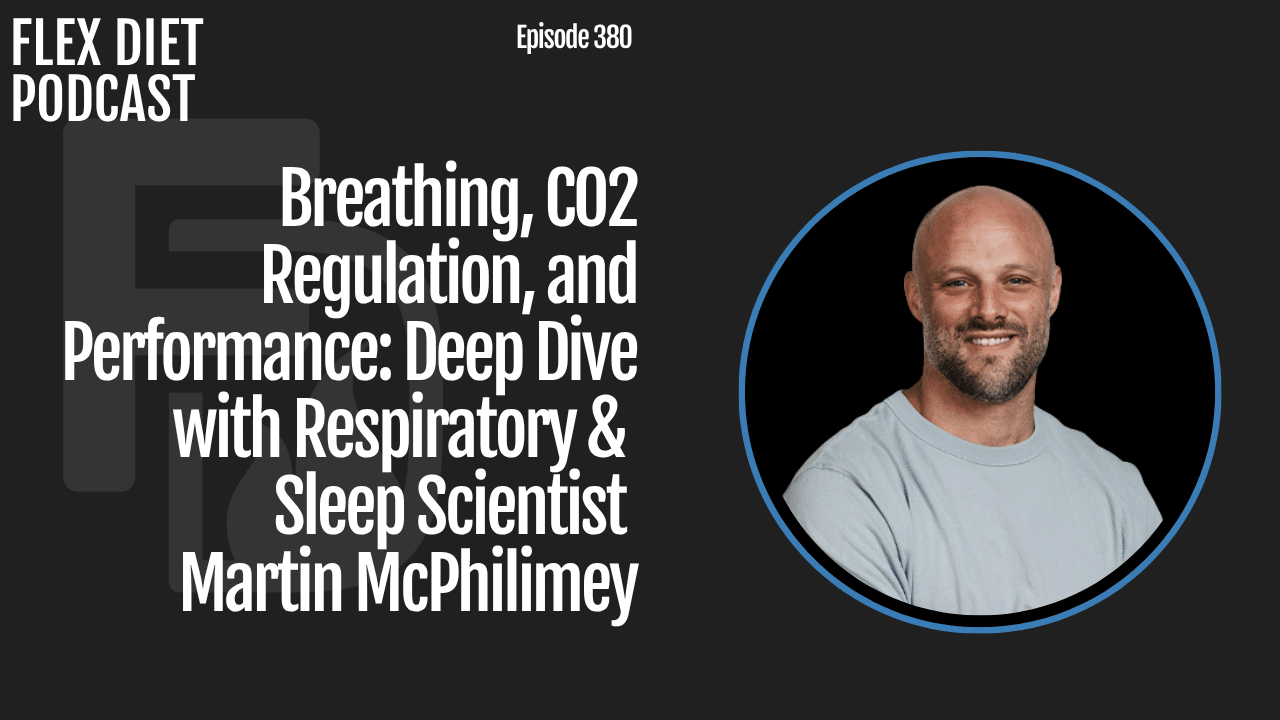
Speaker: [00:00:00] Welcome back to the Flex Diet Podcast. I’m your host, Dr. Mike Nelson. On this podcast, we talk about all things to increase performance, increase muscle, improve body composition, do all of it within a flexible framework without destroying your health. Today we’ve got Martin Mcy. He is a respiratory and sleep scientist, exercise physiologist.
He is the founder of the School of Breath Science. He actually has two master’s degree accredited through the UK National School of Healthcare Sciences. And what’s super cool is he is working at the intersection of breathing, sleep, stress, regulation, and a human performance. And so I wanted to get him on the podcast to do a deep dive into all things breathing related because.
He has such a wide background, both academically and working [00:01:00] with people in the real world, like actually coaching them and he gets paid for results. So I like the combination of having a solid academic background in the mechanisms, but also having to validated by, by doing work in the real world. And this was.
I would say it’s a little bit in depth because we kind of started going super hard into the weeds pretty, pretty soon. But I’ll link to some of the other podcasts I’ve done, um, on, uh, breathing also, if you want a little bit more of a primer in that area. So I didn’t really want to repeat a lot of the stuff that’s been done, um, before, and so we got into much more of the weeds and much more of the intricacies across of.
Wide variety of topics related to breath. And if you really want to take another deep dive, the Physiologic flexibility certification is still open [00:02:00] now through this coming Monday, April 27th, 2026 at midnight Pacific Standard Time. And if you want more info, we’ll put a link down, um, below there in the podcast, and we do, let’s see, it’s pillar four.
Then I talk about O2 and CO2 regulation, and so I was able to get it down to the technical lecture there. I think it was about two and a half hours, which, oh boy, that took me a long time to be able to do that, considering there’s, I took whole physiology, 5,000 level classes on just how your, your lungs are actually moving air in and out, much less all the other mechanisms.
Um, but we also break it down to make it super easy so you can also apply. All of the information across temperature, regulation, pH, and breathing, expanded fuels, uh, all to help increase performance, make you more resilient, and allow [00:03:00] you to be even more anti-fragile, just generally much harder to kill. And then if you’re a trainer and you’ve done really good work with the basics of nutrition, sleep and exercise, and you’re still kind of.
I can’t figure out why clients are not progressing as much as they want. What I found over time is that it’s probably one of these four areas is kind of the rate limiter. And a big one, which we do touch on here in this podcast is CO2 regulation. So I think that part alone will be worth just listening to this podcast.
And then in the course we do a deep dive on it. So, uh, if you’re interested in that, go to the link down below. If it is after the time the course is open, I think you can still get on the wait list for the next time it opens, which probably won’t be until fall of this year. Again, if you have any questions, you can contact me.
Uh, make sure to check out all of Martin’s great stuff, uh, over at the School of Breast Science and all the wonderful certs and everything else he does. Uh, we’ll definitely put links to all [00:04:00] of that down below. And like I said, I think you’ll enjoy this podcast where we talk about. The practical aspects of it, and also a little bit more on the academic side.
So enjoy this with Martin Mc.
Dr Mike T Nelson: Welcome to the podcast. Thank you so much for being here. I really appreciate it.
Martin McPhilimey: Appreciate it too, Mike. Pleasure to be here.
Dr Mike T Nelson: Yeah. And I’ve been following in spine on your stuff on Instagram for quite some time, and like we were saying before we hit record was, it’s super nice to see the depth of physiology that you have, but also trying to make it practical.
Because as you know, the, I think at a surface level people are like, oh, breath work, whatever you breathe, it’s easy. There’s not much, you know, really going on physiology wise. And as you know, there’s so much stuff that goes on. Like, I remember. The first probably hardcore class I did on this was just, um, a whole [00:05:00] class on just respiratory breathing, just literally on how the lungs work.
We weren’t talking about anything else in the body, just, you know, how the lungs are set up, how you get air and how you get air out. And that was like, that was like a whole freaking semester on that stuff, you know? And granted it was more geared towards medical students and people who would be doing, uh, ventilation and ventilators and, and stuff like that.
But it was the first time where I kind of paused and went, oh, there’s a lot more to this than I thought there was.
Martin McPhilimey: Yeah. It’s, um, you know, because it’s such a simple thing that we do, and it’s an unconscious thing we do, you know, every single day we’re breathing to obviously stay alive, but we’re not even really paying attention to it too much.
People just assume that it’s. It’s simple. You know, anyone could go and teach someone how to do breath work. Like you could just go, well, I’ve watched a video on that and I’m gonna go and teach them, but understanding what’s actually happening, what’s going on physiologically. And really, [00:06:00] like there’s a lot of medical professionals say that respiratory physiology is one of the most challenging areas as well as exercise physiology.
It’s, it obviously those, those two are metabolic physiology. Yep. All three of those things are all connected. You can’t have what, you can’t have metabolic physiology and exercise physiology without respiratory physiology or vice versa.
Dr Mike T Nelson: Yep.
Martin McPhilimey: And so, you know, that’s, that’s where for me, the, and, and it’s just in general, it’s like the breath is at the center of the mind body connection.
And it regulates every single, every single system. And it has to be tightly regulated because of pH shifts. And if we go outside of those pH shifts, we spoil all metabolism. And it’s not long until we get sick or die.
Dr Mike T Nelson: Yep. Yeah, I, this was been more even apparent to me. I did a whole class on physiologic flexibility, and so pillar four was all CO2 and O2 regulation.
And when I was setting it up, I thought, ah, you know, I’m thinking all this stuff just can’t really that hard. And then you realize, oh, crap, I’ve been looking at this [00:07:00] stuff for freaking 20 years, and now I have to teach it to someone who may not necessarily have anything past a really basic knowledge. And I first thought I can get this into an hour.
And then I was like, I can get this into two hours. Maybe I could get it into three hours. I had to redo like four times to just, because you, you start and you’re like oh, wait, but to know this, you have to know this. And then, oh, wait to know that, you have to know this. And to know that, you had to have known that.
And so you end up going all the way. Back to the beginning, and like you said, that was not even the overlap into other systems and how they, they deal with it. But, um, what, what kind of made you get into to breathwork more from, you know, obviously the practical side, but even just to want to go that deep into the physiology of it.
Martin McPhilimey: When I studied, so exercise physiology was the, I did sports science degree at university and exercise physiology was the major area that I studied. [00:08:00] And when I was in my, my third year going to do my, my dissertation. We were doing some lung function tests in the lab as a practical assessment, and we were actually measuring, uh, diaphragm strength.
So looking at maximum respiratory pressures.
Dr Mike T Nelson: Yeah.
Martin McPhilimey: I was very fortunate to have two respiratory professors in our, in our lab. And I can remember going round in the lab and my one, a couple of my housemates, I was a rugby player. A couple of my housemates were also in a lab as well. They’re a rugby players, so we got a bit competitive to see who had the, you know, the, the most, the strongest diaphragm, as you can imagine, between two different, uh, athletes.
And I just blew ’em out. The water generally, just so the average, you know, maximum respiratory pressure is between 120, 150 centimeters of water. I hit like two 20, then 2, 2 50, and then like two 60.
Dr Mike T Nelson: Oh shit.
Martin McPhilimey: And so the professor was just like we’ve actually not really seen. That high before, would you be interested to come in the lab and do some more assessments?
Mm-hmm. And so I was like, yeah, of course. And so I then did like a, it was almost like a [00:09:00] bleep test for, for breathing where they would basically, you’d set a a, a rhythm to breathe at and then stack weights on top and build a resistance.
Dr Mike T Nelson: Oh, interesting.
Martin McPhilimey: It was in a vacuum seal and it was a way to obviously measure then respiratory endurance.
And I smashed the whole thing. I got through the whole thing and they were just like, they were gobs mats. They were like, we’ve never seen this before. And so you can imagine that made me very curious. It kind of probably inflated that part of my ego. And I was like, well, so then they asked me if I wanted to do a research project in that area.
And so I did a master’s of research the following year where I then started to look at can we use iso kanick hyper as a way to improve shuttling of lactate following high intensity exercise? ’cause the diaphragm is primarily type one muscle fiber. And so we got people on a bike. We, um, got ’em to do four one minute sprints as hard as possible with 30 seconds in between.
Got lactate. Yeah. Oh yeah. Wingate stuff. Good times. Roof, Wingate roof stuff. [00:10:00] And then we did a 15 minute period following where we either got ’em just to brief normally or we got them to load with 15% resistance and then to hyperventilate through that whilst we were titrating CO2 and taking RT or blood gases at the same time and running them through a sorry, venous blood gases, running ’em through a CO2 monitor to keep the CO2 level the same.
So you can imagine that was a very fiddly yeah. Thing to do. And then we did six weeks of inspiratory muscle training and repeated the test again. And we found that postin inspiratory muscle training, you could actually increase the shuttling of lactate from the system following high intensity exercise by using ISO Kaepernick Nia.
Hmm. And so as a master’s degree I’m doing CPA testing. I’m doing bloods, I’m doing I had esophageal balloons in there.
Dr Mike T Nelson: Oh,
Martin McPhilimey: geez.
Dr Mike T Nelson: You’re going
Martin McPhilimey: hardcore in to look at diaphragmatic pressures. Yeah. As well as, uh, inspiratory muscle training and all that sort of stuff. So dive, I dived in a deep end [00:11:00] straight away, and I wanted to become a sports scientist and work with people in, in, in, uh, obviously teams and stuff like that.
But it’s more about experience and knowing people than it is about having a master’s degree walking into those areas. I always think when you get a master’s degree, it’s like, oh, you’re gonna get a job now. But that’s not how it was. So I actually then I, I applied for a training role that had started in the UK back in 2011, 2012, where they were trying to bring some academic scientists into the clinical space because they were noticing all the senior physiologists were being re retiring and there wasn’t many young people coming through.
And so they did a national training program in the UK called The Scientist Training Program. And there was a role where you could train as a respiratory and sleep scientist as a, in a clinical PO position. And it was a paid position, and it was like PhD. Or do that. And I wanted to make money. Yeah.
Because I,
Dr Mike T Nelson: that’s understandable.
Martin McPhilimey: So I decided to go down the route of getting a wage and getting trained as a [00:12:00] clinical scientist whilst getting a, a salary. And, uh, also did another MSC in clinical respiratory and sleep sciences, and did that for three years. And so, yeah, I ended up working in hospitals and going down the clinical route and mm-hmm.
Becoming a clinical scientist for, for 10 years. And so that was all obviously you know, clinical medical work. But I moved to Australia. I’m from the UK originally. I moved to Australia in 2016 on my own. And I went from working in one of the biggest hospitals in London to a small little clinic in Western Australia.
And so, s as a scientist probably made a poor decision because there was, there was no research, there was no funding, there wasn’t anything other than just seeing, you know, patients. And the type of patients I was seeing changed. Going from very, very sick people and working with, you know, ventilators and people on death’s door to unwell people who were not quite sure what’s going on with their body.
And that’s what I recognized. And so, uh, after about three or four of year, uh, years of doing that, and then doctors go and you results are normal. Go [00:13:00] and see, go back to your gp. I felt as if there was a, a gap where I could help support with like this nervous system regulation, sleep, dysfunctional breathing, anxiety management from a physiological standpoint.
And so I actually built that was then my online business was around that, those three key areas. And that was around about 2018. And then obviously 2019 at the latter end of that COVID hit and the whole world was focusing on social media and online. ’cause they were knocked down. The whole world was anxious.
There was a breathing issue going on, being spread around the world at the same time.
Dr Mike T Nelson: Yeah.
Martin McPhilimey: And breath work became popular. And so I just happened to be in a very fortunate space where I had a good authority in that space. I started to put on free breath work sessions online and educational sessions around stress management for people who were in lockdown, and it just started to work very well.
So I actually decided to quit my clinical career and see whether I could build an online business. Left [00:14:00] Australia, traveled through Asia and managed to build a successful business online. And that turned into people asking me to mentor them in the space. Hmm. Because there wasn’t any depth in science, in the breath workspace.
Yeah. So I kept getting dms saying, Hey, like, would you mentor me? Like, I’m not quite understanding this. I’d really love support. So I put like a six, six month training together, started mentoring people, and that’s now three years later turned into a concept of School of Breath Science, which is a, an international kind of global online school where I’ve got.
250, 300 students around the, around the world and, you know, a big community of practitioners. And so just very fortunate timing. Obviously a good, good history and just lucky that breath, breath became a, a popular thing in the wellness space.
Dr Mike T Nelson: Yeah, that, that’s awesome. And were you kinda, and I’ll go back to your, your study in just a bit ’cause I wanna know more about that and we’ll explain it for the listeners in, in English too.
Mm. But were you [00:15:00] kind of surprised that breath work became popular? I mean, the first time it ever kind of showed up on my radar, like I had, you know, looked at the academic stuff and I look at some of the, you know, the yogi breathing and all these different type techniques have been around for a while.
But my biased opinion is, I think Wim Hoff was kind of the first guy who really popularized it. And I remember being at a dinner, God probably what, maybe six years ago, maybe seven years ago now. I won’t say his name ’cause it’s a private conversation, but. Most people would know who he is, and we’re having dinner and I’m asking him, I said, yeah, you know, what do you think about breath work and this this Wim Hof guy?
And his answer was, I don’t know. It seems pretty interesting, but he’s kind of kooky. And I thought like, oh, that’s kind of the best description of it. But I think it took someone with a big personality and maybe being a little bit over the top to get everybody’s attention that [00:16:00] yeah, you know what, we, we should probably pay attention to this.
Martin McPhilimey: Yeah. I, I, I think again, it’s a, it’s a, it was a timing thing.
Dr Mike T Nelson: Oh, for
Martin McPhilimey: sure. Where people are, everyone was on social media or YouTube then, because that’s all you could do is sit at home and just twiddle your phones control or watching tv. And if you didn’t wanna watch the news about what was happening as the virus was spread, and you would just be on social media going through your, you know, your doomsday things.
But I also think there’s not just timing. I think that particular practice itself, the Wim Hof method, give what people needed in that moment, which was to feel good.
Dr Mike T Nelson: Yes.
Martin McPhilimey: Yeah. Because it make, regardless it’s state change creates, yeah. For a hundred percent. Creates state very fast too. Creates, yeah.
Endogenous, kind of like internal feelings that make you feel, oh, I, I feel good. And so when the whole world is feeling down, you have this practice that comes in that you can do at home that’s free, that also does have this kind of like really crazy kind of personality behind it [00:17:00] that whilst, yeah, he might be kooky also, some people might love because they’re like, okay, there’s characters funny to kind of follow.
I think it’s a combination of that. Those two things, really. And yeah, he has brought that to the forefront. And obviously then you had, you know, Andrew Mann release his podcast. Yeah. I believe his, his first free podcasts were on sleep stress and then nervous system. Them, them breathing. Yeah, something like that.
And so I was, for me, I was just like, wow, this podcast got massive. And I’m also in that space that also pulled me in and obviously, and Wim Hof pulled me in as well. And then obviously the likes of Patrick McKewan, who’s, you know, tion Advantage. And I think it’s just everyone just kind of just raised awareness together really.
And of course, Brian McKenzie and the crew that over there as well, HHP Foundation. So I, I do feel there was kind of some leaders that started to show up more, speak louder, that kind of pushed it. And then you’ve got James Nesta releasing his book at that time.
Dr Mike T Nelson: Oh, that was so huge. That was just like the, and I had him on my podcast early on and.
[00:18:00] And he was great, but that was just like, if you could time anything perfect. And, as, you know, putting out content and stuff, like the amount of back work it takes to get content out in a book mm-hmm. And stuff like that. It’s not something you snap your fingers and shows up in a week. But
Martin McPhilimey: nah,
Dr Mike T Nelson: I think the timing of that was just like dead on.
Martin McPhilimey: Well, h how, how can, and how, how much more can you time a a, a book related to breath when there’s a respiratory virus that’s Yeah. Making the world panic. Yeah. And so I’m just, I’m just sat here with gratitude for all those people as well as I feel like, I feel I actually, the reason why I put on so many free breath work sessions and educational sessions online was because I felt I was one of the persons that was benefiting from a situation where the whole world was not benefiting from.
Yeah. And so I wanted to give back.
Dr Mike T Nelson: Which I think is great. And you, you also then realize when you go that [00:19:00] far down, like how profound you can get changes and like what you were saying with the Wim Hof stuff, like it was the first time I think anyone did breath work where they felt a difference within the first few minutes.
And I feel like a lot of the breath work before that point was, okay, let’s go relax and let’s do zen style meditation and go stare at a tree and all. I love all that stuff. I think it’s great. Mm-hmm. Um, but I’ve noticed in practice it was so hard to get anyone to do it myself included. Where now you got this crazy guy who’s like, yeah, just hyperventilate for a little bit, and you’re like, oh my God, I feel better already.
Oh my God, there’s something to this thing.
Martin McPhilimey: Yeah. That’s it. It captures people. Right? And that all those styles of prep work do capture people. Uh, no, I’d argue that they’re not right for everybody.
Dr Mike T Nelson: Oh, I a hundred percent agree with that. Um,
Martin McPhilimey: certainly needs to be some assessing beforehand and also Oh
Dr Mike T Nelson: yeah.
Martin McPhilimey: Some contraindications to doing that sort of work. And obviously there is there’s times and places as we’ve all physiological [00:20:00] changes and context always matters.
Dr Mike T Nelson: Yep.
Martin McPhilimey: But at that time, I think that was irrelevant to be honest with you, the context, because everyone probably needed some form of coping mechanism.
Dr Mike T Nelson: Yeah. So we’ll talk about contraindications and the Wim Hof stuff, and then I’ll go back and ask you about your study. I don’t know if you’ve noticed this, but one of the things I noticed with the Wim Hof stuff was that when it was becoming real popular, I would have, I still remember, I had a one client who was doing CrossFit.
And we could not, I was beating my head against the wall. We could not figure out why. Her HRV just collapsed. Her stress went off the roof. We’re going through nutrition and her sleep. We looked at blood work, we looked at everything, and I’m like, I’ve looked at enough HRV to know that this is a, there’s a real change.
Like there’s something going on. And then you start thinking, oh my God, does she have a cancer? Do we need to send her to another doctor? You know, what else do we need to do? And finally she said, oh, yeah. Well, I started doing this 20 minutes of, of Whim Hoff and cold water immersion first thing in the morning.
I’m like, when did you start [00:21:00] that? It’s like, oh, about two weeks ago. And like, you look at her scores and they just went off the cliff. Yeah. I’m like, oh, how hard are you doing this? She’s like, well, you know, I do about 10 minutes of Wim Hof as hard as I can. And then, you know, I get into 38 degree water for like three minutes and I’m like, oh yeah.
Those are both like high sympathetic stressors on top of a system that you’re doing a lot of sympathetic stress already. Like, that’ll definitely cause what’s going on. And she is like, oh, really? And I started seeing more clients, very similar, but not to the degree of that. Um, so would you agree that that is kind of more on, if this is a generalization, the sympathetic style of breathing, and when would you use that for some clients versus not use it for other clients?
Martin McPhilimey: Yeah, no, I, I definitely agree. I actually you know, I, I created a post not long ago that was saying that the breathwork style matters less than the overall allostatic load in the [00:22:00] system.
Dr Mike T Nelson: So for sure, and explain all aesthetic load for people that might be a new term.
Martin McPhilimey: Yeah, so that’s, sure the accumulation of stresses in your life.
You could, could really say, bio-psychosocial stresses. You could even put spiritual stresses in there if you wanted to as well. But anything that has a, has an impact on, on, on physiology. It accumulates, and there’s only a certain capacity that people have within a nervous system, whether their muscular system, whether that’s the brain, whether it’s the cells, mitochondria, all of it needs to be considered.
And so if we have someone who is doing CrossFit, who is, drinking a lot of caffeine, who’s also at home having financial issues as well, and then all of a sudden they go, well, I’ve heard this swim half method, or this practice here, or ICE baths are good. Well, it’s not good or bad, it’s context relevant according to the situation.
Eh, and so then we add that cold on top and we add that sympathetic kind of like increase in, in, in breathing practice on top. And we might have just ti tip tipped ’em over the edge of, of how much [00:23:00] atic load capacity they have. And then we start to see a decline in, in, in HRV and it, and it can’t, it can’t rebound now.
That’s okay. If that happens for four or five weeks, they take a rest and it rebounds straight back up again.
Dr Mike T Nelson: Sure. Yeah, yeah, yeah.
Martin McPhilimey: Just like exercise. You’ve got the adaptation. Yeah. But as you were seeing, you wasn’t seeing that. And people don’t know that perhaps they probably should take a break when that’s declining as well, because people don’t know and understand.
And the, the practice itself doesn’t make you aware because it gives you the artificial adrenaline, the end indoor, the endorphins and the, the, the dopamines. You feel
Dr Mike T Nelson: better, which makes it confusing.
Martin McPhilimey: Yeah, yeah. Which I call, I call like it’s, it’s artificial energy state change and so it can mask things.
And so I know, and you’ll know as well is like people who are struggling with fatigue burnout, they often find coping mechanisms such as high intensity exercise or caffeine or nick, you know, nicotine or ice baths. And that then becomes this unconscious thing that gets ’em throughout, throughout the day, not realizing that if they [00:24:00] pull that all that away, they would just collapse into a fatigue.
Dr Mike T Nelson: Yeah. Are there cases where you found Wim Hof breathing to be beneficial or like when, if someone comes to you. When would you say like, Hey, you know, this might be a good method for you to use?
Martin McPhilimey: I, I, I, the only way that I really do look at that stuff, to be honest with you is if you want state change, like if there is a if you’re peeling a bit flat and you have to kind of perform.
Then perhaps there’s an opportunity to use the breath rather than caffeine if you’re trying to avoid caffeine, for example. Sure. Because it’s impacting sleep. Uh, so, so that’s one of the things that I look at. And obviously you do have the longer forms of that sort of stuff, and then you can kind of, there is, you know, there’s more and more scientific literature coming around, I guess you could say, the more transformational style breathworks where we, we can start to see people changing and, and, and reappraising memories or emotions from the past.
And it does, it does look like there is some solid concrete evidence coming around. You know, that like, especially with predictive coding and the [00:25:00] free energy principle kind of being weaved into neuroscience at the moment and that. If you start then pulling that into that style of breath work, it’s like, okay, prediction errors and, and the brain kind of being, being forced through surprise at the same time as an unconscious material being released in a safe space.
Then we have a potential like called perceptual interference, which, and update in your perception associated with that. So there are times where I might do that, but it wouldn’t be anywhere, anywhere until someone has built stability and capacity in the physi, in the physiological, physiological systems.
And so that’s primarily my first role with all of my clients would to build, first of all, restoration, restoring homeostasis, or being able to return to homeostasis. Then we build regulation capacity. And then we build resilience capacity, which is widening, you could say, window of tolerance, or you could say just generally your, your ability to handle metabolic stress, psychological stress, or [00:26:00] allostatic load.
Now I think someone’s in a position to to, to do more intense breath works and get a more of a benefit from it and it, for me to be more safe.
Dr Mike T Nelson: Yeah,
Martin McPhilimey: that’s okay. So that’s how I see, that’s how I see the things. There are some specific, if you look at, there’s not a lot of strong literature.
There are some areas where it’s like a k can we see in, in, in immune, in immune deficiencies or to immune deficiencies. There are some evidence suggesting that you might get some benefit from that, but it’s only one or two studies. And is that the cold or is that the breath?
Dr Mike T Nelson: Mm-hmm.
Martin McPhilimey: You know, or is it the belief even?
No, we, the more and more now I think, uh, we we’re starting to understand, obviously we’ve always understood the placebo effect. But it’s, uh, is it Lisa Pel? Is it El? El Elisa Pel. Her work in, I think it’s Stanford maybe or one of those universities.
Dr Mike T Nelson: Ooh.
Martin McPhilimey: Should be, she writing a book. She’s writing a book called Belief.
Dr Mike T Nelson: [00:27:00] Oh, nice.
Martin McPhilimey: Yeah. And
Dr Mike T Nelson: I always think of Bruce Lipton’s Biology of Belief, which is a little bit
of
Martin McPhilimey: course,
Dr Mike T Nelson: similar to it, but a little bit different path.
Martin McPhilimey: Yeah. And so, we know that expectation or, or anticipation of something happening. If we then tie that into a, a style of breath work where it creates a metacognitive state and a hypnotic state, how much suggestion does an in individual onboard and actually then that creates this belief system that could change.
Yeah. Physiology.
Dr Mike T Nelson: Yeah. Yeah. Immune system,
Martin McPhilimey: you know, we know it’s connected.
Dr Mike T Nelson: Yeah. And then there’s the, the Wim H study in PNAS where they did the, was it a endotoxin? And then they had ’em do like the super ventilation method and pretty impressive results. Again, that could just be an upregulation of the immune system due to an acute sympathetic stressor too.
Martin McPhilimey: Yeah.
Dr Mike T Nelson: You know?
Martin McPhilimey: Yeah, exactly. So I, I, I broke down that study [00:28:00] not long ago and I was like, could we just could we do this with high intensity exercise?
Dr Mike T Nelson: Right? Yeah. Seems like in theory you should be able to, I wouldn’t want to be in that study. It’d feel
Martin McPhilimey: horrible. Endotoxin feel sick. Now you
Dr Mike T Nelson: do Wingate.
Come on. Go.
No, that, that, that’s cool. That’s kinda where similar arrive ended up. Like I only really use the Wim h stuff now for maybe one or two rounds to get comparative and buy-in that, hey, breathwork does make a difference, and then let’s go. So let’s go. So I have a concept I just call human dynamic range.
Like can you push the system here and then can you get it to transition back lower? Yeah. So could you do one or two rounds of Wim Hof to get a high sympathetic tone? And now can we get as parasympathetic as possible? Can you get as
mm-hmm.
Relaxed as possible? Because now your nervous system has that comparative thing to compare it to so it, you can [00:29:00] feel more the difference and kind of feel your way through it.
Martin McPhilimey: Yeah, no, I, I agree. That’s a component a lot of people say, and now I feel really relaxed after, afterwards.
Dr Mike T Nelson: Right.
Martin McPhilimey: And that’s, it’s because you’ve got a distinguishable difference between those two states. But also you might get some parasympathetic rebound in people who are able to return to baseline.
Right now, my, my, my, my issue is that how does a person know that actually they are returning to baseline? Or are they actually going into a space of dissociation because of reduced blood flows or prefrontal cortex? Yes. It’s a question that I ask everybody and that’s, are you aware of the state you’re in and are you actually present with the state you’re in, or are you just kind of in this land, like, oh, I feel light and funny.
And so I think there is a, there needs to be a distinguished way that people can explore relaxation and dissociation and understand those two things. Yeah.
Dr Mike T Nelson: Do you, do you find a lot of people their default is to go to a dissociative state?
Martin McPhilimey: I think if, [00:30:00] especially if there’s a history of trauma or that’s what I’ve
Dr Mike T Nelson: noticed
Martin McPhilimey: a poor relationship to affect in general in the, in, in the system of the body, then, they’ll go into fantasy in the mind or daydreaming.
Mm-hmm. Which is. A partial, or you could say a dissociation. You know, the me cognitive state is where it can be good to be in that state. That’s the meditative state where you’re mm-hmm. The observer of what’s going on. But there’s a fine line between that and then going into, into, you know, daydreaming, which is dissociating from the affective experience, which is not an embodied process.
Dr Mike T Nelson: Yeah. Which again, I think all comes back to you talk about context and what are you trying to do. Right. I think you could make an argument for some types of relaxing meditative states where maybe you are trying to change the default mode network. Maybe you are trying to be a little bit more daydreaming, but the goal is that’s the direction you’re pushing the system kind of on purpose [00:31:00] for a reason, not as a
Martin McPhilimey: yes.
Dr Mike T Nelson: Reaction to something else.
Martin McPhilimey: Intentionality is, is, is everything. Yes. You’re
Dr Mike T Nelson: doing it intentionally,
Martin McPhilimey: absolutely everything. Now, intention is, is you could say intention is one of the most important things to live your life by, but you know, specifically when you’re trying to create an outcome or, or, or using a, a behavior to, to shift a sudden state, an intention is, is very, uh, very necessary, let’s say.
Dr Mike T Nelson: Awesome. So back to your study, were you, do you think respiratory muscle training is beneficial overall? Like if somebody just doesn’t have maybe access to, you know, CO2 gas or to anything crazy, they’re just doing some type of respiratory muscle training, do you, do you think it’s beneficial that
Yeah,
we could sit here and debate about literature.
I could show you tons of literature that I’ve seen the craziest results. From just that type of [00:32:00] training. And other studies are like, eh, I didn’t do shit.
Martin McPhilimey: Yeah. Again, it depends on protocol, obviously. The methodology, yes. How,
Dr Mike T Nelson: yes, huge differences.
Martin McPhilimey: You know, the res, the amount of resistance really matters as well and obviously the outcomes that you’re trying to measure.
But there are so many benefits, particularly with inspiratory muscle training.
Dr Mike T Nelson: Mm.
Martin McPhilimey: You know, there’s a difference between inspiratory and expiratory. If you’re looking for performance benefits, then inspiratory muscle training seems to be better. Respiratory seems to be better for people who like a cough cyst and struggle with, with, okay.
Lung disease and stuff like that. And there are some papers, interestingly, if you do both at the same time, you actually see a detriment to performance and some say interesting improvements. So that’s not quite clear in the literature. But inspiratory muscle training has, you know, there’s a lot of systematic reviews and meta-analysis around improvements in, in high intensity exercise, improvements in obviously reducing.
The respiratory muscle fatigue in long, uh, longer endurance exercise, repeated sprint ability, uh, again, improvements in, in lactate shuttling. We also [00:33:00] have shown in a paper that we published in 2012, reduction in inflammatory markers from ventilation itself. We mimicked ventilation. We got people to cycle on a, on a, on a bike at 60% max of their VO two max.
We then timed their breathing, we recorded the diaphragmatic pressures and also then used, uh, tid carbon dioxide to look at their CO2. Then got them to sit on the bike and match the breathing exactly the same whilst titrating the CO2 to look at what is the inflammatory cost of breathing alone at that.
Mm. Then extended respiratory inspiratory muscle training for six weeks and we significantly reduced you know, interleukin six in glucan 12. Like massively and so
Dr Mike T Nelson: interesting
Martin McPhilimey: benefits for exercise induced asthma. There, you can probably say. Yeah, yeah, for
Dr Mike T Nelson: sure.
Martin McPhilimey: But we, you know, blood pressure regulation improvement in bowel reflex sensitivity sleep apnea, there’s also some evidence with that as well.
Improvements in sleep apnea, particularly mild to moderate sleep apnea. Um, and so [00:34:00] that, and, and even, even if we start to then look at like higher intensity, but lower load, you, uh, so, so reducing volume, but making a bit more and more intensity. You can see improvements in symptoms in people with chronic fatigue syndrome.
What’s the other ones? Improvements in HRV following post exercise. So at 30% of your max for 10, 15 minutes following high intensity exercise, you see an increase in HRV.
Dr Mike T Nelson: So you get more parasympathetic tone then.
Martin McPhilimey: Yeah.
Dr Mike T Nelson: Huh.
Martin McPhilimey: Yeah. And so, so it’s, it’s like it’s bits and pieces altogether, but when you can kind of map the picture out, it’s like actually, and you understand, then you can start to build protocols that are beyond just typically just building new, you know, your diaphragmatic strength.
And so there are, there are and obviously there’s areas that have strong evidence and, and sure. And, and more, more research. And there’s areas that are kind of touching the edge of it. But that’s what I kind of enjoy with the space I’m in now. Whereas in the medical space beforehand, I was kind of like, you know, you have to wait until it’s been put into a protocol or a [00:35:00] procedure that you have to do.
Now I’m like, oh, I, I put, I see three or four papers that kind of connect some dots. I’m like, I see it, see one of my clients and say, Hey, try this and see how it helps and let’s measure it. And then you’re like, cool, it worked.
Dr Mike T Nelson: Is there an easy, if someone wants to play with this, is there an easy way for them to start the training?
And is there any basic assessment to know, like, this might be a rate limiter or like, they may be really horrible at this, or this may have a higher payoff?
Martin McPhilimey: Uh, I, I think if anyone feels, if they have ventilatory or, or breathing limitation during exercise. And so that would obviously just be psychological relationship to believing that mm-hmm.
They’re not feeling well in their breath when they’re exercising. Particularly, obviously more high intensities because one of the biggest benefits with all breath work in general is perceptual change
Dr Mike T Nelson: for sure.
Martin McPhilimey: And so, re reduce perceived breathlessness at higher intensity exercise whilst it’s not gonna increase your VO O2 max and [00:36:00] potentially massively change your, your, um, you know, your endurance times.
It is gonna shift how well you believe you’ve recovered from those sessions. And therefore, like repeated sprint ability and repeated high intensity sort of work becomes more tolerable. Which then long term could obviously lead to improvements for sure. So that would be, without measuring, that would be one of the things that I would say straight up is, do you believe that your breathing could be improved at higher intensity and exercise?
Do you have a poor relationship with your feeling? More breathlessness at high intensity exercise and then. Then you, you don’t need to have advanced devices as long as you can able to create enough fatigue within 20 to 20 to 30 breaths through a device where it feels by your time, you get to that 20 30th breath.
So obviously you got advice in your mouth, nose peg, blowing all the way out, pulling in as hard as you can. If you feel fatigued by the end of that, like [00:37:00] 20 to 25 breaths, then that’s enough load.
Dr Mike T Nelson: Okay, cool.
Martin McPhilimey: Yeah. Then maybe two weeks later it starts to feel a little bit easier. Turn the load at one, two weeks later, easier turn the load at one six weeks.
Standard 30 breaths twice a day is a standard protocol.
Dr Mike T Nelson: Oh, okay. So that’s really not a huge amount of time either.
Martin McPhilimey: It’s not, it’s about five or 10 minutes twice a day. And then you only need I believe it’s about three days a week to maintain. Oh, okay.
Dr Mike T Nelson: Oh, that’s not bad.
Martin McPhilimey: Yeah, it’s, it’s not, it’s really not the, the actual investment for the return.
It’s significant. And I don’t, I don’t understand why this is not in every single sports team. I dunno why it’s not got there yet. What I do is, because most sports teams don’t pay attention to breathing, but
Dr Mike T Nelson: Oh, they don’t at all. Which is so weird. Like, I am sure you’ve seen this too, like I’ve looked at some fair amount of metabolic heart data and in an early on I just looked at all the metabolic things and like now one of the first things I look at is what is their simple respiratory rate like during the whole [00:38:00] thing?
Yeah. And it’s crazy how many people just never look at it. And if you compare that to the volumes and everything else, like, like now you, you can get pretty good and be like, Hey, you’re endurance athlete. Lemme guess. Uh, I bet you spent all your time in zone three, barely touching zone four. Oh my god.
How’d you know that? ’cause everything outside of that is dog shit. And it’s just looking at the, the numbers, it’s nothing, it’s nothing crazy. It’s nothing. Psychic
Martin McPhilimey: respiratory rate is the, i, I believe it’s one of, if not the most sensitive markets of stress right now.
Dr Mike T Nelson: Yeah,
Martin McPhilimey: it is. I did a whole presentations
Dr Mike T Nelson: on that.
Yeah. Especially
Martin McPhilimey: overnight
Dr Mike T Nelson: respiratory rate.
Martin McPhilimey: There’s so much research going into it at the moment to try and create better and more accurate ways to measure respiratory rate. I think what we’ll see is, we’ll see earphones that measure the, the respiratory rate from that. Like if we’re thinking portable stuff and easy, simple stuff, obviously.
Yeah,
Dr Mike T Nelson: totally. Yep. Yep.
Martin McPhilimey: We’ve got hexo skin and we’ve got, you know, stuff you can wear. Yeah. Yeah. That’s not applicable or, or, or feasible for general audience. So I think, [00:39:00] I think we’ll start to see Apple, like AirPods and stuff like that have pick up sound of breath soon.
Dr Mike T Nelson: Sure.
Martin McPhilimey: But, you know, a metabolic car doing a cardiopulmonary exercise test, you see someone’s respiratory rate starting to spike up early.
For me, there’s likely a correlation with HRV there. So those two things for, because it’s, it’s how early that respiratory rate goes up during exercise is, is an indicator of how much load the nervous system’s, it’s gone beyond the capacity of the load of that nervous system. And now the central command sensor of their brain is saying, right, we’re under a lot of stress here.
We need to drive up respiratory rate.
Dr Mike T Nelson: Got it.
Martin McPhilimey: That respirate is more tied. This is Andrea Nicolo’s work at the University of Rome more tied to non metabolic stresses than it is metabolic stresses.
Dr Mike T Nelson: Really? Explain that a little bit. Yeah.
Martin McPhilimey: So obviously we have it, it’s, it’s quite interesting because when you, when we look at the literature from, you could say prior [00:40:00] to 2015, everyone’s just looked at ventilation and then looked at CO2.
Dr Mike T Nelson: Yep.
Martin McPhilimey: Right. But then no one’s ever really looked at, well, what have we break down ventilation into respiratory and volume. Mm-hmm. And is there any, do the, are these factors independently, regulat. And so Mike Tipton, you’ve probably heard of Mike Tipton, environmental physiologist at University of Southampton.
Yeah. Yeah. He had a great, great view of, uh, review paper on, uh, stresses in the system. And he found that when you go in the cold, what typically happens, you get cold shock, respiratory rate shoots up, then your body adapts, you are, then you then start to produce more metabolic activity and your, your volume increases, but your rate comes back down.
Dr Mike T Nelson: Mm.
Martin McPhilimey: And so it’s like, so this Andrea Nicolo was like, I wonder if that’s a similar in, in, in exercise. And so then he did three or four different studies trying to look at was there independent variable. And what actually found was that it’s, there’s an interdependence and independence [00:41:00] with respiratory rate being a behavioral.
And it seems as though that more so met non metabolic factors such as cognition, emotion perception, cold heat, stress anything that’s more of a stress of beyond CO2 and pH drives. Respiratory atop, whereas metabolic factors seem to fine tune your, your tidal volume.
Dr Mike T Nelson: Oh, interesting.
Martin McPhilimey: And so chemo receptors seem to play a, a backup system, whereas actually we have, respiration or grievance changed via pre anticipation predictive systems.
Dr Mike T Nelson: Sure, sure. Like a feed forward mechanism
Martin McPhilimey: feed forward. Yeah. So it’s, it is, it’s re respiratory’s feed forward. Ah. And so then we say, okay, well that’s, that’s a learned behavior then.
Alright. And so now you can put those dots together and go, well, a metabolic stressor can become a non non metabolic stressor if we have someone who has limited capacity in their tidal volume. [00:42:00] And then, CO2 starts to hit a, you know, starts to hit the point where we’re not clearing that as effectively.
Well, the person then experiences a psychological non metabolic stressor called air hunger.
Dr Mike T Nelson: Mm.
Martin McPhilimey: Or breathlessness. That’s an affect, that’s a, that’s an emotional driver. So respiratory rate drives up even further. So this is where, and that’s
Dr Mike T Nelson: because, oh, go
Martin McPhilimey: ahead. Yeah. This is where I actually think the word CO2 tolerance is not quite the right word.
Dr Mike T Nelson: That was exactly my next question. I wrote it down on
Martin McPhilimey: my
Dr Mike T Nelson: little piece of paper.
Martin McPhilimey: Yeah. ‘Cause I, I, I believe that what we’re doing is we’re having a desensitization to the affective experience because we see a, a reduction in respiratory rate with nasal breathing adaptation. Yep. We see a reduction in respiratory rate when people are you know, getting exposed to these sensations.
But tidal volume doesn’t seem to shift too much. And so obviously this is a hypothesis, but it makes sense from, from this new literature. But it also makes expense from [00:43:00] sense, from the experience anecdotally, from everyone who does this sort of work.
Dr Mike T Nelson: Yeah. Yeah. Yeah, that the CO2 tolerance thing is just bugged the everliving crap out of me for years on end because
You talk to anyone who does a lot of the work and you’re like, yeah, I think there’s something there. And then you talk to like, you know, Dempsey in Wisconsin has done tons of this kind of research, and you ask ’em, you like, Hey, what’s CO2 tolerance? He goes, I don’t even know what you’re talking about.
Martin McPhilimey: Yeah, yeah.
Dr Mike T Nelson: Not, yeah. And this is the guy who’s done hardcore respiratory physiology for decades and decades and he is like, what are you talking about?
Martin McPhilimey: Yeah, yeah, yeah. Well it was, it was funny ’cause I saw an interview where he got asked by this young gentleman on a podcast right about, oh, have you heard of CO2 tolerance?
And he was like, no, what is it? Yeah. He said, well, he was like, you, you’re slightly under breathe to bring on, you know, an increase in CO2 so you can desensitize your chemoreceptors so that you can feel like you’re breathing more easily. And he just went, well, if you’re slightly under debris, you’re gonna [00:44:00] increase the amount of CO2 that’s in the alveoli, so you’re also gonna reduce the.
Oxygen gradient in the alveo line slowed down the, the amount of oxygen that can come through the al into the blood. So
Dr Mike T Nelson: Correct.
Martin McPhilimey: It doesn’t make sense to do that. So yeah, he just on this bucket, he goes, it sounds silly to me,
but I, and so I generally don’t think, and, you know, the, the consensus has been obviously, you know, improve the bore effect, improve option delivery. Sure. Increase in CO2, but then there’s no paper that has shown any improvement in VO two Max George d
Dr Mike T Nelson: that’s what’s, so that’s what’s so weird too.
Yeah.
Martin McPhilimey: Yeah. George Dum has produced, probably the only paper where someone’s gone through a significant period of nasal adaptation and then doing a, CO2 uh, a, a metabolic carp before and after, whilst they’re doing nasal breathing and mouth breathing. And the VO two max was the same statist.
Yeah, you could [00:45:00] say observably, it was less in nasal breathing, but there was a moderate effect size with that.
So then you’re like, well, statistically it’s not different. But practically it could be. It could affect, it could reduce it if it’s a moderate effect size, even if it’s not statistically, but observably less in VO two max.
So what I think really is happening is you’re just getting a reduction in potential gas exchange, but then the bore effect is having to compensate for that by extracting more O2 out at the level of the hemoglobin. But it’s not actually creating an advantage or an increase, it’s just creating an adaptation.
Dr Mike T Nelson: Yeah. It’s
Martin McPhilimey: created. It’s created. It’s just found stability. Again it’s able to find stability again. But the benefit is reduce respiratory rate.
Dr Mike T Nelson: Yes.
Martin McPhilimey: And so then if the benefits reduce respiratory rate, well. If we then go back to the concept of mon non metabolic stressors, what does that do?
Well, potentially if it feeds back up to the brain to then say we’re more calm.
Dr Mike T Nelson: Yeah.
Martin McPhilimey: So I think it’s all affective and [00:46:00] perceptual.
Dr Mike T Nelson: Yeah. So in that, in that study, when they did the VO two max test, were, did, was one group restricted only to nasal breathing during the test? Or they could just breathe however they wanted?
Martin McPhilimey: No, so it was the same group and they, they did six months of training and they did two. Uh, uh, they did nasal na, nasal oal mouth over pre and post.
Dr Mike T Nelson: Oh, okay.
Martin McPhilimey: Yeah. So cross, what do you call that? Crossover?
Dr Mike T Nelson: Yeah. Yeah. So they did both conditions. I was just trying to get at, if. Because I’ve seen some metabolic heart data where you’re looking at it and you’re like, I had, this doesn’t make sense.
Like your volumes of error at max are just all goofy. And I, it took me a while to figure it out and I said, what kind of breathing technique were you using this? Oh, I was still doing nasal and nasal out. I’m like,
mm-hmm.
At the end of the test, during a max test, they’re like, well, I was told that’s better.
And I’m thinking, well, you don’t wanna limit air exchange on a max test at the the end [00:47:00] because that’s obviously gonna compromise your performance. So that’s the reason why I was asking that.
Martin McPhilimey: Yeah. Well another thing that people don’t consider is that you might get an increase in, you might get an A better extraction of oxygen because of the bore effect, but also if you’re not getting better clear out of CO2.
Correct. You’re gonna have a change in pH down at the level of the cell. Yes. And the cell itself, you the mitochondria are gonna start to be able to, you know, the screw you buddy able to, yeah. So you, so whilst you might get better oxygen delivery, oxygen utilization. Might, might be compromised by, because if you’ve got an increase in acidity.
Dr Mike T Nelson: Yeah.
Martin McPhilimey: So it’s, this is where the complexity of all this together, as we mentioned at the very beginning, you know, the conversation that we had maybe even before this, it’s like people just look at one component of the breathing and go, oh, there’s a bi. It’s biological plausibility there that can happen.
But not understanding the sequence of events that occurs when you change the breath.
Dr Mike T Nelson: Mm-hmm.
Martin McPhilimey: It changes everything. And evolution has designed or [00:48:00] evolved this way to make it so that our breathing is matched perfectly to metabolism. Because we die if we don’t. So, yeah. So we best not play around with it too much long term.
Yeah. Maybe we stress it for a period like we would with any stressor to get to build adaptation. But let’s not just say that everyone should breathe through the nose all the time at any intensity, because that is just not. Yeah,
Dr Mike T Nelson: yeah, I would agree. That’s, that’s why I went so far down this rabbit hole. I bought a whole frigging metabolic cart and a three moxy setup.
’cause I’m like, well, if I can put sensors on the main working muscles to see SM O2 to see if the bore effect is really still there. But now I have all the, the physiologic markers of respiratory rates, CO2 O2 to try to, you know, figure out like what’s going on. And I don’t know, I probably need to do a lot more testing, but I’m also,
Martin McPhilimey: well, I, I imagine as soon as you get above VT two with nasal breathing, [00:49:00] you’re just gonna see a sma SM O2 just tank
Dr Mike T Nelson: correct.
You see these big changes that a lot of athletes weren’t aware of. And that’s the, what I found was the most useful for that test. But to try to get down to what is their absolute rate limiter in those kind of edge cases where most things look good. I’m not even convinced the athlete will use the exact same strategy from one test to the next because of allostatic load, other things that’s going on.
Their perception a hundred
Martin McPhilimey: percent.
Dr Mike T Nelson: Hundred percent. I haven’t seen it be as reproducible as I want and it drives me nuts.
Martin McPhilimey: Yeah. This is also a issue I have with metabolic cart tests and it did. We if we now know that affect makes a big difference to respiratory rate
Dr Mike T Nelson: Yep.
Martin McPhilimey: And we are not also measuring you, you could say, as a proxy for someone’s ability to, to, to, to embody affect or to have capacity.
We’re not measuring HRV trait, HRV whilst they’re also doing that, that test. Well, that could change the [00:50:00] outcome of respiratory rate. Oh, for sure. Yeah, because you’re
Dr Mike T Nelson: putting ’em under stressor. Throw this mask on, breathe through what feels like Darth
Martin McPhilimey: Vader. Yeah, yeah. Even if you’ve done 48 hours of like, you know, we’re gonna, we’re gonna standardize a protocol where it’s like 48 hours beforehand, you don’t have any recovery.
Like, you know. Correct. Any intense stresses. But that’s not like in terms of exercise, that doesn’t mean they haven’t had massive arguments with their partner or they’re going through depression or, yeah. Obviously you can do that with scales and you can measure that sort of stuff. But there, there’s so many factors there that I do think that if we’re starting to look at breathing as a behavior that is associated with allostatic load, then we need to consider that within the system.
And we need to be able to monitor that as well through questionnaires or measurements of HIV. ’cause we know that h you know, there is a correlation between VT one and HIV, for example.
Dr Mike T Nelson: Oh, for sure. Yeah. Yeah. So do you, so my latest hypothesis, and correct me if I’m wrong on this, as we’re getting close to the end.
I’m not as convinced that nasal breathing changes CO2 tolerance as much as [00:51:00] I used to be. However, I have found overnight respiratory rate if it’s very high. I think as a background stressor, that is an unconscious thing. So if I see someone’s aura and there is 17 breaths per minute, I feel pretty confident.
And we’ve, I’ve done this with multiple athletes, gotten them to 13, 14, 12. In almost every case, their HRV goes up. They’re more resilient. They can handle more stressors. So my new hypothesis is, I don’t know how much of effect it is on CO2 tolerance, ’cause I haven’t noticed concomitant massive increases in performance, especially max performance.
But I have noticed that everyone has reported, they feel better, they feel calmer. We can push more load. Their HRV is better, their resting heart rate is better. Like all those other things do seem to improve.
Martin McPhilimey: Yeah. And so that’s, you know, for me it’s, it’s, it’s. That. Yeah. You, you, it’s, it’s the adaptation’s at the level of nervous system.
Right. Within [00:52:00] so, so, so the way that I, I believe the mechanism is from, from, I guess the hypothesis that I’m putting together with the literature that I’ve read is it’s like, now CO2 tolerance would be desensitization of the chemo receptors.
Dr Mike T Nelson: Correct.
Martin McPhilimey: All right. Now we might see that in long-term free divers who practice this Oh, for, yeah.
Those are crazy people. Yeah. But having someone to practice nasal breathing and doing some gentle breath holds, what I actually believe that is, is that, you know, chemoreceptors send information up to the brainstem, then that information’s relayed into, you know, the salient parts of the brain, you know, insular A, c, C, and obviously that goes into the, the amygdala, which then creates the sensation of air hunger.
That’s what we know the mechanism of air hunger is in general. But then if we’re getting exposure in a way that’s safe. Where people can tolerate it. They’re not going beyond capacity. That leads to anxiety and panic. The frontal cortex can improve cortical modulation of those two areas of the brain. And so we get desensitization occurring [00:53:00] there, which then is a state dependent change.
So does that then cross into, well, someone’s just got better regulation of their amygdala and insular, so they’re better emotionally regulated and so you could call that nervous system regulation. Right. And so I just think that CO2 tolerance was really just nervous system regulation.
Dr Mike T Nelson: Yeah. It’s almost like a, would it oversimplification be, it’s sort of almost like a learned skill.
Martin McPhilimey: Yes, it is. It’s a, it’s a, it’s a, yeah. It’s a, it’s a condition, it’s a, yeah. Conditioned
Dr Mike T Nelson: effect.
Martin McPhilimey: Yeah. Decoupling of fe. And that’s why the, the beauty of it is that if you do have people who have panic and anxiety, you can start to p use it as an exposure.
Dr Mike T Nelson: Mm-hmm.
Martin McPhilimey: The same mechanism will be as the ice bath for resilience.
Dr Mike T Nelson: Yep.
Martin McPhilimey: But you’re just using it cold as a stressor? Well, we’re using air hunger as a stressor in, in, in CO2 tolerance work.
Dr Mike T Nelson: Mm. Okay. Yeah, that’s kind of matches what I [00:54:00] was thinking too. Last question. We can talk to you for hours on end and we’ll have you plug all your stuff here at the end For sure. And this might be another podcast in and of itself, but do you think CO2 as an inhaled gas is useful?
I’m actually talking to a company here that has a full body CO2 thing where I guess CO2 can be absorbed transdermally through the skin. Yeah. Um, because I’ve looked at inhaling CO2 as a gas as expensive. There’s some other issues with it. There’s some very interesting early literature, but I don’t know, just, I guess general thoughts on that, which again, this could be a whole nother hour course, discussion course about it.
Course.
Martin McPhilimey: Yeah. So anecdotally I haven’t experienced large doses of CO2 myself or wore a CO2 suit, but I know people who have and who do you regularly, and they do feel as if there is a, they feel more relaxed effort. So that aligns with what we’ve just talked [00:55:00] about. Yes. It’s likely some form of that mechanism.
There probably is some form of vasodilation you know, and, and, and improvement in oxygen flow in a suit.
Dr Mike T Nelson: Sure.
Martin McPhilimey: That could have no particular benefits for reducing inflammation and reaction oxygen species, if it’s the right dose. If we do too much Yeah. Then obviously it’s gonna be costly as well there.
That’s my issue with it, is that we are, we’re playing with things that nature didn’t intend us to do.
And therefore we have to be mindful of dose. Very, very mindful of dose. So that’s like ado anecdotal and I guess you could say more speculation or hypothesis. Whereas there is a review paper that came out, I believe in December where they’ve actually looked at what’s the evidence for inhalation of CO2 and the benefits.
Oh,
Dr Mike T Nelson: interesting. I haven’t
Martin McPhilimey: seen that one. I’ll send it, I’ll send you the paper.
Dr Mike T Nelson: Yeah, yeah, yeah, for sure.
Martin McPhilimey: I haven’t got way through it yet, but I’ve as you do when you first read it, abstract and scan it before you, you dive into it, the conclusion was there’s just not enough evidence to show a benefit yet.
But there’s [00:56:00] enough evidence to say that there are detriments to do this, and at the moment we are concluding that this is more dangerous, there’s more risk than there is benefit. But that’s not to say that that’s just because there’s not enough evidence.
Dr Mike T Nelson: Yeah. I’ve just seen a couple crazy posts from some biohackers who I’m like, I don’t think you understand anything about O2 CO2 regulation and recommending it as an inhaled gas, as a therapy without.
Some high level constraints and other thing I, that makes me nervous. Yeah. Again, transdermal, I don’t know, I don’t know enough about that delivery mechanism, but
Speaker 3: mm-hmm.
Dr Mike T Nelson: Exactly to your point, we know that high dose CO2 can cause anxiety people to freak out. That’s just the way our physiology is wired.
Martin McPhilimey: Yeah. Yeah. So, so, so for me, CO2 and pH is not the it’s, it’s a state encoder. That’s what it, that’s what it is. Mm. So what, whatever’s happening consciously in the experience of the individ individual gets conditioned and encoded into [00:57:00] that state. And so, you know, we have, we have acid sense in our own channels, in our hippocampus, our amygdala, peripheral nervous system.
And so that when no acid. Reduces those channels open up. And we do know from mice literature and some human studies that that has been associated with conditioning fear and pain suffering. Yep. And so there’s a lot of research around, okay. Particularly in, in, in mice where they’re, they’re starting to demonstrate if we actually genetically engineer mice do not have these, we, it’s hard to give a mouse PTSD
Dr Mike T Nelson: Interesting.
Martin McPhilimey: Yeah. It’s hard to get ’em to condition to the electric shock when they go to get feed, for example.
Dr Mike T Nelson: Hmm.
Martin McPhilimey: And so there, it, it looks like there is a plausible mechanism there that could be associated with, well, here we have, we have a state encoder that encodes fear states.
Dr Mike T Nelson: Yep.
Martin McPhilimey: And we know that also obviously James Nester did write about this in the book.
Yeah.
Dr Mike T Nelson: Yeah. Totally.
Martin McPhilimey: And, uh, Justin Feinstein’s work as well around Yep. Driven anxiety. He’s [00:58:00] dialed into this and touched into this, but I think that if you’re in a safe setting. Where you feel as if you’re okay, we could shift that relationship because the, the, there’ll be an update in perception. But if you’re in, for example, a panic attack and you’re in an environment where actually there is something happening and there’s a stress that causes a conscious state of anxiety, well that’s the state that gets encoded.
Yeah. So that’s the way that ICPH.
Dr Mike T Nelson: Yeah. It’s almost like, but I think of state specific learning or even, you could go down the path of like stress inoculation, right? Yeah. Can you slowly use stress model, expose yourself to it, make sure your state is solid, if that’s good. You can probably, you know, scale up a little bit if you kind of cross a, a threshold or someone had a bad experience before whatever.
Now you’re just, I think of this as the same way, like if people are doing like CBT therapy, like. The reason MDMA therapy for PTSD probably works so well is that you quiet some of those centers in the [00:59:00] amygdala, you don’t have as much fear response. You’re not recoding that experience all the time, getting the sweaty palms, getting the same sensation.
You’re now changing that to, I can talk about the experience, I can go through it, but I don’t have all these negative effects maybe coming in at the same time that I’m, I’m digging the, the trench deeper and deeper. I’m actually rewiring the trench to go somewhere else now.
Martin McPhilimey: Yeah. Updating your perception.
Yeah, for sure. Correct. Yeah, absolutely. Uh, there’s an analogy that I like to give ’cause like, remember the old tape recorders where you used to have to press play? Yes. Record time. It’s like, imagine that’s what, when your, when your body starts to deviate, whether that is high CO2, low CO2 or with excess production of lactate.
Dr Mike T Nelson: Sure.
Martin McPhilimey: Press, press and pause and play gets, gets pressed and then whatever happens in the conscious experience gets recorded.
Dr Mike T Nelson: Mm.
Martin McPhilimey: And if that is significant enough, it might be imprinted in the moment, or if it’s repetitive, it might then get embedded as a memory. And then that’s what gets recalled [01:00:00] into perception when that state is recalled.
Yes. So when we go into those states, then that’s what we record. Now, I had a, I had a lady that I was working with who, who lost her grandfather and then as a way to try and cope with it, she started doing more hard training and then all of a sudden finding that whenever she did hard training, she was actually grieving all the time.
She couldn’t stop crying when she was doing her high intensity work. Yeah. And I was like, to me, that’s like a state dependent learn that’s occurred there. Yeah. The aspect of experience has been encoded likely through, digressing into MCT channels, memory, and all that sort of stuff. Similar sort of concept.
Dr Mike T Nelson: Yeah. Yeah. Yeah. Super cool. Awesome stuff. Um, please tell us where we can find lots more about you.
Martin McPhilimey: Yeah, so you can find me on social media, Martin Mc Filly or just follow a School of Breath Science is the the, my main educational company around, well, I’m educating people in this area and doing professional qualifications and training.
Dr Mike T Nelson: Awesome. And I know you got courses there. You got a ton of free stuff. You got a bunch of stuff. Tell us your Instagram also so we have that.
Martin McPhilimey: Yeah, [01:01:00] so it is, the Instagram is just Martin Mc
Dr Mike T Nelson: Oh, the same name. Oh, okay, great. Perfect. Yeah,
Martin McPhilimey: yeah.
Dr Mike T Nelson: Perfect. Awesome. Well thank you so much. This was super cool. I could talk to you for hours and, uh, thank you so much for answering all my crazy questions.
I appreciate it.
Martin McPhilimey: Thank you, Mike. I enjoyed the conversation.
Dr Mike T Nelson: Thank you.
Speaker 2: Thank you so much for listening to the podcast. A huge thanks to Martin for coming on the podcast and answering all my crazy questions related to, uh, breathing and breath regulation and everything else. Uh, make sure to check out all the great stuff. He is got really good free stuff on Instagram. He is got paid courses and a lot of just really, really good stuff.
Like I said in the intro, I think there’s a lot of people who do breath work that are really good on the practice side of, hey, you know, do this. But as we talked about in the podcast, I haven’t found a lot of people who, uh, have done a deep dive into the academic side and the regulation, and then also [01:02:00] how you translate that into performance and changing your state so that you’re doing the correct technique and you’re doing it also for the right reason.
’cause the context and everything here is gonna be super important. I’ve had some clients early on do breath work that unfortunately made them worse, which was my error because I kind of thought, oh, all breath work will be helpful for everyone, and that is definitely not true. So I check out all the great stuff he’s got on his Instagram and everywhere else.
And then if you want more information for me, the Fiz Flexer is still open through this coming Monday, midnight Pacific Standard Time, April 27th, 2026. And in pillar four we talk a lot about oxygen and CO2 regulation, basically breathing, and then how you can take that information and make it practical.
So big thanks to Martin for coming on the podcast. As always, thank you so much for listening to the podcast. You have a little bit of [01:03:00] time to give us a like, download, subscribe, or even leave us a review. Star is all the great things for all the algorithms. That’s, uh, super, super helpful. And if you have someone who would be interested in this, please forward it on to them or share it online.
Make sure to tag me so I can say thank you for that. So thank you so much for listening to the podcast. We really appreciate it. Uh, stay tuned and we’ll have much more coming up for you very soon. See you.
Speaker 4: You are my sunshine. My only sunshine. Why you old fool? What? I’m not your son. And my name’s not shine. He calls me an old fool.
Speaker 6: This podcast is for informational purposes only. The podcast is not intended as a substitute for professional medical advice, diagnosis, or treatment. You should not use the information on the podcast for diagnosing or [01:04:00] treating a health problem or disease, or prescribing any medication or other treatment.
Always seek the advice of your physician or other qualified health provider before taking any medication. Or nutritional supplement, and with any questions you may have regarding a medical condition, never disregard professional medical advice or delay in seeking it. Because of something you have heard on this or any other podcast, reliance on the podcast is solely at your own risk.
Information provided on the podcast does not create a doctor patient relationship between you and any of the health professionals affiliated with our podcast. Information and statements regarding dietary supplements are not intended to diagnose, treat, cure, or prevent any disease. Opinions of guests are their own, and this podcast does not endorse or accept responsibility for statements made by guests.
This podcast does not make any representations or warranties about guest qualifications or credibility. Individuals on this podcast may have a direct or indirect financial interest in products or services referred to therein. If you think you have a medical problem, consult a licensed physician.