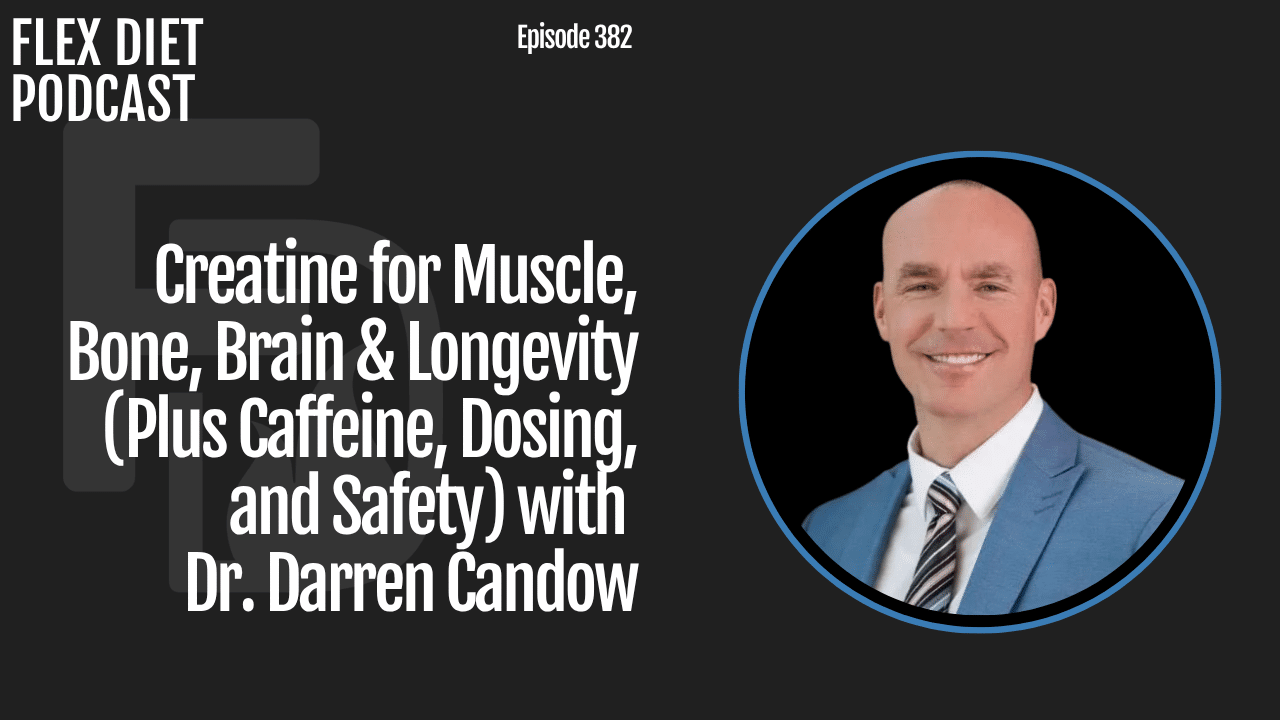
Speaker: [00:00:00] Welcome back to the Flex Diet Podcast. I’m your host, Dr. Mike T. Nelson. On this podcast, we talk about all things to increase muscle and performance and improve body composition. Do all of it within a flexible framework without destroying your health. Today on the podcast, we’ve got Dr. Darren K, and we’re talking all about the many, many aspects of the supplement, creatine.
And I am sure you’re probably familiar with creatine. It’s been around for a long time, but it feels like it’s making another resurgence in the population. And I’ve gotten a lot more questions about creatine over the past, especially six months, and wanted to get, uh, Dr. Kow on here. So he is one of the top creatine researchers in the world.
He’s a professor at the University of Regina, where he leads the aging muscle and bone health laboratory. Uh, which is looking at how creatine resistance training and nutrition can improve muscle, bone and brain health, [00:01:00] especially as we age. It’s published over 120 peer review papers, supervised more than 20 graduate students, uh, and has gotten a ton of funding from various different organizations, and he is worked on some really, really cool and really large multi-year studies involving, um, creatine and.
Uh, many other, uh, subject areas too. So I think you’ll really enjoy this podcast. And again, it’s always, uh, great to get the researchers on here who are doing the actual, uh, research in the field. And if you want more information on Cree team, uh, if you’re listening this week when this podcast comes out, I’ll have a ton more on the newsletter.
It’s free to hop onto the newsletter. We’ll put a link, uh, down below. And then also I just finished a ebook, uh, complete manual on creatine. And I wanted to make this something that was relatively short. I think it came in at about [00:02:00] almost 50 pages, so I’d say it’s not super short. Uh, and talking about all the different research in creatine for muscle bone, brain covering everything from what type do you need to use the timing.
Research, are there any issues with it interfering with perhaps coffee or caffeine? And you’ll find more information on that. We’ll put a link, uh, down below. And we also have, Dr. Au has some quotes in there along with my other, uh, research buddies, Dr. Eric Rosson and Dr. Scott Forbes. And so far the feedback on it’s been really good.
So check that out. Uh, down below if you want a one stop shop for. All things creatine in a way you can understand that’s still based on the research. I think in that we’ve got, I think I have almost like 47 different research, uh, topics or papers we ended up using in the end. And if you want more information, like I said, hop on to the [00:03:00] newsletter below.
And without further ado, here is the podcast with Dr. Candow.
Dr Mike T Nelson: Welcome to the podcast, Dr. Candow. How are you doing?
Dr Darren Candow: Good. How are you?
Dr Mike T Nelson: Good. It was nice to see you at ISSN again, as always, which is great.
Dr Darren Candow: Yeah, you too.
Dr Mike T Nelson: And I know you’ve been, you’re doing a lot of traveling around this this past year, correct?
Dr Darren Candow: Yeah. You been a busy
Dr Mike T Nelson: man. There’s
Dr Darren Candow: a lot, a lot of, a lot of requests, especially around creatine’s explosion on health and longevity and, uh, yeah, quite a bit coming up as well.
Dr Mike T Nelson: Awesome. Any big ones coming up as of this recording?
Dr Darren Candow: Yeah, I have, uh, I go to Austin for the Isis n in Bult one. And then, uh, I speak for Gatorade at a sport dietician conference in, uh, in May. And then, uh, ISIS n Europe is in Spain, which will be lovely in uh
Dr Mike T Nelson: oh, Spain.
Dr Darren Candow: Yeah. Nice. Yeah. Beautiful. Yeah, absolutely. So very fortunate. And, uh, yeah, I try to accept all the offers to travel, especially.
Dr Mike T Nelson: Yeah, that’s, [00:04:00] that’s great. I’m curious, I’ve never asked you this, like, how did you get into studying creatine? Because
Dr Darren Candow: Yeah, you’re not
Dr Mike T Nelson: one of these people who just said, oh look, it’s popular now. I’m gonna study it now. Yeah. You’ve been doing this for years and years.
Dr Darren Candow: Yeah, about two decades. And it was likely by accident.
So my master’s degree, I read Jose Antonio’s review on glutamine. Yeah. And that was, wow. This is gonna be like the next big thing. And, and this was in 1999. And, and I said, okay, let’s propose a master’s thesis on high dose glutamine supplementation on resistance training adaptations with placebo. And at the same time, uh, a good colleague of mine, uh, Dr.
Darren Burke, who published some really seminal studies on creatine early on. And then went more into industry. He was doing creatine research, so I was doing glutamine, he was doing creatine. And lo and behold, when I did my, uh, master’s thesis, you know, it was really injecting at you do a high dose. It was a great study, but all the results came back with no significant findings and.
Hmm. It was interesting that it didn’t have any effect on body [00:05:00] composition, strength. It didn’t even reduce muscle protein breaCandowwn. And now we’ve come to learn, you know, a non-essential amino acid by itself is essentially useless because our body’s obviously getting it or through the diet. But at the same time, he was finding really significant results by, uh, these individuals were getting bigger, stronger, faster, on reine during weightlifting.
And I started to become more interested in the significant effects. And then I started to. Uh, think about what populations might benefit from more muscle mass strength and performance. So my PhD went into healthy aging, uh, and that opened the doors for a lot of population interests, not just for athletes, but actually now for pretty much anybody.
And then it’s evolved into post-menopausal females. We’re now looking at the brain. So, uh, I think by not finding significance, like if glutamine worked, I might have stayed in the individual amino acid path. So I’m very fortunate that it didn’t, and it was also good to show null findings. Glutamine has its place maybe for long duration exercise or for some anti-inflammatory effects for people with sepsis or [00:06:00] cancer.
Uh, but really from a healthy human perspective, in my opinion, is essentially worthless, uh, from a supplement perspective. But creatine obviously is one of the big hitters. Yeah.
Dr Mike T Nelson: Do you think L-glutamine might be, and I know I’m stretching on this.
Dr Darren Candow: Mm-hmm.
Dr Mike T Nelson: Useful for possibly immune function and people who are maybe overreaching, maybe on the borderline of Frank Overtraining syndrome.
That’s,
Dr Darren Candow: yeah.
Dr Mike T Nelson: Something I’ve always kind of. Wondered about, but I can’t point to a lot of literature on it, to be honest.
Dr Darren Candow: Yeah. There’s some cellular evidence to suggest that in extreme cases of overtraining or undernutrition or catabolic stress primarily in animals, high dose glutamine might have some application.
But in healthy individuals, uh, we don’t see any effects. Resistance training is not that catabolic or stressful to the body. Long duration. Marathon training is totally different, so. I don’t see any good evidence in healthy individuals. It might have application for more medical intervention, sepsis, cancer, something like that.
But, you know, from if you go to a store and buy [00:07:00] glutamine and hope that it’s gonna do anything, it’s not. So I, I sort of, you. Can rest my laurels on that. I, I rank glutamine is probably the most worthless supplement out there to buy from a healthy perspective.
Dr Mike T Nelson: Mm.
Dr Darren Candow: Uh, but others would argue against that from, depends on the context you’re arguing.
Yeah,
Dr Mike T Nelson: sure. If we go to the, the flip side mm-hmm. What would you say are probably your top three supplements mm-hmm. That people should look into?
Dr Darren Candow: Yeah, so obviously creatine, and I say that from an evidence-based research, we’re seeing profound benefits Now, hard to get e enough in the diet. Uh, I also, like, caffeine has such great exercise potential.
I don’t lump protein in the supplement form unless you can’t get it through the diet. But my big three right now is, is creating caffeine and, and the Omega-3 fatty acids are always there for me just because it has the potential. Um, and I don’t think, and enough people are getting it through the diet, but when you look at, you know, the beta alanines and all that, they all have a place.
Uh, but the ones that I go [00:08:00] to each day I is caffeine through coffee creatine, and of course Omega-3 fatty acids.
Dr Mike T Nelson: Yeah. And there’s some very interesting data on obviously ISN has published this too, on coffee versus caffeine and just. All the other beneficial effects of coffee. And obviously you get caffeine with it too.
Dr Darren Candow: Yeah, they like, I think on average, a thousand antioxidants per cup. And the one that I’m keeping my eye on closely, and I hope as I get older is this, you know, the note, the big focus on NAD supplements, you know, there’s a lot of, yeah. Eventually in rodents. But the m and n and NR like. Could we get more of this in the aging cell to offset reactive oxidative species, make the mitochondria.
So I’m really hoping this comes more into light in, in, uh, from a healthy aging perspective. So it’s very cool in our areas, you know. We know a lot but there’s more we don’t know. And then it’s really kind of cool, uh, when these new ideas come to light and then we determine if they’re [00:09:00] effective or not and which populations they might be.
But it’s definitely one that I’m starting to, uh, pay more attention to and hope that it could be, uh, something to look at from a healthy aging perspective.
Dr Mike T Nelson: Yeah, I find the whole NED area, like mm-hmm. Super fascinating. Like, as you know, there’s a lot of early work, there’s a lot of mechanistic stuff. It, there’s a cool physiologic story.
It decreases with aging. Mm-hmm. So all the, the stuff leading up to it. But like right now I’ve been kind of sorely disappointed in some of the outcome studies, at least for healthy people like pathologies. That’s, that’s a whole separate area. I may have tested two to three grams of NR for mm-hmm. Eight weeks on my own, just to see if there’s any effect.
Dr Darren Candow: Yeah. Yeah.
Dr Mike T Nelson: I couldn’t noticed anything.
Dr Darren Candow: Yeah.
Dr Mike T Nelson: And again, n of one, you know, all that other kind of caveats apply to it, so it’s,
Dr Darren Candow: yeah.
Dr Mike T Nelson: I think it’s a super interesting area, but it just, I, I would love to [00:10:00] see more simplistically designed studies for just more, ’cause I’m like, if it increases energy
Dr Darren Candow: mm-hmm.
Dr Mike T Nelson: It should be ergogenic.
Right. We should see some benefit in athletes and right now, I, I. Just don’t see a lot, but I can’t point to a ton of data that’s looked at it either.
Dr Darren Candow: Yeah. I think the big context since we both exercise is we’re helping maintain that. The ironic thing, going back to creatine exercise doesn’t cause an increase in creatine, whereas no high intensity exercise NAD levels through the glycolytic pathway and go up.
So maybe could NAD down the road have potential for more sedentary individuals with Yes. Chronic eight. So that’s where I think the context is. But that’s an area I think that, you know, um, in a couple years, hopefully we’ll have more clinical trials and, uh, maybe it turns out to be useless if you’re healthy.
But I mean, in the context of aging, I think anybody’s willing to at least to listen and then make an educated guess.
Dr Mike T Nelson: Yeah. And then we kind of make more sense if you’ve got. Defects or different things in that pathway that it’s helping with [00:11:00] that. But if you’re, you know, already pretty healthy or already relatively trained, which to me has been, is always still fascinating me about creatine that
Dr Darren Candow: mm-hmm.
Dr Mike T Nelson: If you would’ve asked me like even, 10, 20 years ago and I didn’t know anything about creatine, you’re like, Hey,
Dr Darren Candow: yeah,
Dr Mike T Nelson: you take this supplement on healthy people who are athletes. Mm-hmm. And you can see an ergogenic effect above that, that you could in essence push more creatine into a healthy muscle.
I would’ve said, I don’t know. That sounds crazy, man. Yeah, I don’t know. I don’t think physiology works that way. We’ve got tons of data saying that it does Exactly that.
Dr Darren Candow: Yeah. It’s, it’s funny, you know, the, the, and this all goes back to the Harris study in 1992. Yeah. And what gets often overlooked, and it’s quite surprising, is it was such a low sample size, but two individuals in that study, which were larger.
Went way above the expected way above. And so when people say there’s a ceiling, I’m like, well, wait a minute. Are you telling me now that a 280 pound offensive lineman for the New England Patriots has the [00:12:00] same ceiling as I do? It’s, it doesn’t make sense. And so on average we think it is. And. You know, maybe your internal muscle stores are 80% full of creatine as we sit here today.
And, and supplementation can give you an extra 20, but it’s context specific. Your diet, what you were, you know, your, your muscle fiber, uh, uh, morphology dictates it, how much you’re eating. And, and so. I think what’s happened is we’ve expanded our at least curiosity that maybe not everybody’s muscles have the same capacity.
And then of course now we’re starting to see, well, how is creatine having some potential bone benefits, cardiovascular, and of course the brain and now we need to drive more in to disperse to other areas. So I’ve raised the question recently is like, okay, if we accept that the majority of creatine going to our muscle.
What happens if other tissues are in desperate need of creatine before muscle? So for example, if you’re a chronically sleep deprived jet lag, you know, whatever. Maybe when you consume creatine, not all of it goes to our [00:13:00] muscles like we once thought, maybe the brain is now extracting a greater percentage and less go to your muscle.
So I’ve been one of the big pushers of a higher dose. I love how these social media influencers take our information, go on these world famous platforms and say, you need to take 10 grams and all that. And, and actually no study’s ever shown that. It was my personal opinion about six years ago. And it, it makes sense.
I think 10 grams a day checks all the boxes from bone, brain and, and, and muscle. And could you go a bit more, a bit less? Absolutely. I think consistency is there. We do have a series of studies coming out now. Finally putting the nail in the coffin about the timing and the creatine. We, we essentially think it’s, it’s essentially useless.
Per se, as a, a main factor. But I, I’ve, uh, I love how the rollercoaster of creatine has come. We thought we knew everything and then we introduced different tissues and, and now we’re almost, geez, I don’t know if we knew hardly anything and now we need to do more research on it. So it’s still fascinating.
Um, but it’s, it’s quite ironic. It’s been around over 130 years [00:14:00] and, and we’re still researching it. Yeah.
Dr Mike T Nelson: Yeah. And it seems weird to me that. You can’t do anything now on social media and people are like, well, just take 20 grams of cre. Yeah. It seems like that’s the new bandaid.
Dr Darren Candow: Fix
Dr Mike T Nelson: all for everything.
Dr Darren Candow: Yeah.
And, and they’ve take, and to your point, they’ve taken individual studies in a very unique setting. You know, the, the 20 to 30 gram for sleep deprivation. Remember these individuals were healthy. They volunteered to be sleep deprived for just one day. But people take that result and say, wow, I’m not getting a good enough sleep every week.
I said. That is not what the study said. It did not say to take 20 or 30 grams every single day for seven days. It was a very acute, just to show you that there could be some rescuing effects. Yeah. So we need to do these and I, I worry that a lot of things are taken outta context. But by doing more podcasts, uh, like this, hopefully they hear and and sort of tone down our expectations of what creatine really does.
Um, nothing will rescue the, the effects of a bad night’s sleep. [00:15:00] Creatine might help a little bit. But at the end of the day, a better night’s sleep is gonna be the, the safety factor. Yeah.
Dr Mike T Nelson: Yeah. And I think what’s cool, and I can’t remember if it was that study or a different study, I believe did MRS to try to look at the actual mechanism mm-hmm.
Of what’s going on. So it wasn’t just, here’s an outcome, which is a great study. They actually were able to get down and see like mechanistically what was going on.
Dr Darren Candow: And that series of studies. Now, there’s been about five or six that use MRS, and they’ve clearly shown, yeah, Creta can get past the blood-brain barrier accumulate into the brain.
The argument is, well, where is it accumulating in the brain? Like what if it’s in areas that may not need it? There’s some variation. You know, we often never consider the minimal detectable change needed to overcome the instrument error. Um, but of course MRS is about $600 a scan. Super expensive.
Studies super expensive do from a reliability and a pre-test post-test. But the nice thing is we’re confident now that creatine yes, has the ability to get into the brain and some of the mechanisms very [00:16:00] similar to muscle. This is why I think it could work. It seems to decrease inflammation or oxidative stress.
So if you’re healthy sleeping well, creatine is probably gonna be useless from a brain health perspective ’cause you’re already making it. But God, if you’re sleep deprived, you’re an overnight worker, you’re a student staying up all night. If you’re, uh, traveling on air flights all the time, even time zone, I gotta believe that’s where creatine can come to the rescue, a small amount anecdotally.
Now, when I fly to, uh, Europe, especially, I try to take about 20 grams for those few days before and during. And I’ve noticed I don’t get as jet lagged as much, or at least I’m more, uh, clear from a cognitive and memory perspective. And I wish I would’ve known this in the inception of my academic days, you know, trying to get tenure and grants.
You’re staying up all night. Yeah, I know. Drinking, drinking way too much coffee. Uh, I wish we just said. A little bit more is okay. And, and the nice thing is Rick Kreer put out that great study last year looking at all the adverse effects. And even at high dose, [00:17:00] there’s no greater effects than placebo. So taking a little bit more is fine.
We’re not talking like protein, you know, two, 300 grams. We’re talking maybe instead of half a teaspoon, a full teaspoon a day. Um, we’ve shown now recently that you can take that dose split up. You can take it all at once if you like, or you can take, you know, a few grams in the morning, a few grams later.
It will have, uh, very similar effects. So I think creatine has come full circle where it’s a lot easier to consume than most people think. Um, you can, if you’re consistent. Uh, we don’t think that the dose of caffeine, if it’s more than 350 milligrams will interfere in most coffees, in multiple coffees are not.
So whatever’s the delivery agent for you that works is great. They’ve come out with gummies and candies and whichever, and I think at the end of it, if they’re all a, a stable form of bioavailable creatine, I think it’s great. I just hope more people at least consider the evidence to say, is this for me?
I don’t see any reason why you can’t. Unless you have a [00:18:00] metabolic condition where creatine for some reason would interfere with medication. Uh, Stacy ery in Australia’s looking at it from pregnancy and of course we look at in in older individuals and, uh, the collective body of evidence suggests it’s probably the most safest, effective ergogenic aid that we can now take.
Dr Mike T Nelson: Yeah, that’s what I always tell people, like if we don’t know what the potential upside is, like do we at least know what the potential downside is?
Dr Darren Candow: Right.
Dr Mike T Nelson: And I feel like with creatine we’ve got. Decades of data, even in high dose data for long periods of time.
Dr Darren Candow: Mm-hmm.
Dr Mike T Nelson: Almost all the data shows that it’s exceedingly safe.
Obviously at some dose there’s gonna be an issue, but
Dr Darren Candow: That’s right.
Dr Mike T Nelson: For the most part, the downside is pretty well clarified. And so, hey, if you wanna try 10, 15, 20 grams mm-hmm. Like, okay, go ahead. Like, I don’t think there’s much of a negative to, to doing that per se.
Dr Darren Candow: Yeah, and, and of course Surge Ossec is really come up with some really cool data just on the diet from Hans Data.
And the one [00:19:00] gram seems to be the minimal amount if you’re getting one gram through food. It seems to offset some effects from children’s development all the way into now anti-cancer effects. And, you know, creatine is only found in animal-based products, red meat, seafood, and poultry. So that begs the question, what if you’re a vegan, a vegetarian?
That’s where supplementation may have to come into play. And uh, again, for those that are eating a high meat diet at a carnivore, you may not need hardly any from supplementation, but you have to decide how does your diet look? Uh, you know, when you’re traveling, it’s very difficult to eat high quality foods.
For example, on an airplane they don’t give you anything. And the airport’s very difficult when you get to the hotel, it can be difficult there. And maybe that’s where those supplements can, rescue some of those effects. But at the end of the day, you know. Creatine is, is being promoted as a conditionally essential nutrient.
I think that comes from the area showing that a little bit more has these profound benefits. But from a nutrition perspective, you can’t say that because. Individuals, [00:20:00] vegans, vegetarians have a very successful, healthy life with no dietary creatine. The only time it becomes essential is as it for those that are born with an inborn creatine deficiency.
That means they lack the enzyme to make it. That’s where high dose seems to come into play, and I agree with you. I don’t see any downside by taking the supplement. It has no adverse effects on liver, kidney, blood, cell count. We’ve never measured any adverse effects in the brain yet. Um, we’re not seeing any reports from that.
For those that are looking at me, if they’re on camera creatine doesn’t directly cause any baldness, although I was just gonna say, you know, so I’m like, I’ve been taking it for 20 years. I’m okay. Exactly. And so people, I think we’re. It’s on the, the idea, maybe it’s too good to be true. It’s now being used by celebrities and it’s being, you know, one-liners in movies.
But at the end of it, it was discovered in 1832, about 60 years before a TP. And I think most people say, Hey, I’ve heard of a TP, but I didn’t realize that with creatine. And it just didn’t get a lot of momentum [00:21:00] until 1992. And then it’s taken the sport nutrition industry. By storm and we, we, we could literally sit here for 10 hours and I could go through two hours of creating research on muscle, another two on bone, three hours on brain.
And then you look at all those caveats. So at the end of the day, it’s, it’s one of the reasons the IOC ranks it as one of the top, uh, supplements. The Olympics start this week, or actually yesterday. I gotta believe the majority of those high performance athletes, depending on the sport. Uh, we’ll be taking creatine.
And the interesting thing, the evolution is now when you look at cross country skiing and long duration winter sports, creatine has been shown now to reduce markers of inflammation. So Crete might have application essentially for everybody. If it’s not from a muscle performance, could it be from a cognitive perspective?
It, it is interesting. Yeah.
Dr Mike T Nelson: Do you, I only got to chat with Roger Harris a few times. Mm-hmm. While he was alive and
Dr Darren Candow: yeah,
Dr Mike T Nelson: just the nicest dude, like I tried for. 10 minutes to finally get a picture [00:22:00] with him.
Dr Darren Candow: Yeah.
Dr Mike T Nelson: And he is like, ah, no one wants a picture of me. I’m like, you’re Roger Harris.
Yes.
Dr Mike T Nelson: I want a picture with you.
Right?
Dr Darren Candow: Yep.
Dr Mike T Nelson: Um, but I think if I remember correctly. When he started looking at C Reine, everyone kind of thought he was crazy.
Dr Darren Candow: Yeah.
Dr Mike T Nelson: They’re like, what are you doing?
Dr Darren Candow: Yes. It was, uh, you know, by accident again. Yeah. It was originally designed that he wanted to see some, uh, elegance or information in animals.
And then he by said, okay, I’m gonna consume this, and, and measured, and then he went, uh, and did his post-op with Eric Holman. In, in Sweden, and then they put up those two studies in 1992 and 96, clearly showing that, you know, a single five gram dose really maximizes the amount in the blood. And that lasts for about six hours.
Or you could take three grams a day. It doesn’t peak as much, but it gets to the same level after a month. And. And that’s why when you hear three to five grams a day, that’s a very viable dose. Now, in context, that’s only from a muscle perspective.
Dr Mike T Nelson: Yes.
Dr Darren Candow: When it gets to bone, we think we need a bit more in the brain.
We [00:23:00] definitely think we need more there. So if someone’s listening to this and say, yeah, my teenager’s only in, uh, interested in improving like lean mass and strength, uh, I think they could start as little as three to five grams a day with or without a loading phase. And. You’ll get to that. But for the middle aged individual saying, oh, my doctor said I am having reduction in bone density or mass, maybe they’re gonna need a bit more in combination, uh, with exercise.
And then when you get from the neck up, the lowest dose ever been shown to across the blood-brain barrier and accumulate is four grams. But that was in a population diagnosed with long COVID. Mm. So the idea is maybe the brain was under a lot of infl inflammatory stress. The majority of the, uh, uh, studies suggest 20 grams a day.
You may have heard about 10 gram dose. That’s based on a study of Utah where one group who took 10 grams a day, they doubled the amount of brain creatine levels compared to two or four grams, but it wasn’t significantly different. Hmm. So the thought is if I take [00:24:00] more, I check off all the boxes. If I personally take at least 10 grams a day, that definitely checks the, the box for muscle bone and hopefully is accumulating in the brain.
Dr Mike T Nelson: Yeah, we had Dr. Eric Sson on the podcast mm-hmm. A couple years ago now, and we were talking with him about some of the early work he is done in there. And, and for listeners, as you know, it’s, it’s much harder to look at brain levels ’cause MRS is probably the best. We can’t do biopsies of brain tissue in humans.
Like we can just stick a needle in your muscle and
Dr Darren Candow: mm-hmm.
Dr Mike T Nelson: Grab direct measures. So since that podcast and even before, what are your thoughts about. Creatine prophylactically. Mm-hmm. For potential reduction of TBI concussion, things like that. That’s something I’ve personally been doing before. Mm-hmm.
Kiteboarding trips I’ve suggested to athletes in contact sports.
Dr Darren Candow: Yes.
Dr Mike T Nelson: Again, on the premises of. There’s not a ton of data there, but I feel very confident that there’s really not a whole lot of harm associated with doing
Dr Darren Candow: it. Yeah. Yeah. I’m a hundred percent for it based on a couple [00:25:00] things. So if you look at the animal research that this is where it’s got its inception.
Yeah. In a study done in mice where they gave a high dose of creatine before going through. Head trauma. Yeah. They whacked him on the head. That’s right. The mice had about 50% less cortical damage when they took creatine. And then when they took, uh, they introduced a concussion and then gave creatine after, uh, the symptoms were reduced as well.
So we haven’t done that yet in humans. We’re trying to do that. But the idea is, well, if creatine speeds up and the recovery symptoms of concussion, what if you gave it before the individual suffered head trauma? The brain might have an increased bioenergetics or ability to recover. I use the same analogy.
If you’re going in for pre ACL surgery, why wouldn’t you take something that might help speed up recovery by taking. Could Sidney Crosby have come back from a concussions quicker if he had it? Eric Lyra, professional football players, so I totally agree that anybody involved in head contact sports, I think A UFC or box.
Oh my heaven. [00:26:00] Like I think the data is suggesting take it before in hope, it can speed up recovery. There’s certainly no downside. So I, I a hundred percent, uh, um, tell that to my students or athletes. If you’re involved in head contact sports, this is something that has no downside. If anything, it has potential upside.
Dr Mike T Nelson: And I know we’re definitely speculating here. Mm-hmm. But what I’ve done is I’ve had ’em go up to 20 grams per day starting out maybe three, four weeks before the event if they know Correct. Oh
Dr Darren Candow: yeah.
Dr Mike T Nelson: They’ve got a season coming up or they’ve got a fight, or things like that. Mm-hmm. Figuring, we don’t exactly know how long it takes to saturate the brain, but it appears to be higher dose probably appears to be a little bit longer, but I can’t point to a ton of studies that have looked at that.
Dr Darren Candow: Yeah. Uh, the one study outta Brazil looked at 20 grams or a little bit more for seven days and it didn’t accumulate. But if you do it a little bit longer, there’s other studies to suggest that during times of metabolic stress. So I agree with you. If I had a [00:27:00] UFC fighter and his match was on just say Saturday, I would probably be recommending 20 grams or more, at least seven days, if not longer.
And then of course right after the match.
Dr Mike T Nelson: Yeah,
Dr Darren Candow: you’re taking it again. So I, I don’t know if you watched the Rodder cup, but Ro McElroy on Sunday looks so exhausted and he actually has come to public. He say he takes 20 grams a day and, and he just looks so exhausted. The argument is since he went through three days of hell, metabolic stress, physicality.
Could he actually have taken a higher dose that had something left in the tank when he played Scheffler on Sunday? Uh, we don’t know. But even an elite athlete like that with multi-millions of dollars, he just looked exhausted. And that opens the, the idea of discussion of areas or people that we’ve never considered.
And, and you know, I, I think of musicians on tour continuously three hours, like Taylor Swift did a, I think your concerts were each like two and a half, three hours. That’s crazy. Multiple. And doesn’t matter how much money you have, your body’s gotta go through a lot of training and adaptation and cognition.
To [00:28:00] remember that. And so I think the musicians or other individuals we haven’t even really tapped into or other types of sports, not just the mainstream one. So I think there’s gonna be application for a lot of different populations we never thought where creating might have some application for improving their work performance.
Yeah.
Dr Mike T Nelson: Yeah. And I did a presentation on different topic for the F1 teams.
Dr Darren Candow: Yes.
Dr Mike T Nelson: And you know, I, I wasn’t necessarily, there’s some q and a, so I was kind of suggesting creatine might be useful because you’ve got a sport that has, I don’t think people realize them on a physical exertion that those athletes go through.
Mm-hmm. Their heart rates are just pegged the whole time. Yeah. And cognitively incredibly demanding. Like you think you’ve got Right. Creatine may help with the cognitive and maybe the physical components at the same time.
Dr Darren Candow: Yeah. I totally agree. And then I go back to like, we don’t think the diet influences the brain levels ’cause we’re making enough.
Dr Mike T Nelson: [00:29:00] Doesn’t seem to,
Dr Darren Candow: but there’s been a little bit of data from Carolyn Ray where vegans and vegetarians might respond favorably. So I wonder if a lot of people out there, they, they’re emphasizing a plant-based diet for whatever reason, they could potentially benefit more from supplementation for something they never thought of.
You know, the World Cups coming up in the summer. From a soccer perspective, there’s evidence that yeah, creatine can improve soccer performance. But my question is, what if there’s five minutes to go left in the in the championship game? Can the athletes have a little bit more cognitive function to make that pass or strike a little bit better when there’s a hundred thousand people watching you?
This is where it’s sort of evolving to a whole body supplement perspective.
Dr Mike T Nelson: With soccer. There’s very interesting studies on just the impact of heading the ball too. And obviously in professional soccer, that’s legal.
Dr Darren Candow: Mm-hmm.
Dr Mike T Nelson: So I’ve often wondered, I don’t know of any study, but it’d be interesting to see.
I don’t know how you could rank performance at the end of the game versus. [00:30:00] This guy, you know, headed the ball six times before that. I just
Dr Darren Candow: Yep.
Dr Mike T Nelson: Had this gut feeling that you’re, every time you do that, you’re just losing a little bit. Mm-hmm. I can’t point to any study, but
Dr Darren Candow: yeah,
Dr Mike T Nelson: again, back to, prophylactically, maybe it’ll help in those cases.
High stress, everything else going on.
Dr Darren Candow: And the nice thing is we have some pretty good data. ’cause you know, some of those sports are susceptible to, to weight gain and if you do incorrectly the loading phase, if you do add a little bit of water. But we now know you can take smaller, more microdosing and it doesn’t have those effects.
So at the end of the day, I think it has applications for almost essentially every athlete out there. It would’ve been cool for someone to survey the Olympic games, you know, in Milan, how many people are taking it, and then the correlation to performance there. It’d be very interesting. Yeah,
Dr Mike T Nelson: I would imagine it’s gotta be.
Virtually everyone at this point. I’m, I remember when the beta alanine kind of came on the scene. It was, it the, was it the South Korean sprint? Skaters, I think were like the main team that was public about using it [00:31:00] and they did really well. And that was many, many, many years ago.
Dr Darren Candow: Oh, like speed skaters if they’re not taking bicarb and, and so, and be Allen and creatine for the buffering effects that long.
You know, these are the best of the best and I gotta believe they have the best sports dieticians in the world, or hopefully, uh, supplying it. But you know, our Canadian. Uh, men’s and females hockey team, are they taking creatine to offset the effects of not only concussion, but performance? I gotta believe, or hopefully our research is finally getting out there.
But, um, it would’ve been interesting to actually do a qualitative type of study on survey analysis and see what they’re consuming. But, um, yeah. Very interesting.
Dr Mike T Nelson: Yeah. Go back to something you mentioned before about caffeine and creatine. Yes.
Dr Darren Candow: Yep.
Dr Mike T Nelson: This seems to be one of those things that just never seems to.
Go away. So the first question is, never die. Never die.
Dr Darren Candow: Yeah, that’s right.
Dr Mike T Nelson: Is, is there any mechanistic data to say that there might be an interaction and then what do the actual outcome studies show?
Dr Darren Candow: Yeah, so the great studies [00:32:00] outta Europe clearly showed there is a mechanistic potential. So for those, listen, this is really point of clarity.
Calcium is really important in the sarcoplasmic reticulum to bind a troponin to allow your muscles to contract. So caffeine seems to speed up the release of calcium, which is great. More calcium release combined and cause a muscle to contract, and that’s why caffeine is one of the most genic aids from a muscle performance perspective.
On the alternative side, creatine likes to take calcium back in. So unfortunately you argue maybe there’s a tug of war, maybe caffeine is releasing calcium and then creatine is bringing it back in. So there’s been a couple studies by Vandenberg, of course, the legendary Peter Hessel and creatine research showing that when you take a high dose caffeine in conjunction with high dose creatine, they do oppose each other at the calcium cycling.
That has been shown to interfere with muscle relaxation, but it’s never been shown to interfere directly with hypertrophy or, or strength or things like [00:33:00] that. When you look closely at the cellular data, they didn’t give coffee or tea. They gave pure, uh, caffeine powder, and the dose was based on the size of the person, but on average it was 350 milligrams.
Dr Mike T Nelson: Hmm.
Dr Darren Candow: So the person listening saying, Hey, I just had a cup of coffee. On average, a drip top is 80 milligrams. I think a large Starbucks at best would be. Maybe three to three 50.
Dr Mike T Nelson: Yeah.
Dr Darren Candow: But again, it’s two different deliveries. You have a coffee or a tea or a chocolate bar or a cola versus pure powder. So at the end of the day, there is a potential, but there’s also other studies suggesting that, uh, um, lower dose uh, creatine does not interfere.
So if someone’s listening say, the only way I’m gonna take creatine is if I take a teaspoon and dump it in my coffee. I’m totally for it. I don’t see any evidence to suggest there’s interference, but if you start to notice you’re putting your creatine in a large coffee and you’re letting it sit all day, you heat it up in the microwave, you let it sit, you heat it up again and again, and you’re not noticing any benefits.
It’s possible that there’s an interference effect. [00:34:00] We’ve done the only study to date looking at, caffeine, uh, uh, sort of uh, powder and creatine powder combined, and they sort of oppose each other from a muscle growth perspective, but it was a super, super low sample size, so you can’t really conclude much.
So at the end of the day, I’m not seeing any reason there’s a huge interference effect as long as the dose is is below three 50.
Dr Mike T Nelson: Yeah, that was kind of my general thought of that. There’s probably not much of an interference effect, and again, if people are. Super worried they could just take creatine at a different time.
Okay. It’s gonna be stored in the muscle. The acute dose you’re taking is probably not gonna have a huge
Dr Darren Candow: right,
Dr Mike T Nelson: massive effect either. Where we know timing and dose of caffeine is super important for performance.
Dr Darren Candow: Yes, totally agree. And, and at the end of it, the pharmacokinetic dynamics are, are not interfered between the two.
So pragmatically, I don’t see any reason why you would have to specifically separate ’em, but if you’re really conscious of [00:35:00] it. Pre-exercise, caffeine is the gold standard. You can essentially take creatine anytime you want and, but at the end of the day, if this is the only time you’re willing to consume it, I don’t see any reason why not.
Dr Mike T Nelson: Related question on caffeine. Mm-hmm. Do you still think in the, sort of the published research, and I’ve helped with some of these is SN research reviews and stuff on it, the, the three milligram per kg, up to six milligram per kg. I, I agree that the literature does show that. Mm-hmm. But I’ve also noticed individually the response is.
Extremely wide.
Dr Darren Candow: It’s a very wide, a lot of genetic predeposition for it, but you’re right on average to three to five or even three to six seems to be that wide range. And so for those listing, you know, if you’re 70 kilograms, that gives you a base of 210 milligrams all the way up to almost 500. And, and so if your delivery agent is, is coffee or tea, that’s quite a bit a day.
Most people, if you’re looking at a pre-workout, it’s gonna be a bit higher. So [00:36:00] I think the nice thing is that there’s a wide range people can choose to have that where you know it’s an adenosine antagonist. There’s evidence that it can influ influence, uh, the sodium potassium pump. Um, when you combine it with other things, I use caffeine as sort of the spark plug to get the body and that going.
Yeah. Um, and, and then, you know, they’ve looked at the effects of, of caffeine on hypertrophy. Nothing really, uh, stimulating the mTOR pathway and it makes sense. You know, it’s, it’s not designed for that. Luckily it doesn’t interfere with per se, so you could take your coffee before. I don’t see any advantageous effects of, of taking caffeine immediately after exercise.
It doesn’t really influence fat oxidation from a noticeable effect. So you’re right, you can take it at any time, but, uh, pre caffeine or pre-exercise caffeine is, is logical and it makes most sense.
Dr Mike T Nelson: Awesome. I’m trying to think, and I may have got this completely wrong, but. Wasn’t there some study showing that caffeine post exercised?
Was it increasing a carnitine or [00:37:00] something like that? Or did I get that completely wrong? I’m not
Dr Darren Candow: aware of that one, but
Dr Mike T Nelson: I’d have to go back and look that up. Now. There’s something where I can’t remember it, but it was giving caffeine at a high dose after exercise did something, and I was like, mm-hmm.
That’s super interesting from a mechanistic standpoint, but basically worthless in the real world.
Dr Darren Candow: Yeah, because I’m trying to think of how it would increase histidine residue to get carnitine or be like alanine. So
Dr Mike T Nelson: forgive me. I’ll have to go look it up
Dr Darren Candow: now. Yeah, I’m not, I’m not aware of it, but that’s an interesting one for sure.
Dr Mike T Nelson: Yeah. Uh, so back to creatine. I know you’ve done some work on bone now. Yes. It appears a massive study you’re involved with. Tell us about that.
Dr Darren Candow: Yeah, we’ve done a series of smaller ones and of course the big one finally got published a few years ago, so we took a large group of post-menopausal females and we put ’em on a pretty high dose of, of creatine.
0.14 grams per kilogram. So on average it was about 10 to 12 grams a day for two straight years. Uh, and when we, uh, [00:38:00] performed, uh, supervised resistance training and also encouraged walking and, and lo and behold, over two years, all that creatine did was preserve bone strength and at a little bit of favorable effects on geometry.
Uh, compared to the females on placebo. So it was quite eye-opening because I had a lot of hope for creatine on bone density and matrix, and, and it really just helped preserve the bone. Now you would argue that’s still beneficial, especially for postmenopausal individuals, but it didn’t have profound benefits.
Uh, the big take home is it did not improve bone density. It just sort of preserved what they had. That could have applications for those that are, are small frame. They have, uh, osteopenia. We don’t know. Could it rescue the effects of osteoporosis? So those were primarily done in older adults. The, the question is, what if we started this?
In young individuals, primarily biological females, during adolescence, could we cure more bone so when they do start to lose it, they had more. And of course those are longitudinal studies. So [00:39:00] at the end of the day, I think there’s a place for creatine potential in certain populations for bone health. But if you’re a young, healthy individual, we’re not seeing any evidence to suggest it has.
Anabolic effects. The best lines of evidence suggests it has anti catabolic effects. So almost like a bisphosphonate, it might preserve bone matrix over time.
Dr Mike T Nelson: Super interesting. What are your thoughts about in, in doing bone research about. Bone mineral density versus geometry because the one of the labs I was in, they’re one of the early labs that actually was able to start looking at geometry and
Dr Darren Candow: Yeah.
Dr Mike T Nelson: And the people I know in that lab, their, their sort of argument was, and this is 10 years ago now. Mm-hmm. That, yeah, bone mineral density is okay. It’s easy to get, but it’s not. The be all, end all measurement. It’s kind of made out to be without knowing what the bone physically looks like.
Dr Darren Candow: Yeah. Yeah. The bone research is almost awful.
It just takes so long to do and yeah, it’s hard to do. Oh. When you measure dexy, [00:40:00] you’re measuring like, I don’t know if people see it, but when you’re measuring dexy, the density, you’re just measuring the aerial bone. Right. Picture a pen in your hand. All you’re measuring is the weight of the bone, but you have no idea what’s inside.
And of course with CT and and high resolution CT scans, you can go in and look at trabecular and cortical bone or as you talk, talked about bone architecture or geometry. So we’ve evolved with technology. It’s super expensive. A lot of people refrain from bone research ’cause it takes about six months at minimum.
See any statistical, uh, noticeable effects. Uh, but for those that are willing to do it, it’s very expensive. And but the tone down expectations, those changes in bone are so small that we really don’t see a noticeable big change. And, uh, you’re right, if you’re relying on dexa, uh, you know, a two dimensional, it just measures the weight of the bone.
But the bone strength and architecture is likely more important than just measuring the density. So if you have three or four compartment, uh, tools to do that, it’s even better young.
Dr Mike T Nelson: Yeah. And that’s what’s so hard too about that research. Like you [00:41:00] said, the, the timelines are just so long. I mean, even the worst case, like if you look at how long it takes to see osteoporosis, right?
Right. You’re, you’re talking. Decades. So even if we do something positive
Dr Darren Candow: mm-hmm.
Dr Mike T Nelson: We can’t expect to see a difference in
Dr Darren Candow: like a couple months. Exactly. Yeah. And it’s, you know, it’s so hard to get an individual, a master’s student to do bone research ’cause they don’t wanna be paying tuition and waiting so long.
And for a PhD you almost need to start from the get go. So the people who do bone research, my hat is off to you. It takes a long time. It’s a slow. A painful process to see any big changes. You can measure urinary markers, but at the end of the day, most people are susceptible. Say, Hey, I wanna know how strong and and rigid my bone is getting, and then by doing that, you also want to take it a step further and say, okay, if the bone got stronger now, does it actually decrease fractures?
And so now you need to do another year or two longitudinal studies. So, you know, that study you alluded to, we, it took a decade from start to finish to finally publish, uh, because we also measure falls and, and, or sorry, fracture, [00:42:00] uh, uh, indices for a year later. And you know, when you’re measuring large sample sizes, it can take a long period of time.
And that’s why there’s bone area is very trying from an academics perspective. Yeah.
Dr Mike T Nelson: And do you remember the rough cost of that? I think it was in the millions of dollars.
Dr Darren Candow: Like for the total time in Yeah, in Canada approached over, uh, $500,000 just for the dxi supervision and, and things like that. So if you were to extrapolate that in today’s terms, it’d probably be well over a million dollars US to do that study again.
Yeah.
Dr Mike T Nelson: Yeah. And I think that’s the part people. Forget that. How expensive this is. Mm-hmm. Someone’s gotta pay for it.
Dr Darren Candow: Right.
Dr Mike T Nelson: Someone’s gotta do the measurements. Someone has to be on the study, ideally from start to finish to see everything you know through and Right. It’s, and like you said, getting grad students to do a long-term project that
Dr Darren Candow: Right.
Dr Mike T Nelson: God, it’s just, it’s just a hard sell all the way around.
Dr Darren Candow: Yeah. And, and, and when you’re asking someone to volunteer their time for three years, the withdrawal rate is always very high, high. So, you [00:43:00] know, it’s, it’s great for the person, but everybody’s time constraints and, you know, asking someone to volunteer for those periods of time.
So that’s why these long-term studies are, uh, are so difficult, almost near impossible to do at a, at a scientific level that you would expect. Yeah.
Dr Mike T Nelson: Yeah. And so they’re definitely needed, and one of my little pet peeves of people who argue online is we just need more long-term chronic studies on bone and stuff.
I’m like, do you have any idea how much time, effort, money, et cetera, goes into that? And I’m not arguing that we don’t need them. We a hundred percent need that.
Dr Darren Candow: Oh, we definitely need ’em. But I agree. Yeah.
Dr Mike T Nelson: It’s just, man, is that a, that’s a heavy lift.
Dr Darren Candow: It’s, yeah, totally. Yeah. Yeah.
Dr Mike T Nelson: What about cardiac effects?
Do you think there’s some effects with creatine there?
Dr Darren Candow: Yeah, I think there is. I think from, uh, it doesn’t have much effect on VO two max per se, in, in the athletes, but I think as we get older, uh, Eric Rosson and Mike Ormsby could put out a couple studies last year about, you know, improving endothelial function or vasodilation and that could have applications for cardiac rehab.
So I think from the [00:44:00] cardiovascular size, it has more of an application from a rehabilitation perspective, um, you know, heart failure, things like that. And the cardiomyocyte. Uses creatine, just like, you know, our skeletal muscles. So I think there is potential application for, so for those listen that are in that area, um, maybe look at those few studies and, but there is something there.
Yeah.
Dr Mike T Nelson: The question I get all the time is creatine forms. Hmm. I remember you’ve been around long enough to see the whole creatine Yl Lester craze. Mm-hmm. Where their whole marketing was. They had a glass, they put it in there and they see it dissolved and they’re like, look, this is amazing. It dissolves so much better.
It’s more air quotes bioavailable. And I remember talking to Roger Harris about this, and he’s just like. Shaking his head and according to him that they got lucky that where the body cleaves it off, it, it actually was not toxic, but he is like, if they, if the body cleaved it in a different spot, it would’ve been highly toxic.
The [00:45:00] people who came out with it, I guess didn’t do a lot of toxicology studies. It turned out to be not really beneficial and mm-hmm. Not really negative.
Dr Darren Candow: Yeah.
Dr Mike T Nelson: But he was very worried at the time. This was many years ago about. Everyone and their brother at the time was trying to come out with this new form of creatine.
Dr Darren Candow: Oh yeah.
Dr Mike T Nelson: And he is like, people are just putting ’em on the market without doing basic toxicology research Yes. Or anything else.
Dr Darren Candow: Yeah.
Dr Mike T Nelson: And his argument was what problem are you trying to solve with these,
Dr Darren Candow: with
Dr Mike T Nelson: these new Forbes?
Dr Darren Candow: Yep. It’s all, uh, I mean, every day I, I, I, I. Lump it into quackery, right? So this idea that you can get higher bioavailability, more stability and solution, more solubility, and God forbid it got into the cell quicker.
My argument is, show me the study that shows all that from a safety profile and then that has better the monohydrate. And of course, no study has been done that. There’s one that just kind came out. I laughed the other day. Liposomal, creatine. It gets past, oh no, the plasma, my memory, my creatine’s hydrophilic, but it still has the active [00:46:00] transporter.
Also, it gets through the circle limit quicker, but show me the data and it’s triple the price. It’s fancier. You can take it from a different delivery. So I think what was happening where creatine monohydrate white powder was so boring. We thought we knew everything. From a money grab perspective, I tell everybody, just stick to monohydrate.
Make sure it’s a, a reputable third party tested, and I’m guaranteeing that you’re gonna save a lot more money. We know the safety profile and you’re probably gonna have a lot more efficacy behind it, you know?
Dr Mike T Nelson: Yeah. Awesome. Last question. Where do you think the future of creatine is, is going? Obviously you work actively in this field.
Yeah. I know you’ve got stuff going on you probably can’t talk about yet, but just
Dr Darren Candow: Yeah.
Dr Mike T Nelson: In general, where do you think we’re going?
Dr Darren Candow: Yeah, I think in a few key areas. So I think the antica properties, uh, of creatine or potential from a. Adjunct to a therapy is there, uh, especially from the anti-inflammatory perspectives, I think I’m really curious on Stacey yell’s work around pregnancy and, and fetal development and, [00:47:00] and how the to transition there as well.
And then the biggest one, I think from a, a. Big is that from the neck up, we need to do big studies on neurological diseases. Yeah. The one that I we’re hoping to do is the traumatic brain injury. Yeah. Could it be a prophylactic concussion? I think for the next two decades, that’s the area we’re gonna be focusing on.
Can we get it in different areas of the brain to improve? So. Uh, I think, you know, creatine’s not going away anywhere, anytime soon. And then the fourth area is, what about creatine in combination with other ingredients? You know, the essential amino acids. Could creatine and collagen have potential for those with osteoarthritis?
What about creatine? A magnesium? So I think creatine is gonna be one of those main ingredients in a multi ingredient supplement. So I think this area will be evolving for the next two, three decades at least. Yeah.
Dr Mike T Nelson: Awesome. Well, thank you so much for all your time. I really appreciate it. Thank you so much for, all the research and everything in your lab and everyone you’ve collaborated with has done over the years to, to [00:48:00] push everything forward.
Uh, where can people find out more about you? I know you’ve got some stuff on Instagram and other places.
Dr Darren Candow: Yeah. Uh, no, thanks for having me. And I think Instagram is the easiest. We just post, you know, research articles and, and stuff about creatine. So at Dr. Darren Candle is probably the easiest. Yep.
Dr Mike T Nelson: And then are you looking for any graduate students or anything of that nature?
Dr Darren Candow: Yeah, right now I have six that are defending and then I’ve committed to one in the fall. And then after that we’ll sort of reset and, and see. So nothing currently right now, but uh, we’ll reset in a few years. Yeah.
Dr Mike T Nelson: Awesome. Well, thank you so much. I really appreciate it. This
Dr Darren Candow: was great. Thank you so much.
Thanks.
Dr Mike T Nelson: Thank you.
Speaker 2: Thank you so much for listening to the podcast. We really, really appreciate it. Uh, huge thanks to Dr. Candow for coming on the podcast and sharing all the wonderful knowledge. Uh, he’s accumulated and actually helped take part and literally helped create a lot of the data we have on creatine. And also if you want more [00:49:00] information from all sorts of researchers, especially in the area of sports nutrition.
Uh, check out the International Society of Sports Nutrition, an annual meeting coming up in Florida this June. So we’ll put a link down below for more information. Uh, I’ll be giving you a talk there this year along with a ton of other people. If you have any questions on it, you can just drop me a note.
But great conference, uh, great people. Always wonderful to see everybody again and get all the latest and greatest information. Speaking of the latest and greatest on creatine, I put together the complete manual on creatine. It’s a downloadable PDF you can get as soon as you purchase below. And I wanted to cover all of the areas from muscle to brain to even cognition and several other areas, and the easy to digest, readable format, but it still has all of the reference and everything, and that actually I started working on this almost two years ago.
And the part that took me the [00:50:00] longest recently was just going through and trying to verify all the actual references, making sure it was laid out in a way that people could understand and that it has the details. Um, but you’ll learn all about what type of ing is best. Everything from timing to interactions.
Uh, do you need a higher dose if you’re using it more for cognition or brain effects? Uh, so we cover all of that there. If you want more information about that this week, uh, check out the newsletter below. We’ve got free stuff there. As always, we’ve got a highlight this week, uh, all about creatine. We’ll be able to learn a lot more there for free.
And if you’re not listening to that this week, then you can still hop on and get a lot more free information there. So thanks again to Dr. Duren Candow. Thank you so much for listening to the podcast. As always, if you could help us out by doing the download and subscribe and share. That always, uh, helps with distribution of the podcast.
If you have time, leave us a short review. [00:51:00] Uh, all that stuff is super, super helpful. If there’s someone you think may find this information about creatine useful, please forward it on to them or share it on social media. Make sure to tag me so I can say thank you so much. So thank you so much for listening to the podcast.
We really appreciate it. Talk to all of you next week.
What do you suppose they call that? A novelty act? I don’t know, but it wasn’t too bad. Well, that’s a novelty.
Speaker 3: This podcast is for informational purposes only. The podcast is not intended as a substitute for professional medical advice, diagnosis, or treatment. You should not use the information on the podcast for diagnosing or treating a health problem or disease, or prescribing any medication or other treatment.
Always seek the advice of your physician or other qualified health provider before taking any medication. Or nutritional supplement, and with any questions you may have regarding a medical condition, never disregard professional medical advice or delay in seeking it. Because of something you [00:52:00] have heard on this or any other podcast, reliance on the podcast is solely at your own risk.
Information provided on the podcast does not create a doctor patient relationship between you and any of the health professionals affiliated with our podcast. Information and statements regarding dietary supplements are not intended to diagnose, treat, cure, or prevent any disease. Opinions of guests are their own, and this podcast does not endorse or accept responsibility for statements made by guests.
This podcast does not make any representations or warranties about guest qualifications or credibility. Individuals on this podcast may have a direct or indirect financial interest in products or services referred to therein. If you think you have a medical problem, consult a licensed physician.