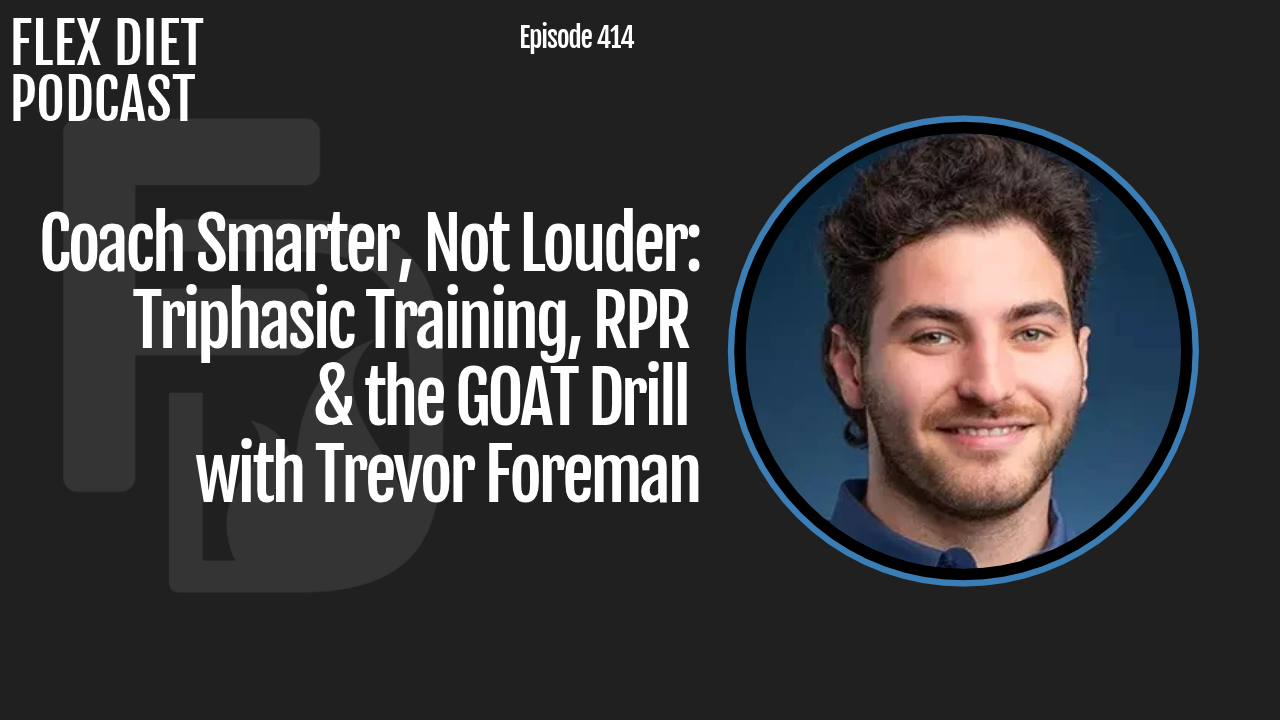
Flex Diet Podcast Ep 414 — Trevor Foreman
Timeline B: final MP3 (includes intro). Speaker labels recovered from interview context. Interview begins at 02:46; raw Zoom trim 11:28. Transcript below excludes off-air pre/post conversation. The separate intro/outro/ending clip are not transcribed here.
[03:00] Trevor Foreman: Oh, man. Um-
[03:02] Dr. Mike T Nelson: And we mean this in the very loving way, ’cause we both
[03:04] Trevor Foreman: love
[03:04] Dr. Mike T Nelson: Cal.
[03:04] Trevor Foreman: Yeah,
[03:04] Dr. Mike T Nelson: yeah. But he’s a character.
[03:05] Trevor Foreman: And, and, and to be fair, he did, he, at the UberZati conference, he did call me fat, third party. So I, I feel like I have a little bit of space when he, he said, “Oh, this isn’t an athlete, this is just a fat intern.”
[03:18] Trevor Foreman: I get a little bit of wiggle room with what I say here. But i- in a lot of ways, he’s a mad scientist, um, because he’s always testing things, and he’s got a supercomputer brain, but he’s also mad. Um- Yeah. You, you walk into his office and there’s papers cluttered everywhere, and he looks like he went through a tornado, and his fly’s down, and it- Th- that’s who he is.
[03:47] Trevor Foreman: But, I mean, any- anyone that knows Cal knows that he’s one of one, and he’s just a contagious person to be around when, when he’s not cutting.
[03:58] Dr. Mike T Nelson: Yeah. Yeah, don’t be around Cal when he’s on a, a, a diet, and you’ll know immediately. Like, I know a few times I’d, I’d walk into his office and I’d ask him a question, and then I’d be like, “You on, you on a diet, Cal?
[04:11] Dr. Mike T Nelson: You cutting a…” “Well, you know, I’m just trying to cut down a little bit, you know.” And I’m like, “Yeah, I, I, I figured that out.”
[04:16] Trevor Foreman: Yeah, yeah. His, um, oh, what is it called? The, uh, fasting-like diet where he’s eating seaweed in the morning and a black tea at night. And it’s like, oh man, I’m, I’m gonna give you your space.
[04:30] Dr. Mike T Nelson: Yeah. I was describing it to one person and he’s like, “Oh, the Triphasic 2 book.” I was like, “Yeah, I r- I wrote it with, uh, Cal Dietz, you know, based off the triphasic principles he came up with.” He’s like, “Cal Dietz, that name sounds familiar.” He’s like, “Oh, is he the guy who looks like he just walked out of a trailer park every morning with, like, the disheveled hair and, like, the big gap in his teeth?”
[04:51] Dr. Mike T Nelson: I’m like, “Yeah, that’d be him.”
[04:54] Trevor Foreman: Yeah, yeah. It, he had a, he had a bad stint with that tooth where, like, he gave up on it- Oh. I know … and then he was trying to jam it back in. It kept falling out. Eventually he got to the dentist. But y- his dentist was an ex-player of his that he pushed pretty hard, so even, even in that context he was getting a little bit back.
[05:14] Trevor Foreman: But
[05:16] Dr. Mike T Nelson: Were you at the St. Thomas, uh, talk he gave a couple years ago, where he gave the talk and he gets up there and he’s like, he’s like, “Ah, this is a stupid tooth. Hold on a sec.” And he like takes it out and sets it on the podium. And he’s like- No way … “All right, that’s a lot better.”
[05:31] Trevor Foreman: I mean, I believe it, ’cause it was just, it was a trav- like, it was just a traveling prop for a while.
[05:38] Dr. Mike T Nelson: Yeah.
[05:38] Trevor Foreman: It was just like you just, you never knew if it was in or out. Like, ’cause I remember when he lost, like when it first really came out, he thought like, he figured like, “Ah, it’ll just go back in.” Not, that’s not how-
[05:52] Dr. Mike T Nelson: Yeah. …
[05:53] Trevor Foreman: it works. But he’s, he’s better about it now. When he’s, when he’s doing his serious talks, it’ll be in.
[06:00] Trevor Foreman: When he’s hanging around, could be out. You never know. Yeah.
[06:04] Dr. Mike T Nelson: I, I’ve used it now to determine if, uh, Cal’s in serious mode or not. It’s like, is the tooth in- Yeah … or not.
[06:11] Trevor Foreman: Yeah. That’s a great barometer. He, uh, he has-
[06:13] If
[06:13] Dr. Mike T Nelson: his hair is combed, that’s the other one.
[06:15] Trevor Foreman: Yeah. He has four nice shirts. If any of those four are on, he’s speaking somewhere- Yep
[06:22] Trevor Foreman: or he’s going out to dinner. So that’s a, that’s another good one.
[06:27] Dr. Mike T Nelson: Yeah. And I heard you had to take him to a little ER visit a couple years ago from the, the quad incident.
[06:31] Trevor Foreman: Yeah. Yeah, he got, uh, he got kinda caught, um, he tripped, he tripped on like the loop of a water bag and he fell backwards, tried to catch himself.
[06:45] Trevor Foreman: But like, we were doing something and I was just like, I looked at him and he was just profusely sweating, and he’s getting red. And I was like, “Y- are you okay?” Like, like, I, I… When you work with Kalanoff, you start to speak Kal and you know- Yeah … when something’s not right.
[07:04] Dr. Mike T Nelson: Yeah.
[07:04] Trevor Foreman: And almost kinda like looking like, is this gonna get directed at me?
[07:09] Trevor Foreman: And like, he’s like, “Ah, I think I, I think I, I think I might have tore a quad. I think I might have tore a quad.” I’m like, “Okay, it’s a Saturday, uh, it’s a snowstorm.”
[07:20] Dr. Mike T Nelson: Mm-hmm.
[07:21] Trevor Foreman: All right. Um, so his truck’s out front. I go take his truck, I go spin him around the, um, the, uh, the bus ramp, get him down, get him into the car.
[07:37] Trevor Foreman: I gotta like lift his heavy ass into the car. The roads are so slippery. He, he’s insisting on using the back roads to get to the-
[07:46] Dr. Mike T Nelson: Oh, no.
[07:48] Trevor Foreman: Um, I’m like trying to drive fast. I’m trying to not lose control. He’s also just navigating me, which is difficult. Um, get him to the hospital, everything’s fine. I’m just hanging around, hanging around with him in the, uh, in the waiting room, listening to them list off the available prescriptions for him and, and then eventually Tatum, his, his daughter comes and that was a, that was definitely a, one of the many, one of the many stories.
[08:22] Dr. Mike T Nelson: Yeah, ’cause he called me up and I, I was like, “Hey, man, how you doing?” He was like, “Yeah, I tore my quad.” I’m like, “How? What, what, what?” And he tells me the story and I’m like- Yeah … “Oh my God, dude. Are you all right?” And he’s like- Yeah … “I think they had to like surgically reattach it and all sorts of stuff.” Yes. It was
[08:36] Trevor Foreman: pretty
[08:37] Dr. Mike T Nelson: bad.
[08:37] Trevor Foreman: They, they, they had to move pretty quick because when I was there they were like, “We’re a little bit concerned about some blood clotting.”
[08:46] Dr. Mike T Nelson: Yeah. And some compartment syndrome and stuff-
[08:48] Trevor Foreman: Yeah …
[08:48] Dr. Mike T Nelson: he had going on.
[08:49] Trevor Foreman: Yeah. And they had to go that night, but I mean, he, he was taking the, the Metabolic Elite BPC chewables every eight hours.
[09:01] Trevor Foreman: The amount of money he spent on BPC-157- … was unbelievable. But yeah, stimming the shit out of it, doing the BPC and like- He’s just a nut with that stuff, and I’m sure he, he learned a lot along the way. I mean, now he’s got… On one quad he tore it. On the other quad he cut out an infection when he was deep in the woods in Canada with his family, so-
[09:26] Dr. Mike T Nelson: Oh, geez
[09:26] Trevor Foreman: he’s got, he’s got twin scars at this point.
[09:31] Dr. Mike T Nelson: Oh, maybe Laval gave him a discount on it. He bought it by the, the truckload or something, you know? I’ll give you a little bit of-
[09:35] Trevor Foreman: Probably … a discount, buddy. Probably.
[09:40] Dr. Mike T Nelson: Uh, what are some of the top things you’ve learned from being there? Because as much as it is a chaotic, crazy environment that I personally decided after being there the first time for, like, four hours I never wanted to be an intern there, it’s also, like, he’s doing shit that I’ve never seen being done at a- almost any other place I’ve been to.
[10:05] Dr. Mike T Nelson: Yeah.
[10:06] Trevor Foreman: Absolutely. I mean, I, I originally came there as an intern and just kinda had, like, the feeling from, from my past experiences and being a college athlete that, like, there had to be more- Mm … and I just didn’t know about it. And then I get there and it’s just like the fantasy factory where no idea is too big, and it’s just a matter of how do we facilitate it.
[10:31] Trevor Foreman: And I mean, on a daily basis you’ve got five programs running at, at once. Um, everyone’s flying around, and I loved it. Um, and I loved that no idea was too big ’cause it really just allowed me to, to think and to, to move forward with, like, the idea that just because we’ve been doing it this way doesn’t mean it’s right, and if you can think of something and you can test it, it might be worthwhile.
[11:03] Trevor Foreman: Um, but like- I, I, I mean, I g- I, I don’t know if I could even in, in an hour tell you about- … like, what I took from it, because I mean, it’s, it’s the system I run. It’s learning how to use RPR, learning how to read a, a 1080 graph. It’s thinking about room logistics, talking with athletes. I mean, it, it’s by and large the…
[11:31] Trevor Foreman: What I did w- was take as much as I could of that and just put it in a different weight room with no in- I have one intern instead of 12, and- … I have one 1080 sprint instead of four, and I have no syncros, and I don’t have a weight room that… I credit to him and the foresight of, of how he built that weight room.
[11:54] Trevor Foreman: As Performance Cycling started to grow, when he built it, it wasn’t what it was with how big those blocks are now. But I mean, like, the custom glute ham reverse hyper with the, the front and behind bars, um, just the way that that room flows, and he’s added half racks everywhere, which is awesome for the logistics.
[12:18] Trevor Foreman: But it, it, it’s So much of what I do is what I learned there.
[12:28] Dr. Mike T Nelson: Yeah, and I, I think of that as an example when I hear, let’s say, old school traditional strength coaches be like, “Oh man, we can’t do RPR because that’s too complicated.” Or something that I think I could, I could show you how to implement this in, like, five seconds.
[12:45] Dr. Mike T Nelson: Yeah. When I think of all the shit that I’ve seen go through there at a high level that looks like controlled chaos, and I’ve got, you know, someone else who’s like, “Oh, I don’t know if I can add this to my, my intro warmup,” I’m thinking, “Well, what are you talking about?”
[13:00] Trevor Foreman: Yeah. Yeah, I mean, I, I, I think that’s a- another thing I learned.
[13:06] Trevor Foreman: I mean, when I, when I was first exposed to RPR, I watched, um, Cal on Mark Bell’s video.
[13:15] Dr. Mike T Nelson: Oh yeah, I remember that one.
[13:16] Trevor Foreman: Just running through it. And I was like, ah, like, you know, the … I, I’d, I’d read Cal’s, like, High School Athlete free book that he put out when he did Summer Strong, and, like, I got amazing results running Triphasic, and I was like, “This guy’s got something figured out.
[13:34] Trevor Foreman: I might as well try it.” And I tried it, and I absolutely butchered it. But- … I was just like, “Oh, this doesn’t work.” Like, I don’t feel any different. Like, yeah, this is, this is whatever. And then I go there, I learn about it. I, like, actually learn how to do it. I get muscle tested. I, I think for a lot of people the, the gap is just having somebody there that knows and can muscle test you and actually show you- Yes.
[13:57] Dr. Mike T Nelson: You have to feel it …
[13:58] Trevor Foreman: like, do, do you see the difference? Like- Yeah … I did not do anything but hit some of these spots. Like, do you see … I think, I think the, the most obvious one is when you get, like, a powerlifter or someone who does a lot of traditional lifting, and you do the glute firing pattern test- Mm
[14:18] Trevor Foreman: and their sh- opposite shoulder just rips up, and they’re weak. And you resolve that, and they don’t move their shoulder, and they’re strong, and it’s like, “I could’ve pushed you down with a couple fingers before, and now you’re not going anywhere,” like- Do you, like, w- what else could I have done other than just- Yeah
[14:35] Trevor Foreman: has changed that fast. Um, but I, I, I think, like, being there opened me, opened me up to so many ideas. When, when you can conceptualize something so small and so seemingly meaningless have such a big impact, um, I … W- with my athletes in pain, like, sometimes it really is that simple, is their glute firing pattern’s off and there’s too much muscle toneness in their QL, and you re- restore that and it’s gone.
[15:06] Trevor Foreman: And it’s such a simple, fast, and easy fix. And I mean, I, I have RPR within my warmup, so whether they’re doing it right every time or not, the w- it’s pretty seamless. It’s pretty low effort for me most of the time.
[15:22] Dr. Mike T Nelson: Yeah, and the craziest thing with, with me about it was, I mean, I, I was doing my PhD at the University of Minnesota when
[15:29] Dr. Mike T Nelson: I’ve probably told this story multiple times in podcasts. So Cal comes in one day, you know, ’cause for people who don’t know, like, the lab I was in is in Mariucci, is, like, his place. I could walk to his-
[15:38] Trevor Foreman: Yeah, right across …
[15:39] Dr. Mike T Nelson: office- eight seconds if I sprint right- Walk down the
[15:42] Trevor Foreman: hall, yeah …
[15:43] Dr. Mike T Nelson: down the hall, literally.
[15:45] Dr. Mike T Nelson: Um, so he comes over one day and he’s like, “Hey, man. Uh, I got this guy from South Africa. He’s coming in. Crazy shit, man. Crazy shit. You gotta come to this cert.” I’m like, “Cal, what are you, what are you talking about?” He’s like, “Ah,” this is January. He’s like, “Ah, he’s coming in in June.” I’m like, “Uh, okay. Like how much is it?”
[16:03] Dr. Mike T Nelson: So Cal’s like, ” $1,500 for two days.” And at this time I had, like, dick for money. I’m just like- Yeah … “Ah, I don’t have any free time. I don’t have any money. My, everything is tied up in finishing this PhD and keeping my business going.” I was still working part-time in a med tech company. If it was anyone else on the face of the planet, I would’ve been like, “Hell no.
[16:21] Dr. Mike T Nelson: There’s no way I’m giving you $1,500 just because you think this is cool.” But it’s Cal, so I’m like, “I mean, is this really, is this worth $1,500? If it is, I will find the money. I will be there.” He’s like, “Oh yeah,
[16:32] Dr. Mike T Nelson: man. You gotta go. You gotta go. Gotta
[16:33] Dr. Mike T Nelson: go.” Okay. So we’re presenting at Paleo fX in May, and we’re sitting at the speaker dinner, and I’m sitting next to Cal.
[16:41] Dr. Mike T Nelson: And I’m like, “Hey, man. What’s this guy from South Africa I’m paying you $1,500 for in June?” He’s like, “Oh, man. Stand up. Stand up.” So we stand up at this speaker dinner, in the spot between, like, the bottom part of your ribs and the top part of the pelvis. Yeah. He takes his thumb and, like, jams it into my side.
[17:00] Dr. Mike T Nelson: And I’m like, “Ah!” I’m, like, screaming. And everyone, like, stops eating, like, turns around and looks. And Cal’s like 280 at the time with his arm around me, like giving me this side noogie of death. And I’m, like, screaming, and we’re standing up at this formal dinner. And we sit down, and he’s like, “Crazy shit, man.
[17:18] Dr. Mike T Nelson: Crazy shit.” And I’m like, “Cal, what, what are you even talking about? I don’t even know what you just did, other than this hurts really bad.” He’s like, “Oh, it’ll be worth it.” So that was when, you know, Doug Heel came over and did the, the level one, level two, which they, you know, bought part of the rights and did RPR after that.
[17:34] Dr. Mike T Nelson: And, and even after the first day I was kinda like, “I don’t know about this. This is kinda weird.” And I had done muscle testing. I had done a lot of hands-on work at the time. And, uh, I remember, um, Jim Snyder picked me up when we were driving, and I said, “Hey, Snides, what do you, what’d you think of day one?”
[17:51] Dr. Mike T Nelson: He’s like, “I don’t know, man.” I’m like, “What’d you think of Cal’s amazing touch when he did hands-on work?” He’s like, ”
[17:57] Dr. Mike T Nelson: Oh, it’s fucking horrible.”
[18:01] Dr. Mike T Nelson: And so we go to, like, the day two, and I’m thinking, “I don’t know. Maybe this is a mistake. This is weird.” But it was, like, at that point where he started doing some of the visual stuff, we repeated some of the tests, and I was like, “Oh, shit.”
[18:12] Dr. Mike T Nelson: Like, I went from, like, having a huge visual deficit to being able to s- you know, like, catching a ball and all sorts of stuff. Like, everything worked better. My HRV went up, like, 15 points, stayed for four days. Like, it was the craziest thing I’ve ever been to. And even then, I still, I still didn’t believe it, ’cause I’m like, “Okay, that’s just me.”
[18:33] Dr. Mike T Nelson: So I took, like, 30 old clients and said, “Hey, first session is free. After that, it’s 250 bucks. Come on over.” And I even grabbed a bunch of people who are like, “This sounds like the biggest bunch of bullshit you’ve ever told me.” Perfect. You come on over. I’m like, if it has a nocebo effect and it still works, and, like, you know, 28 out of the 30, like, got significantly better, and we had people, you know, advanced athletes, we’d have them deadlift before, deadlift after.
[18:58] Dr. Mike T Nelson: You know, like, they … I didn’t cue them at all. Like, this one guy warmed up, does 315, just a triple, great, and you could see he couldn’t sit back all the way, and he kept complaining that his low back hurt. Do the RPR stuff, he rips 315 off, or three singles faster than he ever did before, and he’s like, “Oh my God, I can feel my glutes and my hamstrings.”
[19:18] Dr. Mike T Nelson: Yeah. You know? And that was not cuing it. That was just literally getting his structure and activation patterns to be, you know, better afterwards. So yeah.
[19:28] Trevor Foreman: Yeah. I mean, I, I can relate to you and Jimmy, ’cause there was maybe, like, a month where for some reason, like, multiple people Cal was talking to were all having psoas problems.
[19:39] Dr. Mike T Nelson: Mm.
[19:40] Trevor Foreman: And so I had a bruised V on my stomach- … from just getting torn apart by him. But y- y- I, I think that RPR is such a good starting point for opening- Now anyone kind of on our side of strength and performance, PT, AT, chiro, of opening them up to the neurological side of things and-
[20:07] Dr. Mike T Nelson: Yes …
[20:08] Trevor Foreman: and how we can affect that, sometimes in, in such a quick and easy way, and level one is such a great intro to that.
[20:16] Trevor Foreman: And I’m so fortunate to have, have been through that because I, I… It’s been such a perspective shift for me, and now at this point with levels one through three, and I just did square one, which I really loved and- Oh,
[20:29] Dr. Mike T Nelson: cool …
[20:30] Trevor Foreman: and so just c- continuing to go farther down this neurological route, like RPR does such an amazing job kinda opening your mind up to stuff like that, and I think that that’s really a great forward point and is starting to be part of our evolution kind of in this segment of medicine.
[20:50] Dr. Mike T Nelson: Yeah. And the last part on that, and I’ll ask you some other questions, is, you know, I went on to teach RPR. I taught level one, level two a fair amount, and it was great because, like, it, as much as I like the online version, I think they did a very good job with it.
[21:04] Trevor Foreman: Yeah.
[21:04] Dr. Mike T Nelson: It doesn’t beat having someone in the room show you how to do it- No
[21:10] Dr. Mike T Nelson: how to actually practice the muscle test, making sure you’re on the right target, ’cause a lot of these people just … And they’re super intelligent, but they just have no experience. It’s like you don’t know- Yeah … what you don’t know, and to make sure you can … And you can learn that in level one and level two in a weekend, and the craziest part is- Out of all the people I taught, like, I don’t wanna say it’s impossible, but it’s very hard to make somebody worse if you screw it up.
[21:35] Dr. Mike T Nelson: Yeah. You may not see the result you wanna see, but rarely did you make somebody worse. Where, I’m a big fan of functional neurology, I love neurology, all that kinda stuff, like, you start doing the wrong shit with somebody’s eyes, and you could turn them into a fucking melted candle in front of you .
[21:52] Trevor Foreman: Yes, absolutely.
[21:53] Trevor Foreman: Like, you … On some of these bigger neurological systems, you can mess people up if you do not- Yep … mess them up bad. Um, and, and RPR is such a … Yeah, like you said, there’s, there’s so little threat. I think the worst you can do is give someone a noxious stimulus by just pushing too hard.
[22:14] Dr. Mike T Nelson: Yep.
[22:14] Trevor Foreman: Um, and even that, like, is super easy to resolve just by going back and hitting zone one after and giving them a, a safe stimulus.
[22:23] Trevor Foreman: But-
[22:23] Dr. Mike T Nelson: Yep …
[22:24] Trevor Foreman: I, like, I totally agree with you because m- I cannot tell you how to be a better muscle tester. Right. I c- I cannot. Like, it doesn’t matter if you know, okay, for a psoas test, I put my hand on the opposite hip, 45 degrees, I push down, I don’t wanna beat them. Like, all, all these things, like, it’s a skill.
[22:46] Trevor Foreman: Mm-hmm. And it’s a skill that only develops through feel. I cannot tell you how to have more feel. Yes. Like, it, like, it’s, it’s, it’s just that simple. And I, I, I wouldn’t say it’s you have it or you don’t, but, like, it is something that some people are better at naturally. Um- Oh,
[23:01] Dr. Mike T Nelson: for sure …
[23:02] Trevor Foreman: people in the Minnesota area probably know about Jim Olson, but-
[23:06] Dr. Mike T Nelson: Yeah
[23:07] Trevor Foreman: probably one of the best manual therapists that I’ve ever seen. And, like, I, I know people that have worked under him. I’ve … I watched him for two summers. My girlfriend interned for him. His kids work for him. His kids work for him, and they’re not him.
[23:25] Dr. Mike T Nelson: Mm-hmm. ’
[23:25] Trevor Foreman: Cause it’s just that it doesn’t matter how much knowledge you pass on.
[23:29] Trevor Foreman: His … What he does is all about feel and skill, and I don’t think muscle testing’s any different than that.
[23:35] Dr. Mike T Nelson: Yeah. And then the cool part is, on the other end of the spectrum, like, you can teach someone to do really basic mid-range stuff, like, in a weekend, and they can be good enough to be useful.
[23:48] Trevor Foreman: Absolutely.
[23:49] Dr. Mike T Nelson: Like, they’re- Absolutely … they’re not extreme, they’re not Ken Kanaka, and they’re not Jim, they’re not some of these high-end people that have been doing it for decades. But you can literally get good enough that you’re doing shit that most people in your area, like, won’t even get close to.
[24:03] Trevor Foreman: Yeah, 100%. Like, there’s a couple easy things you can pick up where it c- could be as simple as somebody struggling to lift their knee up.
[24:12] Trevor Foreman: They’re struggling- Mm-hmm … to create knee flexion or on something where they are doing knee flexion, their, their torsos is relatively unstable. Like, if you can identify that that’s a psoas, the r- the, the fixes- Really easy, really simple, really fast. And it’s just the way … That’s, that’s something that being with Cal is so invaluable to develop an eye for resolving these movement issues with stuff like RPR.
[24:40] Dr. Mike T Nelson: Do you feel that, like, coaches now … And this is probably not so much coaches, I would say, but even personal trainers, I just feel like There’s a rush to be online and to make more money, and which is fine, like I … uh, yeah, everybody should make a living. Like, these people are historically underpaid, there’s no question.
[24:59] Dr. Mike T Nelson: But I feel like they … It’s easy to skip a lot of reps and not literally see things. Like, so one of the things I do with new coaches is I’ll show video, ’cause some of the stuff I do is online, some is in person. I’m like, “Okay, let’s watch this person squat. What do you see?” “I don’t know.” And like, you have to keep going through and go, “Okay, look at their hip.
[25:19] Dr. Mike T Nelson: What do you see? Look at their right knee, for Christ’s sake. Like, what are you…” And the knee’s like, rar, like going in and out, and they’re like, “I don’t know. It looks good.” I’m like, “Oh my God.” But you, y- you forget that, like, a lot of people just don’t have reps of watching other people move, and having someone else say, “Hey, did you see this?
[25:40] Dr. Mike T Nelson: Okay, watch this again. I want you to look at their right knee. Okay, walk again.” And just constantly pointing these things out so that you can get reps, because you see it, but it doesn’t register because you, you just don’t have that knowledge yet of, of it.
[25:57] Trevor Foreman: Yeah. Yeah, I, I think we’re in a weird space right now with s- strength conditioning, human performance, whatever, with this growing online side of things.
[26:09] Dr. Mike T Nelson: Mm-hmm.
[26:10] Trevor Foreman: It’s not that it’s wrong. I, I, I definitely see on social media some people trying to push- Oh, boy. … all strength coaches need to be online. They need to be doing online training to get their worth, to get their money back. Uh, there’s, th- there’s some truth to it. We definitely get the short end of the stick in a lo- in a lot of ways, and I think a lot of it’s our fault.
[26:30] Trevor Foreman: But, um, like, the … I don’t … Just like Cal, I mean, I don’t really try and coach movement. And, uh, like I understand how crazy that sounds, but I, I- You
[26:44] Dr. Mike T Nelson: realize that sounds insane to
[26:46] Trevor Foreman: everybody else … insane. Insane. But I, I, I think when you look at something like a Yuri, like if somebody cannot do a Yuri, it’s probably ’cause they’re overthinking it, not under thinking it.
[26:56] Trevor Foreman: When you create an environment f- to let athletes be athletic and be athletes, they probably need to think less, not more. But I, I don’t wanna cover up compensations, and, and issues, and, and things that might find itself down the line. Um, and, and that is just developing your, your coach’s eye. I had my, my intern, um, when
[27:24] Trevor Foreman: Well, this was, uh, Wednesday When we were out at practice and the ice was still pretty much fresh, I told him, “Just, just watch the lines that the skates make.”
[27:36] Dr. Mike T Nelson: Mm-hmm. ”
[27:36] Trevor Foreman: Just, just look at the lines.” I didn’t tell him anything else. I just told him, “Just, just watch the lines until the ice gets, gets bad and you can’t see.”
[27:45] Dr. Mike T Nelson: Yeah.
[27:46] Trevor Foreman: And I was just like, “What do you think?” They’re like, “Well, I can definitely tell a difference between how much pressure they’re pushing with how big the line is, and how when they stop the line becomes wider.” Like, these, this type of, of mentorship and this type of Just being a, a curious learner about movement, I think is something that we’re losing ’cause we’re trying to jam people into boxes.
[28:13] Trevor Foreman: Like, everyone should move this way, everyone should squat this way, and it’s, it’s just, uh … When you watch pro sports y- you don’t find that.
[28:24] Dr. Mike T Nelson: No.
[28:24] Trevor Foreman: Right? Like, what, like, like, why are … Well, like, that … It’s just, uh, uh, he, again and again, another thing that I found being with Cal and being in that environment is, like, we have some general guidelines that we create by watching our best athletes, ’cause they’re probably gonna be the best at solving movement problems, and then from there we’re, we’re just trying to see how different people fit into it.
[28:48] Trevor Foreman: But it’s not about over-coaching, it’s about putting them in a position where the, they’re just, they’re just being an athlete and making sure everything’s functioning well, whether it, like I said, it’s can’t lift your knee up high enough, you’ve got a lot of noise in your torso, your, your foot’s collapsing upon impact, whatever it might be.
[29:07] Trevor Foreman: But trying to let the body tell you instead of just creating your own narrative.
[29:14] Dr. Mike T Nelson: Yeah. I feel like a lot of coaching systems get to be based on we, we always coach this way, we coach- Yeah … knees out, whatever, or knee never goes over the toe, or whatever these weird things that just develop over time. And it, I feel like you, you get sort of, in fitness, known for that, and oh my God, if you go against that, then you’re, you’re just a, you’re a horrible coach, and your solution is, like, the same hammer into the square pegs- Yeah
[29:45] Dr. Mike T Nelson: all the time. And, and you’ve been around long enough to know this too, and this is a mistake I made early on is I used all sorts of cues, and then I was like, “Oh my God,” I read, you know, Gabriel Wolf’s stuff I think about external cues, and I’m like, “Oh, external cues solve everything.” And they were a lot better.
[30:02] Dr. Mike T Nelson: And then, you know, you do some hands-on work, you do some of the RPR stuff, and I realized, shit, I don’t hardly cue in person much at all. Yeah. But I look to see where they’re missing, and then it’s like, okay, I think your right glute meat is a piece of shit, so I’m gonna put you on a table and I’m gonna test it.
[30:21] Dr. Mike T Nelson: Maybe I’m right- Yeah … maybe I’m wrong. Okay, if I’m right, it’s weak, and if I’m right, I can fix it, but then your movement pattern here, if I was correct, should be better. And a lot of times it is, and sometimes it isn’t. So, okay, maybe that was part of it, but maybe that wasn’t all of it. Right? So to me, it’s this iterative process, or putting them and doing a different skill.
[30:38] Dr. Mike T Nelson: Okay, let’s have you do this lunge this way. Let’s change this, let’s change that. Okay, now let’s come back to this. Did that alter the movement pattern? Oh, cool, it did, so let’s change the exercise order and stuff like that, versus this old school, I think outdated model of- “Oh, Johnny’s knees are coming out.
[30:55] Dr. Mike T Nelson: We’re just gonna tell him knees out,” or, or whatever the thing was. Yeah. And it’s like, if Johnny’s on 200 reps of doing this and your shit hasn’t changed him, like-
[31:03] Trevor Foreman: Yeah …
[31:03] Dr. Mike T Nelson: maybe you’re doing something not the best.
[31:07] Trevor Foreman: Absolutely. It … Like, we just need to, we need to ask the questions instead of creating the narrative.
[31:13] Trevor Foreman: Sean Sherman talks about killing the storyteller, but, like, test the muscle. Te- Yeah … like, test if the exercise is working. Get them on a jump mat. Get, get some form of objective measure. Like, like you gave the glute med example, and I think that’s a good one in our field, because people see a, a knee cave on a squat and they lose their mind, and it’s like- Yeah.
[31:34] Trevor Foreman: “Let’s mini band on their knee. Let’s tell them spread the floor. Let’s tell them to do all these things.” And W- time goes on and they’re still experiencing the same intervention-
[31:48] Dr. Mike T Nelson: Mm-hmm …
[31:50] Trevor Foreman: like, are, are we really creating change, or are we just creating a story around what we believe because somebody told us that knee valgus is dangerous?
[31:59] Dr. Mike T Nelson: But if somebody goes to your weight room, it looks like you’re coaching, bro.
[32:02] Trevor Foreman: Yeah. It doesn’t look
[32:03] Dr. Mike T Nelson: like you’re
[32:03] Trevor Foreman: just standing there watching. Yeah, yeah. When you, when you go to, like, a, an SC- there’s an SCC weight room, like, media day, and all the coaches feel like they have to n- not stop talking ’cause they need to pretend to be doing their job.
[32:15] Dr. Mike T Nelson: Right.
[32:16] Trevor Foreman: Um, but I mean, go, go watch elite Olympic weightlifters, especially females, and their knees go straight in when they squat.
[32:23] Dr. Mike T Nelson: Oh, yeah.
[32:24] Trevor Foreman: Nobody’s getting hurt there. And you look at, you look at biomechanical data from any sport and you see aggressive knee angles, and nobody’s- Yep … nobody’s stopping the play to be like, “Whoa, whoa, whoa, you can’t track that far.”
[32:35] Trevor Foreman: Look
[32:35] Dr. Mike T Nelson: at that cut the receiver made. Holy shit, did you see the angle of his knee? Well, he better stop doing that.
[32:39] Trevor Foreman: I mean, Justin Jefferson is a
[32:41] Dr. Mike T Nelson: biomechanical
[32:42] Trevor Foreman: mess. Jefferson’s are insane. And nobody’s, nobody’s telling him he’s gotta stop playing football.
[32:46] Dr. Mike T Nelson: Yeah.
[32:48] Trevor Foreman: So yeah, we, we … I think we just like to … It’s, it’s, it, it’s easy to make ourselves feel and seem smart around people that don’t know by creating these big stories, but we’re just not asking enough questions for, one, is it true, and two, is there anything else at play?
[33:08] Dr. Mike T Nelson: Yeah. And, and some of the better coaches I’ve been around, like I’ve noticed they generally don’t talk a whole lot when they’re coaching. Yeah. But if you ask them, “Okay, hey, what are you, what are you doing?” “Oh, I’m looking at this person and this movement, this…” They’re, they’re constantly thinking and they’re observing.
[33:23] Dr. Mike T Nelson: They’re not just, like, checked out to lunch. Yeah. You know? Harps. And it’s like, “So in this case, what would you do?” “Well, I’d probably do this or that, but I saw him correct this movement over here, so I don’t really think it’s an issue. Now I’m gonna let him do two more exercises, see if the pattern shows up again.”
[33:35] Dr. Mike T Nelson: And so they have all their- Yeah … algorithms and stuff they’re working through, and they’re paying attention, but they’re not … They’re trying to only work and help when is needed, and not just … It’s a … That sounds derogatory, but it’s like a higher level of, of thought, of prob- constant problem-solving, but not just- Yeah
[33:56] Dr. Mike T Nelson: rote memorization execution.
[33:59] Trevor Foreman: Yeah, and allowing for the athletes to have a little bit of discovery and a little bit of their own … Like, and movement is just creating physical solutions to problems, right? And if we do it for our athletes, they’re probably not gonna be very well-rounded when it comes to playing a sport.
[34:14] Trevor Foreman: But w- What I saw with, with Cal and what I, I absolutely agree with you on high-level coaches is when you have good people that work for you that can run things, it just … Like I, I found that like I have, I have a great intern this year, and it’s allowed me to step back so much more and, and watch and observe.
[34:35] Trevor Foreman: Yes. And it allows me to, to use the soft skills of RPR, the square one, the just years of coaching where I can sit back and only do some of the more high-level stuff and just let the running of the lift be handled by someone else. And it sounds weird, and it sounds crazy, and it sounds like I’m not doing my job, but really it just allows me to do these, these more fine skills.
[35:02] Trevor Foreman: And that was what I saw with Cal. I mean, you’d see him in the corner and he’s quiet, and he’s just serious face- … standing at the runway just watching prime times, and that’s probably where he’s best.
[35:15] Dr. Mike T Nelson: Yeah.
[35:16] Trevor Foreman: Letting him watch and use his coaching eye and trying to … I mean, even, even if he’s not even seeing any problems, but just thinking about movement
[35:25] Dr. Mike T Nelson: Yeah, and I just think that that whole
[35:28] Dr. Mike T Nelson: I wonder how much of this has been lost because a lot of coaches are just never given that permission, right? A lot of it is, oh my God, if your superior showed up on the weight room, it looks like you’re standing there with your thumb up your ass. It doesn’t look good. It’s like, but that person may have fixed one of their biggest athlete’s problems- Yeah
[35:46] Dr. Mike T Nelson: and done something amazing. You know what I mean?
[35:48] Trevor Foreman: Yeah, absolutely. Yeah. I, I do.
[35:52] Dr. Mike T Nelson: But doesn’t look like it should, should fit. But to me that … You’re using each person’s skillset to a higher degree. And when you’re new, like again, you just don’t know what you don’t know. So yes, you need to have them doing the mechanics.
[36:05] Dr. Mike T Nelson: Yes, you need the weight f- room to flow in a specific way. You can’t have chaos. All those things I think are like the minimum that you can have a good system and have one or two interns can handle that or train your athletes over time so they know what to do, that allows you to do the higher level thought, the problem-solving, the, the issues, the things that people who don’t have the reps just may not physically even see or understand yet.
[36:30] Dr. Mike T Nelson: And then they can learn how to do that, and then they can, you know, move further up and, and gain in their skillset.
[36:36] Trevor Foreman: Yeah, I mean, this concept of like 100-foot view is used in every form of business, and if y- if you’re on the floor, like direct constantly directing traffic, constantly talking, constantly coaching in a very in front of me view, like you’re just not gonna be able to have those, those nuanced thoughts about looking at things from a broader view.
[36:58] Trevor Foreman: Um, so yeah, I’d … 100% I’m with you on that.
[37:03] Dr. Mike T Nelson: And then on testing, like what would be some basic tests you would have new coaches do? Because I was surprised, and I won’t say the name of the forum years ago, but years ago good buddy of mine ran there, and there’s this debate about, you know, who should have a, a plyo step or teaching people to start a sprint.
[37:19] Dr. Mike T Nelson: And we were watching film, and I’m like Man, it looks to me like almost all, every single high-level athlete I can find does a plyo step, right? The paradoxical step backwards to, to move forward. Yeah. And at the time, this is y- eons ago, they’re like, “No, you just fall forward into a sprint.” So my buddy, who will remain nameless, goes to his facility and he’s like, “Hey, let’s just start timing athletes.”
[37:40] Dr. Mike T Nelson: So he times them, plyo step, fall forward, plyo step, fall forward. Every single one, 10 out of 10, he comes back, posts on the forum. He’s like, “Hey, man, here’s all my videos. 10 out of 10 people used a plyo step and they were much faster.” He got roasted. They’re like, “Well, uh, you’re stupid.” And he’s like, “Okay, well what did you guys find?
[37:57] Dr. Mike T Nelson: Like, what, what did you test and what did you find?” This went on for a week and we both got kicked off the forum for being- … annoying. And what we realized was, like, no, no one was willing to test their own assumptions. Yeah. But it doesn’t even have to have your ego involved, because at the end, if you have, like, a vertical jump test or some, you know, data, y- it just allows you to make better decisions.
[38:24] Dr. Mike T Nelson: Like, you don’t have to have your ego in it. You’re like, “Oh, maybe that w- maybe the athletes were tired. Maybe they did something else. Maybe we did too much the day before.” It doesn’t mean that what you did at that point is wrong, but it gives you at least an output to iterate on. Where I feel like, yes, we’re good at, at, at tracking, you know, one-arounds and stuff like that, but beyond those, like, what are some other things you would have people just consider testing so that you can just iterate faster based off of the actual data?
[38:54] Trevor Foreman: Yeah. Like, I, I think that goes back to, like, just trying to jam people in, in movement boxes where, like-
[39:02] Dr. Mike T Nelson: Right …
[39:03] Trevor Foreman: theoretically, biomechanically, wasting time and, and movement is probably gonna be slower. But then when you actually play it out, sometimes it’s just a movement strategy that athletes need to solve that problem.
[39:17] Trevor Foreman: Um, on the ice, I’ve, I’ve been getting on the ice in the last year and doing skating stuff, and there are a handful of guys that like to crossover start. Hmm. And it’s probably w- a worse movement strategy in that same perspective of, like, there’s more movement, there’s more wasted time, their initial acceleration is slower, and a couple of those guys are the fastest.
[39:41] Trevor Foreman: I don’t know, I don’t know if that’s, that they can make up that time with the crossover- Sure … what. But I mean, I run a sprint-based program with a group of athletes that doesn’t do off, off-ice sprinting, right? So, like, I watch gross sprints Monday through Thursday.
[40:01] Dr. Mike T Nelson: Uh,
[40:02] Trevor Foreman: and time and time again, I mean, I’ve got some really fast guys that don’t look good.
[40:07] Trevor Foreman: And it’s not, not in a dangerous way, but like, I mean, sometimes I’m looking at these 1080 graphs, like, trying to look at asymmetries and trying to look at- ways that I can potentially intervene with some of these neurological systems. Sometimes I just have to chalk it up as, well, they’re a hockey player and they’ve got a gross sprinting mechanic.
[40:29] Trevor Foreman: But-
[40:30] Dr. Mike T Nelson: Yeah. ’Cause you’re comparing hockey players to overground sprinting, correct? Yeah. Like, with a 1080?
[40:35] Trevor Foreman: Yeah.
[40:35] Dr. Mike T Nelson: Yeah. But- And that’s, that’s a weird thing too, because the first time I saw hockey players walk around at Cal’s place, I’m thinking, “Cal, what’s up with that dude’s gait?” He’s like, “Yeah, that guy, but that guy makes, like, $12 million a year.
[40:46] Dr. Mike T Nelson: You should see him on the ice.”
[40:47] Trevor Foreman: Exactly. It,
[40:48] Dr. Mike T Nelson: it- And I watched him on ice- Yeah … I’m like, holy fuck, that’s the same dude?
[40:51] Trevor Foreman: I mean, I’ve got a, I’ve got a guy who c- who’s hit over 20 miles per hour on a 10-yard fly, with a 10-yard fly on 10 yards with three kilos. Like, I’ve got a ton of … I, we don’t have a, we don’t have a guy that can’t skate above 20 miles per hour with three kilos.
[41:10] Trevor Foreman: Like- … got a lot of fast guys, and they’re … I, o- one of my guys has a m- theoretical max velocity when you do the, the 1080, um, force velocity profile. His theoretical max velocity is 23 miles per hour on, on the ice.
[41:29] Dr. Mike T Nelson: Damn.
[41:29] Trevor Foreman: It’s 21 off the ice.
[41:32] Dr. Mike T Nelson: Damn.
[41:33] Trevor Foreman: He’s not a good … It … You watch that sprint and you’re not like, “Oh, yeah,” like, “he’s really refined.”
[41:38] Trevor Foreman: Like, look at how good his acceleration technique is with his early push-offs. He transitions so well. Not, not at all. Not even in the- His
[41:46] Dr. Mike T Nelson: acceleration’s probably horrible looking.
[41:48] Trevor Foreman: No, it’s gross. Yeah. But, like … But he, like, on a, on a plyo mat, he can jump a 40. Like, he, he’s just a really good athlete.
[41:57] Dr. Mike T Nelson: Yeah.
[41:57] Trevor Foreman: Um, and he knows how to solve movement problems.
[42:02] Trevor Foreman: Maybe, maybe not in, in a way that, uh, somebody who studies biomechanics would say it’s right, but he’s still doing it at a high level. Like you said with … You watch some of those pro guys at Mariucci that have been skating their whole life, and they might run like they’re skating.
[42:19] Dr. Mike T Nelson: It doesn’t,
[42:20] Trevor Foreman: it doesn’t mean they’re not fast.
[42:25] Dr. Mike T Nelson: Yeah, and that’s where you think like just the more high level people I’ve seen, it’s like you just can’t, you can’t get around the specificity. Yeah And watching them do something that is not their sport, and I think hockey is probably like the, the most extreme I’ve seen in this. Yeah. It just … It’d be like to
[42:43] Dr. Mike T Nelson: Also, um, like swimmers, like watching them do running. Yeah. It’s like, uh, that just, it doesn’t look good, but you see them in a pool- No … you’re like, “Son of a bitch, that looks smooth.” Like, I can’t do a fraction of that.
[42:54] Trevor Foreman: Yeah. Yeah, and swimming’s a weird one, ’cause sometimes it’s gait-based, but when you have some of those like non-gait-based distance swimmers-
[43:02] Dr. Mike T Nelson: Yeah
[43:03] Trevor Foreman: their patterns are gone. They’re out the window, ’cause they’ve- Yep … been given so much stimulus outside of gait.
[43:09] Dr. Mike T Nelson: Yeah, they’re like a fish.
[43:10] Trevor Foreman: Yeah. But, but time and time again, I mean, I’m sure if you go to the Olympic Training Center and see some distance non-gait-based swimmers, they’re still great athletes.
[43:22] Trevor Foreman: Yes. They solve movements, they solve movement problems in a different way, ’cause they’ve, their system has adapted to some odd problems, but it doesn’t mean they’re not fast
[43:33] Dr. Mike T Nelson: Yeah. And that’s, I mean, how many, like I’ve heard like even recruitment now is going back and at a professional level even looking for early multi-sport athletes and-
[43:42] Trevor Foreman: Yeah
[43:42] Dr. Mike T Nelson: there’s how many examples now of athletes who, you know, I could have been a pro baseball player. I played hockey once in a while ’cause I grew up in Minnesota, Wisconsin, and, you know, then I really got into football later. And- Yeah … or even people who are into football who changed positions completely. You know, I can’t remember, was it Tyson Hill used to be a receiver and then played a quarterback part of the time.
[44:05] Dr. Mike T Nelson: And even the NFL, like played quarterback part of the time, receiver, and running back once in a while. Uh, Taysom? Taysom, yeah, yeah.
[44:12] Trevor Foreman: Yeah, yeah. I mean, yeah, he-
[44:14] Dr. Mike T Nelson: It’s like what the fuck? He
[44:15] Trevor Foreman: played- This is the
[44:16] Dr. Mike T Nelson: NFL.
[44:16] Trevor Foreman: In one game he played tight end, wide receiver, quarterback, running back, and special teams.
[44:20] Dr. Mike T Nelson: Yeah, that’s what it was.
[44:21] Dr. Mike T Nelson: Yeah. Yeah.
[44:22] Trevor Foreman: Yep. I, I, I think if you came and watched a lift you could tell who did and did not play field sports.
[44:30] Dr. Mike T Nelson: Yes.
[44:31] Trevor Foreman: Um, I mean, I’ve got, I’ve got one guy who his dad played, um, semi-pro basketball, and he grew up playing soccer and basketball and hockey.
[44:41] Dr. Mike T Nelson: Oh, damn. It’s
[44:42] Trevor Foreman: very, it’s very obvious that he had a more general athletic development when you watch him run and jump.
[44:48] Trevor Foreman: Mm-hmm. It’s, it’s very clear. And then you’ve got some guy from, from Minnesota who s- played baseball till like middle school and hasn’t played hockey si- uh, only hockey since then, and everything they do somehow looks like a stride on the ice.
[45:07] Dr. Mike T Nelson: Mm.
[45:08] Trevor Foreman: Any time we do any lateral movement. Like it’s very, their arms and their push-offs- Ugh
[45:13] Trevor Foreman: all sinks for a stride. And there’s nothing wrong with that, but-
[45:17] Dr. Mike T Nelson: Yeah …
[45:17] Trevor Foreman: time and time again, I mean, one of my mentors in undergrad, oh, one of his fundamental rules was Wolf’s Law. Mm-hmm. But Wolf’s Law can be generalized to anything. Yep. The body adapts to the stimulus provided. If you give the body a lot of skating, that’s the way it will solve those movement problems.
[45:34] Trevor Foreman: If you give it lots of breaststroke, that’s the way it’s just gonna view movement. Um, I would argue that when we try and take athletes out of that because it’s not right for the context, you’re just gonna make them worse.
[45:48] Dr. Mike T Nelson: Yeah. And that’s the Oliver Kosansky quote, right? Like all high-level athletes are asymmetric to some degree.
[45:53] Dr. Mike T Nelson: Yeah. Right? Especially- Yeah … you get into asymmetric high-speed sports, you know, baseball, tennis, golf, that kind of stuff. And then the, the flip side to that is we also know that if you, if you just get super far away from being human shaped, like you are at a higher risk of injuries. Yeah. But that doesn’t mean that you have to be perfectly symmetrical in an asymmetric sport.
[46:15] Dr. Mike T Nelson: If you are, you probably suck.
[46:18] Trevor Foreman: Yeah. Yeah, like high performance and health don’t go hand in hand. And l- we do a, we do a speed rotation on the 1080 where it’s a five kilo concentric, let them get a crow hop, and they’re just- Almost looks like they’re swinging a baseball bat, they’re throwing, they’re doing a one-timer.
[46:34] Trevor Foreman: It, it’s, it’s pretty relevant to hockey in the sense of upper to lower body rotational coordination at a high speed. And for a lot of those guys, guess what? The side that they shoot on is significantly higher.
[46:47] Dr. Mike T Nelson: Yeah,
[46:47] Trevor Foreman: shocker. And we’re looking at that like, “Oh, oh my God- … like, we can solve this,” ’cause how is that relevant?
[46:52] Trevor Foreman: They never shoot the puck the other way. But, and like, it’s, it’s still a great tool to see, like, is that going up? Is that going down? Are we getting better? Are we getting worse? Is the asymmetry getting bigger? But not, there’s not second where I’m like, “This asymmetry is bad. We’re gonna get hurt.”
[47:10] Dr. Mike T Nelson: Mm-hmm.
[47:11] Trevor Foreman: When are they gonna do it the other way?
[47:14] Dr. Mike T Nelson: Yeah. Yeah, I agree. Uh, last question as we wrap up. Uh, tell me about the, the goat drill, which the first time- Oh,
[47:21] Trevor Foreman: yeah …
[47:21] Dr. Mike T Nelson: Cal showed me that on video, I, I lit- I literally looked at him and I went, “You have completely lost your mind.” And he’s like, “No, man, this is the greatest thing ever.”
[47:31] Dr. Mike T Nelson: And so I, I thought about it for a while and I started playing with it, and I was like, “Holy shit, this is actually- Yeah … this is amazing.”
[47:38] Trevor Foreman: I, I really hope that, that more people do more research on the infinity pattern, um, Sundback’s work. There’s, I think, three studies right now.
[47:50] Dr. Mike T Nelson: Mm-hmm.
[47:50] Trevor Foreman: There’s, there’s some, some decent research on, um, the hemisphere connection, um, and improvements in gait.
[48:00] Trevor Foreman: But I mean, there are three small level studies, but, um- I felt like my athletes were not counting the way I wanted them to.
[48:12] Dr. Mike T Nelson: Mm.
[48:12] Trevor Foreman: Um, and I mean, the, the cognitive aspect of it,
[48:18] Dr. Mike T Nelson: I mean- So explain what the GOAT drill basically is, just for people who are like- Yeah … “What are these guys even talking about?”
[48:22] Trevor Foreman: So, so however you wanna orient it, at the end of the day, it has to be you walking within an infinity, running, walking, whatever, within an infinity pattern.
[48:33] Trevor Foreman: You’re fixating visually on an object, whatever it is in front of you. You are creating u- upper to lower body separation coordination by passing something around yourself, and you’re adding cognition with i- in the book math. Um, and I, I think it really boils down to trying to create the neurological environment of sport without playing sport.
[49:04] Dr. Mike T Nelson: Yes.
[49:05] Trevor Foreman: I found that going into my senior year of college football, when I was at Mariucci for my first internship, I didn’t really have the opportunity to play a lot of football in the summer working as an intern, and I fe- uh, previously I felt like when I did not play football for a while, I’d kinda get tunnel vision in coverage, and I felt like I couldn’t really see the whole field.
[49:27] Dr. Mike T Nelson: Mm.
[49:27] Trevor Foreman: And just doing GOAT drill throughout the summer, I, I didn’t feel that returning. Um, but I, I, I really felt like my guys were either trying to memorize the math or just not doing it or not pushing themselves through it, and really leaving neurotransmitters on the table when we don’t get that struggle with perseverance.
[49:53] Dr. Mike T Nelson: Yeah.
[49:53] Trevor Foreman: Um, so I wanted to make sure that we were actually doing the math hard. So I just kinda like, there’s gotta be like a kids quick math video on YouTube that just kinda like runs through equations. It solves for my visual fixation, but it also makes the m- the math and the cognition a little bit more reactive.
[50:17] Dr. Mike T Nelson: Nice.
[50:17] Trevor Foreman: And I couldn’t find anything.
[50:20] Dr. Mike T Nelson: Oh.
[50:21] Trevor Foreman: Um, so th- I, I, I think one of the coolest parts about AI is the agency it allows us to have over our own personal problem-solving. So I was like, all right, I, I could probably figure out a way to tell, t- to figure, make my own kinda like just quick math app.
[50:38] Dr. Mike T Nelson: Mm-hmm.
[50:39] Trevor Foreman: So I made that.
[50:40] Trevor Foreman: It, it was working well. It was just flashing basic subtraction, addition equations on an iPad, and it, it worked really well. And, and as we were starting to get outside, doing some longer sprints as the summer went on, I realized I need Wi-Fi for this, and I do- … not have Wi-Fi. So I we- I went back to the drawing board.
[51:01] Trevor Foreman: I made kind of a, an app that- allows for m- multiplication, subtraction outside without Wi-Fi, and then it just kept growing. Um, I got really into, like, the quiet eye and visual fixation and-
[51:19] Dr. Mike T Nelson: Mm …
[51:19] Trevor Foreman: now into lots of vision training and vision drills. Um, but I ended up building out an app where I use it primarily for the goat drill, um, with go, no-go, with a moving ball for quiet eye fixation- Yep
[51:35] Trevor Foreman: with math, um, Stroop effect, and it’s allowed for just… I, I think the most important thing about brain training is, is novelty, right? Yes. ’Cause you don’t face the same problems, equations, and there’s also, like, there’s just not gonna be as much adaptation. There’s not gonna be as much of a, like you say in the book, there’s the, the effects of difficult but situations where you’re trying and you’re fighting, but you’re winning, the dopamine and acetylcholine, like, that happens at a s- such a higher level when it’s also a novel problem.
[52:13] Trevor Foreman: So like we did, we did a three-ring goat drill with, um- With a go, no-go, and when you see the red light, you have to reverse.
[52:23] Dr. Mike T Nelson: Oh, cool. Love it.
[52:24] Trevor Foreman: Or if you see the green light, the ball that you’re passing, you have to throw it against the wall and catch it.
[52:29] Dr. Mike T Nelson: Nice.
[52:30] Trevor Foreman: So adding in these new movement problems, where it started as, like, I can make this math better, and I absolutely think that by giving them these flashing problems, it makes it better.
[52:42] Trevor Foreman: But even just having m- a bigger dial with, I do, like, multiple, it’s 10 plus 12 plus three- Mm-hmm … and I have it at a longer flash time, and it kinda makes it a, a larger, but less snappy, versus, like, when we’re getting towards the end of the week and we’re getting closer to a game, I’ll do really easy equations and it’ll be really fast.
[53:07] Trevor Foreman: Mm-hmm. So trying to potentiate kind of m- our problem solving the same way you would throughout a week with velocity.
[53:15] Dr. Mike T Nelson: Yeah, yeah, yeah.
[53:17] Trevor Foreman: The Stroop effect has been really cool. Any of these go, no-go where it’s not about just making, like, making over and over decisions with the math. It’s about making the right decision.
[53:26] Trevor Foreman: It’s about the, the, the hesitation of figuring that out. Um, Dan Fickner is doing some cool stuff with just changing the orientation of the rings, and that really got me thinking. So lately I’ve been doing kind of a, more of a, a V, uh, in the infinity, and that just kind of creates a different vestibular input, ’cause that-
[53:47] Dr. Mike T Nelson: Oh, sure
[53:48] Trevor Foreman: over run-
[53:49] Dr. Mike T Nelson: Yep …
[53:49] Trevor Foreman: forces you to tilt your head. So doing stuff like that, uh, changing the object in which you pass the ball, um, there’s a level of mental strain to annoying, I would argue. So, like, sometimes we’ll pass a volleyball- Ooh … ’cause it’s just another cognitive task to add on top of, like, being mindful of, like, this is more cumbersome.
[54:13] Trevor Foreman: This is harder to pass. I love the water bag early in the week for, for turning slings on and, and, and making the body sort out, like, more novel movement problems with the perturbation. But I also think about it in the context of, like, throughout the week we’ll go slow to fast. It’s just adding resistance- Mm-hmm
[54:32] Trevor Foreman: that makes it slower. So I really, I, I, I, I don’t know if there’s a, a future for this app. I haven’t, I don’t really wanna put it out to public yet. I’d be happy to show you after. But- Um, I, I really, I, I really tried to get as creative as I could with these GOAT drills to, to give the brain what it needs in terms of the novelty and complexity, but I’d love to see other people try and mess with it and, and innovate around it, ’cause I think it’s been really cool and really fun for the athletes.
[55:02] Trevor Foreman: Like, it, it just gets tiring. Like, I don’t, I don’t think any athlete would disagree that doing the same thing every day is pretty boring.
[55:10] Dr. Mike T Nelson: Yeah, yeah. It’s just- It just gets
[55:11] Trevor Foreman: very
[55:12] Dr. Mike T Nelson: repetitive …
[55:12] Trevor Foreman: whether it’s, whether it’s the s- I like the simple two ring in the beginning of the week, in the middle of the week I do the three ring, then I go back to the simple, and sometimes there’s hurdles, sometimes there’s ducks, sometimes there’s people in the circle blocking vision.
[55:29] Trevor Foreman: Sometimes you gotta throw the ball against the wall, but I think, I think it’s been one of my favorite new things to do, is just try and figure out what little layers I’m gonna add to the GOAT drill. Yeah. It’s such a, it’s such an awesome drill. I mean, when I was working with high schoolers, the, the improvement I saw, and look, I, I don’t know if there’s any, any drill, any strength training, anything you can do that gets athletes to, in every way, just be a better athlete than that, where I saw people that you wouldn’t think would have a chance to play on special teams in high school football, to be like, “You know what?
[56:08] Trevor Foreman: This guy could play for us.”
[56:10] Dr. Mike T Nelson: Yeah.
[56:10] Trevor Foreman: I saw it really transform athletes, and if, if anyone can take anything away from this conversation, I think it’s do GOAT drills and give yourself novel problems within the context of the infinity pattern.
[56:23] Dr. Mike T Nelson: Yeah, I totally agree, and I’ve had all my, even just physique clients, like I have literally almost every client now to some degree, it’s just part of their warmup.
[56:32] Dr. Mike T Nelson: Even if it’s one or two days per, per week. Yeah. ’Cause I’ve just found it’s so beneficial for just everybody at this point.
[56:39] Trevor Foreman: Yeah. Yeah, I mean, everyone has a brain, right? Like-
[56:42] Dr. Mike T Nelson: Yeah, yeah …
[56:43] Trevor Foreman: it, it doesn’t discriminate, and- Providing those neurotransmitter interactions, I mean, it’s just aside from your day-to-day probably being better, there’s gotta be some longevity effects to increasing hemispheric connection and the various neurotransmitter effects, and even just, like, your eyes.
[57:03] Trevor Foreman: Like-
[57:04] Dr. Mike T Nelson: Yes …
[57:04] Trevor Foreman: how often are you stimulating your eyes? So I think the quiet eye research is so cool, but seems like visual fixation is an, a pretty important factor in all forms of being accurate at a task. Um-
[57:18] Dr. Mike T Nelson: Yeah …
[57:19] Trevor Foreman: just looking at things hard is a skill, and trying to develop that I don’t think really discriminates to athletes.
[57:27] Dr. Mike T Nelson: Yeah. Awesome. Well, thank you so much for your time. We’ll have to have you- Yeah … back again some other point. I know you’ve got great stuff on Instagram. Where can people find
[57:35] Trevor Foreman: you? Thank you. Yeah, uh, my Instagram, uh, foreman_performance, is really the only place I’m putting things out right now. Um, I’d love to maybe grow that at some point, but right now with the season, I’m just trying to put out as much as I can.
[57:50] Trevor Foreman: Um, but it’s hard with the amount of time I have.
[57:54] Dr. Mike T Nelson: Yeah, you got nothing else going on.
[57:56] Trevor Foreman: Yeah. See if we can win a couple games this weekend, but I appreciate have- you having me on and, and what you do for the field and putting out an amazing book.
[58:07] Dr. Mike T Nelson: Yeah. Thank you so much. I really appreciate it, and, um, yeah, we’ll have you back on, and, uh, thank you so much again for sharing everything today.
[58:14] Dr. Mike T Nelson: This was really awesome.
[58:15] Trevor Foreman: Absolutely. Thanks, Mike.
[58:16] Dr. Mike T Nelson: Awesome. Thanks, buddy.