Oh man, the crazy biohackers are at it again, especially one whose name rhymes with Barry Drecka.
The claim?
The creatine supplement he recommends beats plain old creatine monohydrate.
Hmmm.
I have my doubts as I sit at my computer in the full impress-me-bro stance of some dooodes at the back of a SLAYER pit.
Pretzeled arms.
The version he is touting as superior is creatine hydrochloride, or creatine HCl.
Yawwwwwn.
Now, if I am in a generous mood, I’d say creatine HCl may produce similar results to creatine monohydrate in some settings.
…but the human head-to-head trials discussed here do not show that HCl produces better strength, power or body-composition outcomes.
That is different from proving the two forms are identical in every possible way.
Data Pleeeeze
First up, the ballers.
A triple-blind randomized controlled trial, with athletes, researchers and the stats nerds all kept in the dark, put 31 elite handball and softball players on 5 grams per day of creatine monohydrate, creatine HCl or a maltodextrin placebo for eight weeks.
Both creatine groups jumped higher and increased fat-free mass.
Between the two creatine forms?
Statistically, a big fat nothing.
One within-group difference did show up: only the monohydrate group significantly increased its fat-free mass index.
That does not establish monohydrate’s superiority, because the between-group comparisons were not significant.
But it certainly didn’t help Team HCl’s marketing pitch.
The authors didn’t mince words either, calling HCl superiority claims “unfounded and misleading.” Londoño-Velásquez et al., 2025.
Next, 40 young men lifting for eight weeks, split into four groups:
- Creatine HCl
- Creatine monohydrate with a loading phase
- Creatine monohydrate without a loading phase
- Placebo
If HCl were the magic molecule, this is where it should have lapped the field.
Instead, the researchers found no significant differences among the three creatine groups in strength, skeletal muscle mass, muscle cross-sectional area or the measured anabolic/catabolic hormone responses. Eghbali et al., 2024.
Even the no-load monohydrate crew kept pace by the end of the eight-week study.
Loading can get muscle creatine stores up faster. It just didn’t produce a detectable advantage in these end-of-study outcomes.
And yes, we have data on female lifters too, for anyone about to ask, “But what about women?”
Trained women taking either form alongside resistance training saw improvements in several oxidative stress and antioxidant markers.
HCl brought no detectable extra benefit to the party. Dadvand and Arazi, 2025.
Fair warning: this study examined oxidative stress markers, not strength.
It speaks to biochemical changes, not whether your next PR arrives sooner.
Details, Details
Creatine HCl has been reported to be about 38 times more water-soluble than creatine monohydrate.
That part comes from actual nerd chemistry, not supplement fairy dust.
But there is an important detail: the reported comparison used different saturation pH conditions for the two forms.
It is not a universal 38-fold advantage under every mixing condition.
And before the great Drecka drags that figure into a full marketing parade, here is the buzzkill:
Better solubility has not been shown to produce greater muscle creatine retention or better performance and body-composition outcomes in humans. Kreider et al., 2022.
Cool story, bro.
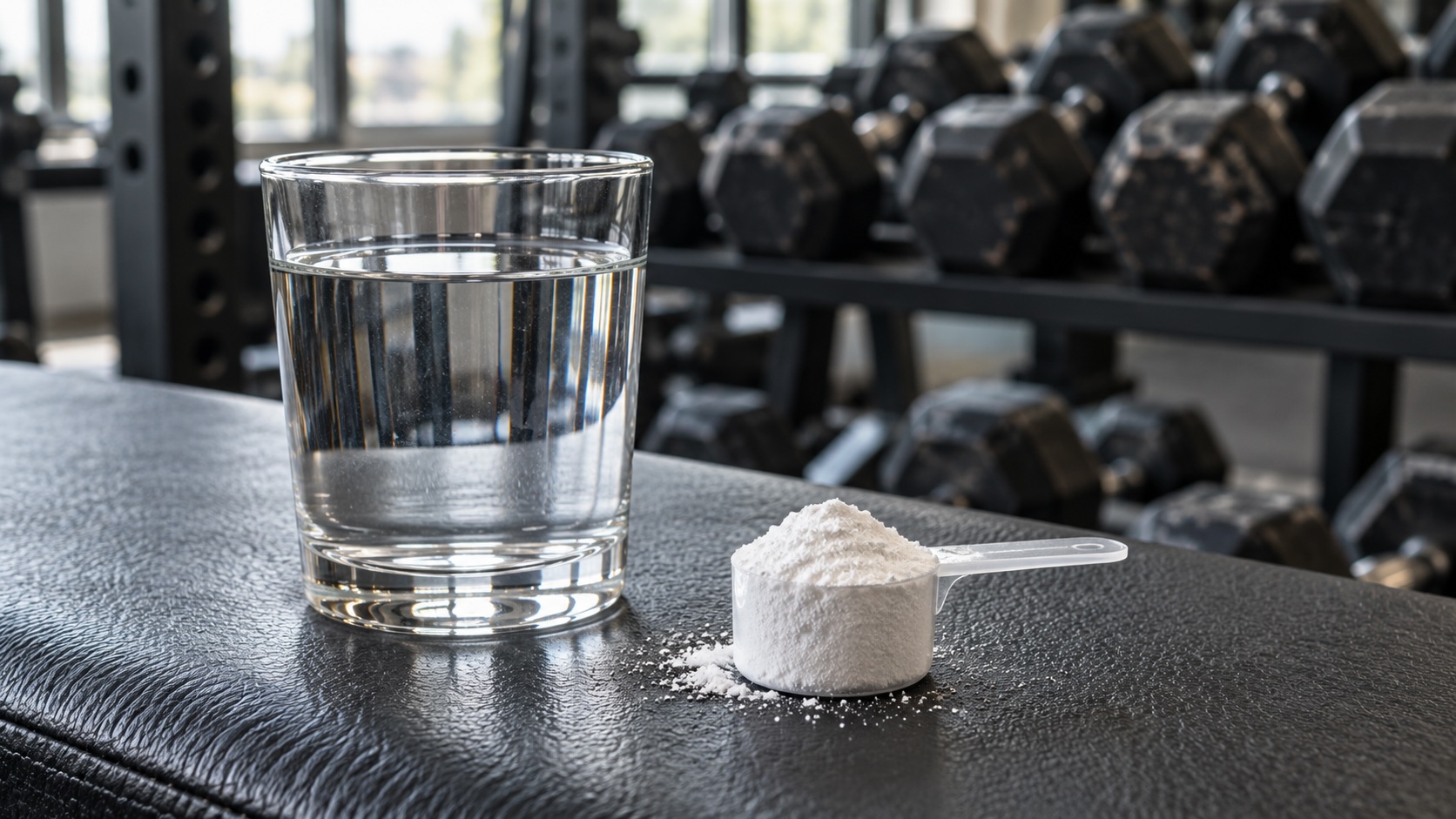
It may look prettier in your shaker cup.
That is not the same thing as working better.
Keep in mind that there isn’t an obvious absorption problem to solve here, Columbo.
Creatine monohydrate is already highly bioavailable. That does not mean every gram ends up stored in muscle, but dissolving more easily does not automatically improve tissue uptake.
And the human head-to-head data discussed here still do not show an HCl advantage.
Read dem studies and weep in your fancy-pants creatine form, Mr. Human Biologist.
What the Creatine Comparison Actually Shows
Creatine HCl and creatine monohydrate have produced similar results across several measured strength, power and body-composition outcomes in the trials discussed here.
Claims of HCl superiority are unsupported by those head-to-head hooooman trials.
So I don’t care what a study in three-eyed old ferrets, a petri dish or a marketing deck says.
Small studies with no significant differences do not establish perfect equivalence.
They also do not give anyone permission to sell superiority that wasn’t demonstrated.
Creatine monohydrate remains my winner.
It has the deepest evidence base, and the direct comparisons discussed here have not shown a reason to replace it with HCl. Read the review of creatine forms.
Boring?
Absolutely.
That’s part of the charm.
Want More Info on Creatine?
Want to learn about creatine for muscle, strength, cognition and the research on bone health?
I have you covered like a Jimmy hat with my Complete Creatine Manual.
Get the Complete Creatine Manual.
Already Skoooled on Creatine?
If you are all solid on creatine, the one I recommend and personally use is straight-up boring creatine monohydrate from my friends at Driven Nutrition.
Full disclosure: I am an affiliate for Driven Nutrition, so I make a few shekels when you purchase through my link.