
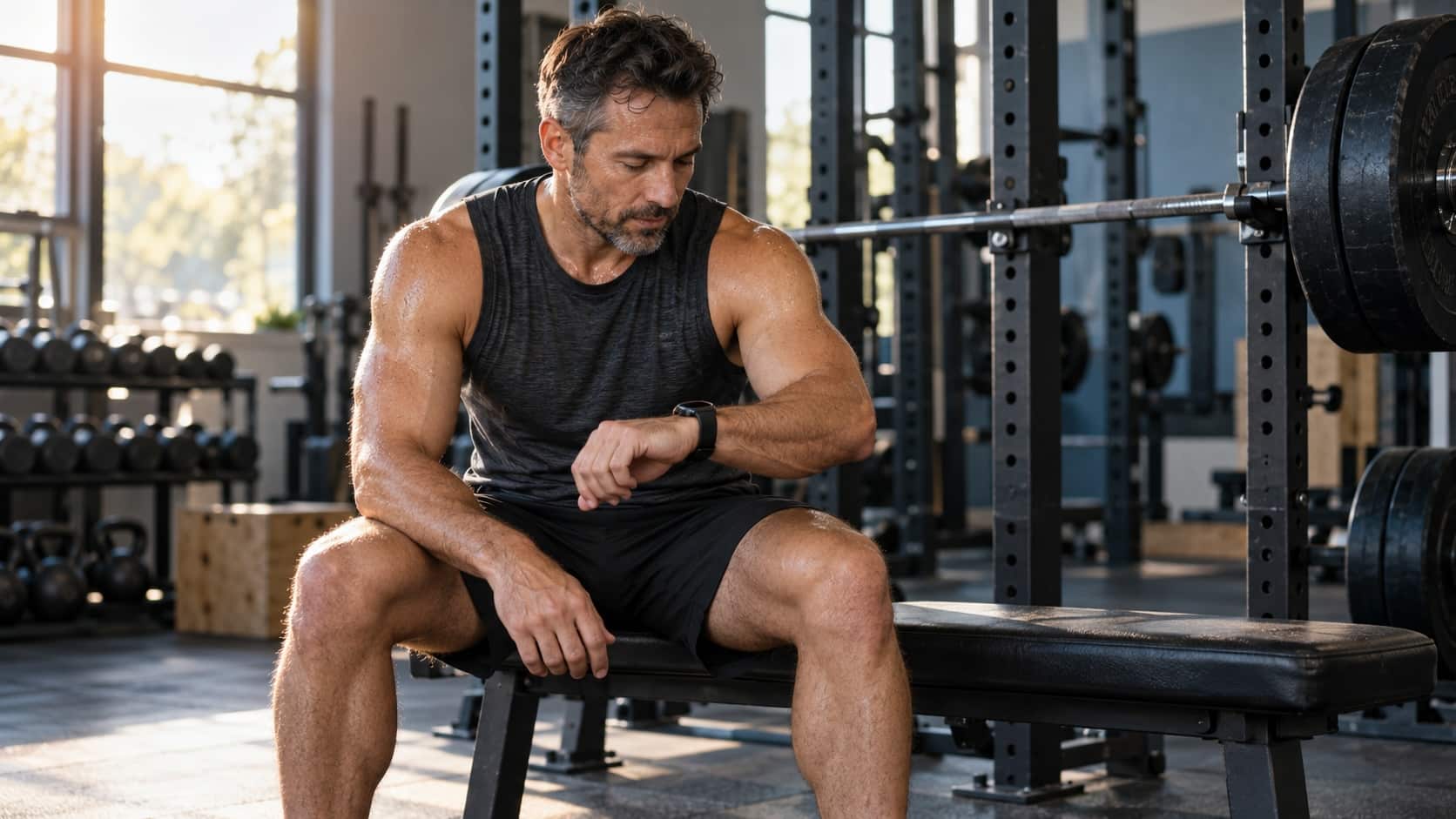
Most training programs answer this question with the cold confidence of a Soviet parking meter:
Rest 3.5 minutes.
Fine.
But why?
Why three and a half minutes?
Why not two minutes and 17 seconds?
Are you actually recovered, or did the stopwatch simply finish counting while your lungs were still trying to chew through the front of your face?
Why program the same rest period for all four sets when fatigue accumulates and you may need more rest before your last set than your first?
Fixed rest periods are clean on paper.
Human physiology is not.
Plus, recovery can change from day to day.
Some days, you crush a set of squats and feel ready to attack again before the bar stops rattling.
Other days, the same load leaves you folded over the rack, bargaining with several minor deities and wondering whether your hamstrings have legal representation.
This is where heart rate becomes useful.
Let Your Heart Help Decide When the Next Set Starts
Inside Triphasic Training II, Coach Cal Dietz and yours truly nerdy cover several biometric methods for autoregulating training.
One of the simplest methods uses heart-rate recovery to help determine rest periods.
The setup is brutally simple:
Perform the set.
Watch your heart rate come down.
Begin the next set when it reaches your predetermined number, provided your breathing and ability to perform the exercise are also ready.
For a main strength exercise, one coaching starting point is around 85 beats per minute.
Hit the set.
Recover.
When your heart rate reaches roughly 85 bpm and you are ready to perform another quality set, grip the bar and return to the scene of the crime.
Now your rest period responds to feedback from your physiology instead of forcing you to obey a number that was typed into a spreadsheet three months ago by a coach eating cold chicken and soggy broccoli over a laptop.
One important nerd note: your heart rate coming down does not prove your muscles are fully recovered. Use it alongside breathing, technique and your ability to maintain the intended performance.
Why This Can Beat the Stopwatch
Recovery changes.
Sleep affects it.
Stress affects it.
Heat, hydration, conditioning, exercise selection, load, reps and accumulated fatigue all pile into the vehicle like heavily armed circus performers.
A heavy set of squats may require four minutes before your heart rate settles.
Later, a set of dumbbell lateral raises may only require two and a half.
The stopwatch does not care.
It sits there counting with the emotional range of a microwave oven.
Heart rate gives you feedback from the organism, aka you, currently doing the training.
That is the entire point of autoregulation.
Use a Higher Trigger for Accessory Work
You do not need the same recovery target for every exercise.
For heavier compound lifts, one starting point is 85 bpm.
For higher-repetition accessory work, try 100–110 bpm.
The higher trigger can keep the workout moving and carry more fatigue into the next set.
That may be useful when the goal is hypertrophy, local muscular endurance or creating enough metabolic distress that your triceps begin transmitting coded messages to the Coast Guard, provided you can still perform the intended reps with good technique.
These numbers are coaching starting points, not universal recovery cutoffs.
They are not sacred commandments hammered into granite by the ancient prophets of leg day.
Adjust them based on the athlete, exercise and desired training effect.
This Works Especially Well for Remote Coaching
Cal puts it this way:
“This works especially great if you are coaching athletes online or in the offseason when they are not at your facility.”
The athlete does not need a coach standing nearby with a stopwatch, clipboard and the haunted stare of a man who has watched 400 consecutive sets of Bulgarian split squats.
They only need a heart-rate monitor and a phone or watch.
A chest strap is generally preferable when you need accurate feedback during lifting. Wrist sensors can help establish the habit, but they may be less reliable during resistance exercise. Read the research on wrist-monitor accuracy.
I have programmed rest periods this way for myself and my online clients for more than a decade.
It makes the program easier to follow.
More importantly, it adjusts to what is happening that day.
Bad sleep?
Rest may take longer.
Excellent recovery?
You may be ready sooner.
The program bends without snapping in half and flying through the window.
You Do Not Need More Technology
Could you purchase velocity trackers for every rack?
Absolutely.
You could also install biometric eye scanners, surround the platform with motion-capture cameras and hire a former NASA engineer to monitor bar speed from an armored van in the parking lot.
Most people will not do that.
They just want to know:
How long should I rest before my next set?
Heart-rate recovery gives you a practical way to help answer that question.
Perform the set.
Allow your heart rate to fall.
Once it reaches your target and you are ready to perform the next set well, go again.
Simple enough to use in your next workout.
Useful enough to make the rest clock less arbitrary.
And considerably better than sitting on the bench scrolling Instagram until you lose all awareness of time, space and why you came to the gym.
The complete heart-rate protocol, including how to establish targets for strength, hypertrophy, speed and conditioning, is laid out inside Triphasic Training II.
For more information about the Triphasic Training II book, I also write a separate newsletter covering practical methods from the system.
Go to Triphasic2.com and opt in.