I get hit with some version of this question all the time:
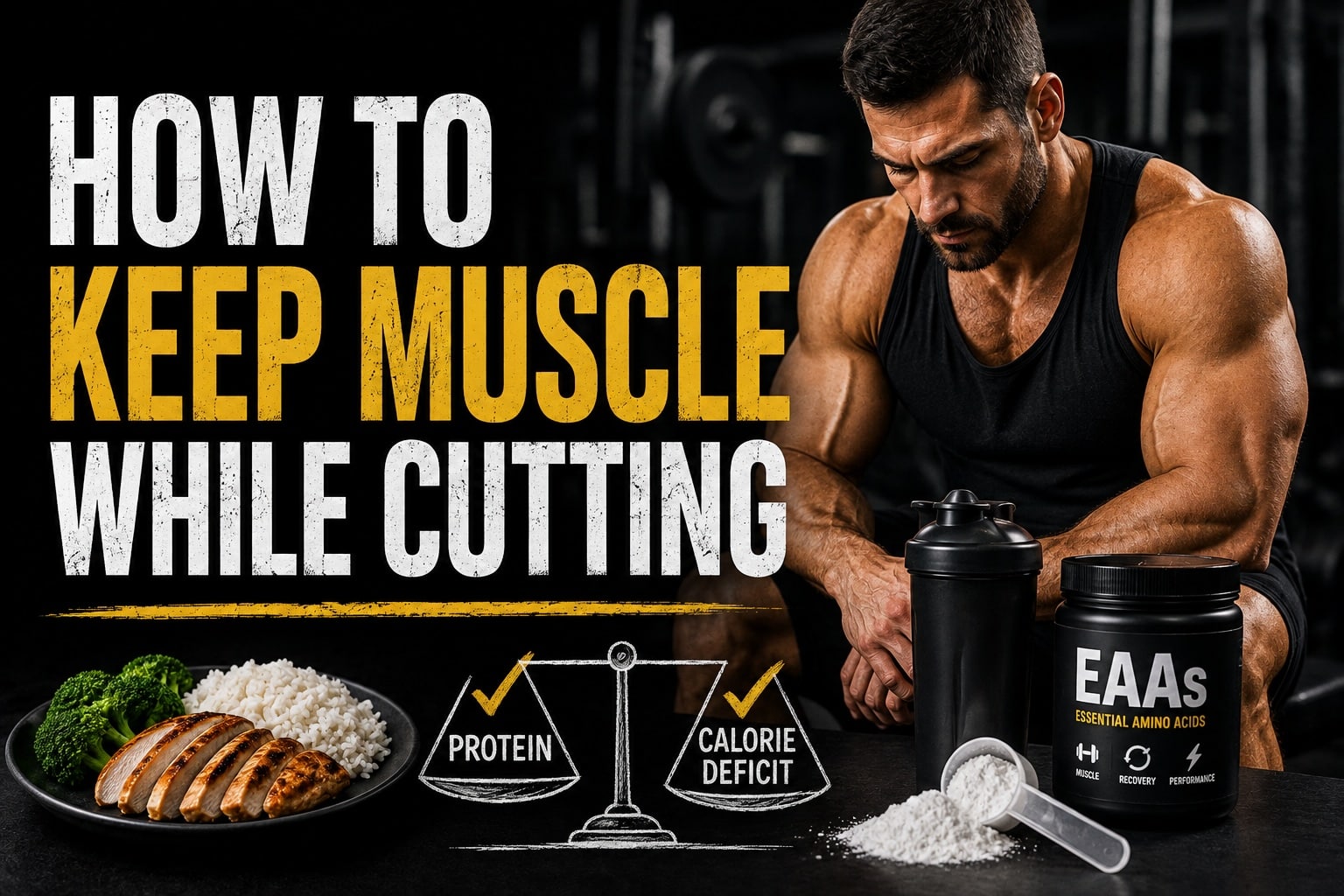
“I’m cutting. How do I not lose muscle?”
The standard answers are correct and nearly useless.
Eat more protein.
Keep lifting.
Do not slash calories with a chainsaw.
Fine. That’s the standard elevator speech advice.
But let’s strap on our propeller hats and go a$$ first down the nerd chute, because researchers at the University of Arkansas have spent years grinding this question through controlled studies, including work with military collaborators.
Their answer is stranger, and more useful, than anything printed on a watermelon-flavored supplement tub.
Why Dieting Changes the Protein Equation
When you’re eating enough calories, the amino acids from dietary protein have plenty of places to go.
Start cutting calories and things get more competitive.
During an energy deficit, more of the amino acids you eat can get pulled into energy-yielding pathways and other whole-body protein needs.
Your liver wants dem AAs, bro.
Your immune system wants them too.
Then your gut lining, connective tissue, wound repair and acute-phase proteins all have invoices stamped:
PAST DUE. PAY UP, BEOOOTCH.
The researchers phrase this more politely.
During a moderate energy deficit, ingested essential amino acids (EAAs) appear to primarily support whole-body needs. Muscle protein synthesis may be physiologically secondary.
Secondary.
In writing.
From the people running the tracer infusions.
Think of muscle as unsecured debt.
In good times, everybody gets paid. During a cash crunch, muscle receives a tasteful letter thanking it for its patience.
And that’s where the research gets interesting.
Study One: Triple the EAAs, Same Muscle Signal
In one randomized, double-blind crossover study, 19 resistance-trained men completed two five-day energy deficits at roughly 30% below their energy requirements.
All the things that make research geeks high-five each other.
Two details matter.
First, dietary protein stayed at 1.6 g/kg/day. The energy deficit came from carbohydrate and fat.
Nobody was protein-starved.
Second, routine training was prohibited. On the test day, subjects performed eight sets of 10 repetitions on the leg press and leg extension at 80% of 1RM using a single-leg model.
Then they drank either:
- 0.10 g/kg of free-form EAAs, or about 7.9 grams
- 0.30 g/kg of free-form EAAs, or about 23.5 grams
They tripled the dose.
This was not one extra gummy tossed into the cauldron.
And this is where the results surprised me.
Whole-body protein balance improved dramatically with the higher dose.
Protein synthesis increased more, protein breakdown fell by another 15.6 grams, and net protein balance finished 19 grams more positive over 180 minutes.
But what happened to muscle protein synthesis?
It increased after feeding in both conditions.
Between roughly 8 and 24 grams of EAAs, however, there was no significant difference.
The authors concluded that roughly 8–10 grams of EAAs was sufficient to stimulate resting and post-exercise mixed-muscle protein synthesis during a moderate energy deficit.
That’s approximately the EAA content you’d get from 20–30 grams of high-quality protein.
Tripling the EAA dose didn’t buy an additional muscle protein synthesis signal.
It did buy better whole-body protein protection.
That’s potentially valuable, but it’s a different scoreboard.
National GDP going up does not guarantee your paycheck went up.
One disclosure is worth bringing to light here: the EAA formula is covered by a UAMS patent with two senior authors. According to the study, those authors did not collect or analyze the data and remained blinded until final data consolidation.
Study Two: Different Format, Same Plot Twist
Another study put 10 adults through three separate five-day energy deficits, again at roughly 30%.
Each condition provided 34.7 grams of protein, but the EAA content varied:
- EAA-enriched whey: 24 grams of EAAs
- Plain whey: 18.7 grams
- Mixed meal: 11.4 grams
Whole-body net protein balance was substantially better with the EAA-enriched whey.
It was about 22 grams better than whey alone and 18 grams better than the mixed meal over three hours.
Mixed-muscle protein synthesis?
No significant difference between treatments.
Same crime scene.
Whole-body protein balance responds. Muscle reaches its ceiling and leans against the wall smoking a cigarette.
Every condition met the proposed 8–10 g EAA threshold, so one possibility is that the muscle protein synthesis signal was already maximized.
More EAAs could still be doing something useful. They just weren’t pushing MPS any higher.
Study Three: Here Comes the Mud
Then a 2025 study complicated the clean story.
Seventeen adults completed five days at energy balance and five days at roughly 30% below their energy requirements.
After exercise, one group received 304 calories containing 56 grams of protein and 48 grams of EAAs.
Yes.
A metric piss ton of EAAs.
My buddy and newsletter insider DC helped with the study and can vouch for it, haha.
The other group received 311 calories containing 34 grams of protein, 24 grams of EAAs and more carbohydrate.
Still a lot of EAAs.
During the energy deficit, the high-EAA group had higher muscle protein synthesis, substantially lower protein breakdown and more than double the net protein balance.
The researchers concluded that when supplemental calories were fixed, allocating more of those calories to amino acids instead of carbohydrate better maintained post-exercise anabolism during underfeeding.
So does this murder the 8–10 gram rule and bury it behind the lab?
Not cleanly.
Both groups consumed well above 8–10 grams of EAAs.
The treatments also differed in total protein, EAA dose and carbohydrate. Plus, there were only eight and nine subjects per group.
Different design.
Different comparator.
Different question.
What the study does show well is that when supplemental calories are fixed during an energy deficit, amino acids may be a better anabolic investment than carbohydrate.
Then the Military Data Kicked Over the Furniture
Controlled metabolic studies are gorgeous.
Real-world military operations are a swampy metabolic mess with boots.
During strenuous winter military training, participants accumulated a massive 54% energy deficit, putting them roughly 3,313 calories per day in the hole.
Participants received four 20-gram whey protein supplements every day.
That’s 80 grams of additional whey protein.
Whey naturally supplies EAAs, although it’s important to point out that this isn’t the same as testing isolated free-form EAAs.
Even with all that additional protein, whole-body protein retention did not improve.
That doesn’t prove EAAs are useless during a severe energy deficit.
It demonstrates something more important:
Once the energy deficit and physical workload become sufficiently severe, adding a substantial amount of intact protein may still be insufficient to restore whole-body protein balance.
At some point, physiology stops negotiating.
How Many EAAs Do You Need While Cutting?
Looking across this research, here’s what I actually take from it.
1. Around 8–10 grams of EAAs may be enough to maximize the acute muscle protein synthesis signal
During a moderate energy deficit, roughly 8–10 grams appears sufficient to maximally stimulate muscle protein synthesis in the research discussed here.
Larger doses haven’t consistently produced a larger muscle signal.
That doesn’t mean 8–10 grams is a magical universal number. I didn’t cover every EAA study ever published, and research in this area is still evolving.
But it’s a useful starting point.
2. More EAAs may still benefit whole-body protein balance
This is where people can get confused.
If 8–10 grams maximizes muscle protein synthesis, why would a larger dose ever help?
Because muscle protein synthesis and whole-body protein balance aren’t the same thing.
Higher EAA doses can increase whole-body protein synthesis, suppress protein breakdown and improve net protein balance.
That supports more than your biceps.
Immune proteins, gut tissue, connective tissue and recovery all live on that ledger.
3. EAAs don’t replace adequate dietary protein
These studies generally provided adequate protein, typically around 1.6 g/kg/day.
EAAs weren’t being used as a hall pass for eating like a distracted ferret.
If you’re cutting and trying to retain muscle, your total protein intake still matters.
A lot.
4. Amino acids may sometimes beat carbs when supplemental calories are limited
When calories are matched, allocating more of them to amino acids rather than carbohydrates may better preserve post-exercise anabolism during an energy deficit.
But again, context matters.
Training demands matter.
The size of the deficit matters.
Total dietary protein matters.
And there is a point where no macronutrient shuffle is going to rescue a catastrophically aggressive diet.
5. You can’t supplement your way out of a terrible cut
This may be the most important point.
Severe, prolonged, real-world energy deficits can outrun the supplement.
No supplement gets veto power over thermodynamics.
At some point, no amount of EAAs is going to save the crash 70% deficit horrible plan Bob from PF dreamed up.
A Practical EAA Strategy for Cutting
If your goal is retaining muscle while losing fat, start with the boring stuff.
Keep your dietary protein high.
Keep resistance training.
Use a reasonable calorie deficit instead of seeing how quickly you can turn yourself into a sad raisin.
Then EAAs can become another tool.
Based on the research above, 8–10 grams of EAAs around training is a reasonable target for stimulating muscle protein synthesis during a moderate energy deficit.
A larger dose may make sense when you’re also concerned about whole-body protein balance and recovery, especially as training stress increases.
But that’s different from saying more EAAs automatically means more muscle protein synthesis.
It doesn’t appear to work that way.
The EAAs I Use
I use Kion Aminos.
It’s a free-form, complete EAA formula containing all nine essential amino acids, and it’s leucine-forward.
It also tastes good.
That stops being a cosmetic detail around week three of a cut when every meal starts feeling like court-ordered community service.
If you want to check out the one I use, you can get it here:
Full disclosure: I’m a Kion affiliate. If you buy through my link, I make a few bucks at no additional cost to you.
The Bottom Line on EAAs and Muscle Loss During a Cut
When calories run short, muscle becomes an unsecured creditor.
The research discussed here suggests that roughly 8–10 grams of EAAs may be enough to maximize the acute muscle protein synthesis response during a moderate energy deficit.
More EAAs may still improve whole-body protein balance, but that’s a different benefit than simply producing a larger muscle-building signal.
And once an energy deficit becomes sufficiently severe, even a lot of additional protein may not be enough to compensate.
So don’t start with the supplement.
Start with the size of your deficit, your total protein intake and your resistance training.
Then use EAAs as a tool where they make sense.
Because beyond a certain depth of deficit, physiology stops taking suggestions.