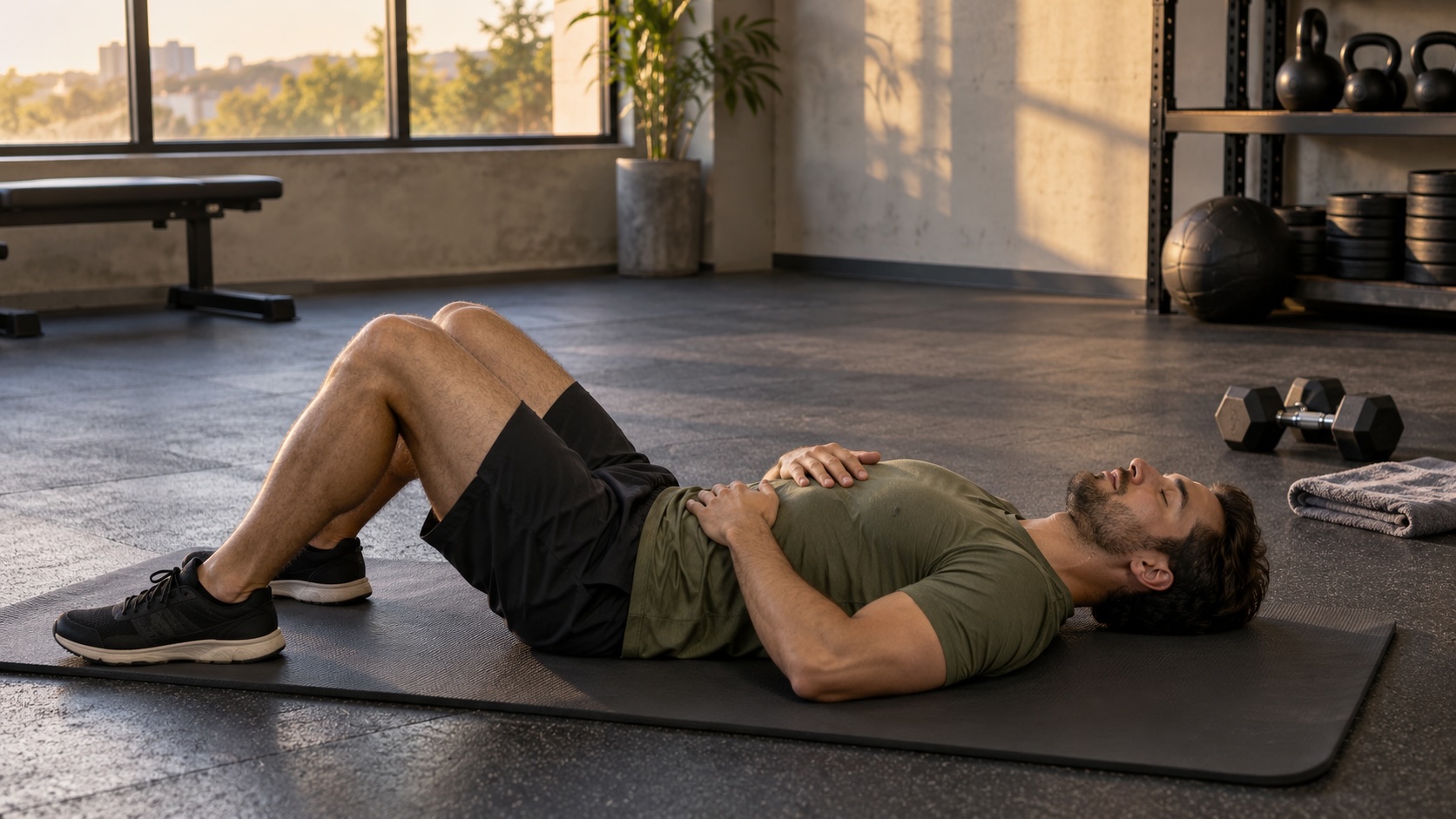
I got served an ad that hit two of my favorite internet-science buttons at once: Soviet sports science and a recovery claim so precise it practically arrived wearing a lab coat:
“In 1978 Soviet Sports Scientists discovered muscles rebuild & recover 2.5x faster with slow breathing immediately after your workout.”
Well, $hit.
Anything old and Soviet must be true, cuz Supertraining…
Throw in a grainy photo of some doooode wrestling a bear between squat sets and we basically have enough proof of anything now.
Except I went looking for the receipts.
The Soviet Mystery
I could not verify the specific 1978 research behind the “2.5x faster muscle rebuilding” claim.
Without the source, I can’t even tell what “recovery” meant: muscle protein synthesis, collagen remodeling, force recovery or subsequent performance.
Maybe it exists in a concrete bunker under Moscow next to Ivan Drago’s original training logZ…
…but until somebody produces it, I’m not buying the 2.5x number.
That doesn’t mean slow breathing does nothing.
Slow Breathing Actually Does Something
Sugimoto et al. (2025) had 15 healthy young men cycle for 10 minutes at 50% of their peak oxygen uptake, or VO₂peak, then spend 10 minutes recovering with either normal breathing or slow breathing at six breaths per minute.
Each participant tried both conditions in randomized order.
Slow breathing increased total heart-rate variability, or HRV, power and another measure of beat-to-beat variability. The researchers interpreted that as faster cardiac parasympathetic reactivation: a quicker return of the heart’s “rest-and-digest” influence after exercise. Read the study.
Cool.
Heart rate and high-frequency HRV were not significantly different between conditions.
This was also a brief, moderate-intensity cycling bout, not a heavy lifting session.
Those are cardiac measures, not a muscle-repair stopwatch.
The study’s reported outcomes did not include muscle protein synthesis.
I saw zero data on Wolverine-quads either.
Recovery of What?
Ammirati et al. (2026) studied 15 young baseball players in a four-week crossover comparison of slow-paced breathing and active recovery after strength workouts.
Some resting cardiac-autonomic measures favored slow breathing. But the researchers did not detect an extra benefit for sprint performance or handgrip strength compared with active recovery.
Grip strength improved over time. Breathing just didn’t add a detectable advantage. Read the study.
That matters because whenever somebody tells you something “improves recovery,” your next question should be:
Recovery of what?
HRV?
Heart rate?
Soreness?
Sleep?
Force production?
Sprint speed?
Muscle protein synthesis?
Your ability to squat heavy again tomorrow?
Those things overlap, but they are not interchangeable.
Raidl et al. (2026) randomized 34 participants to four weeks of sprint interval training, with or without added slow-paced breathing.
The breathing group did 10-minute sessions after training plus additional sessions before bed.
Training improved performance, but the researchers did not detect an additional performance or recovery benefit from the breathing protocol. Nocturnal heart rate actually rose slightly in the breathing group relative to the control group. Read the study.
That is not proof breathing can never help.
It is a reason not to sell a guaranteed recovery multiplier.
So no, these studies do not establish that five minutes of breathing after deadlifts makes your muscles rebuild 2.5 times faster.
Where I Depart From the Data
I like deliberate downregulation after hard training and have been doing it myself and with clients for years.
My bias is that it is worth the few minutes spent on it.
That is my coaching preference, not a muscle-repair outcome these studies measured.
I think about recovery in its most basic physiological sense as returning toward homeostasis after a stressor.
Training intentionally knocks you away from baseline.
Heart rate and ventilation climb, sympathetic activity rises and metabolic demand increases.
You WANT the disturbance.
Once the work is over, though, I don’t see much value in dragging that activated feeling around for another three hours because you immediately grabbed your phone, answered 17 emails, argued about Zone 2 online, slammed more caffeine and launched yourself directly into another stressor.
Who does that sheeeeet?
My reason for sitting down and breathing is simple: I want a deliberate transition out of training mode.
Whether that improves my next session is a separate question.
The Sophisticated $0 Protocol
Finish training.
Sit or lie down.
Put the darn phone away.
Breathe slowly for 5–10 minutes.
My practical starting target is around six breaths per minute, roughly one full breath every 10 seconds.
Something like four seconds in and six seconds out, if that feels comfortable.
Keep it easy rather than forcing huge breaths or straining to hit a number.
This is recovery, not the breath-holding Olympics.
Cost: $0.
Equipment required: lungs.
Apparently, they have not moved to a subscription model yet like every other freaking thing!
OK, slooooow exhale.
If you want to get fancy, I’ve also used the Shiftwave chair as a more elaborate way to create that transition out of training mode.
That is my experience with a different tool, not something these breathing studies tested.
Different tool.
Same intention.
Now you have a cheap, simple way to finish a hard training session deliberately, even if Ivan thinks your biceps are rebuilding 2.5x faster.