
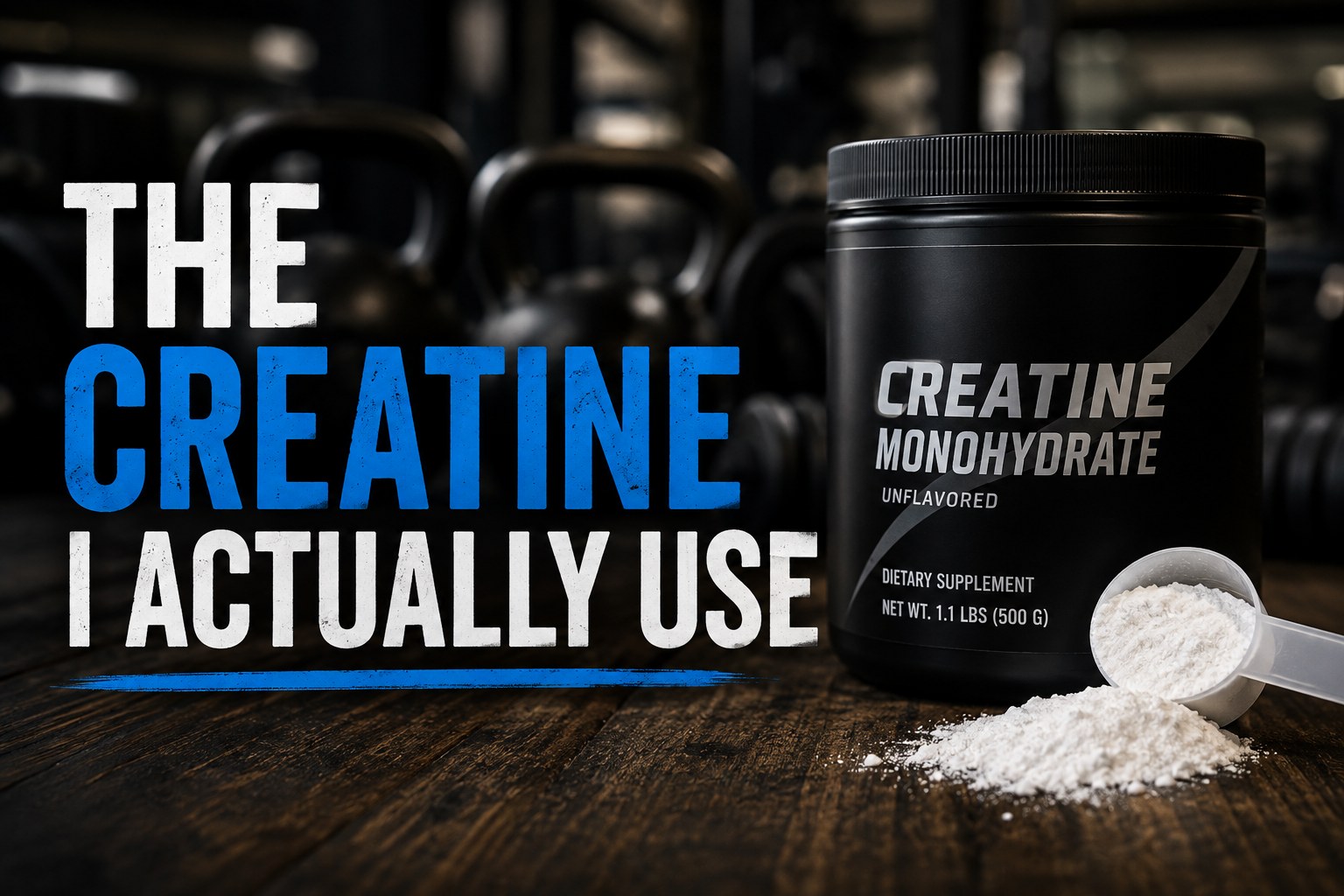
I get asked about creatine all the time, but one question comes up more than almost any other:
“Okay Dr. Mike, what creatine do YOU use?”
Easy.
Creatine monohydrate from Driven Nutrition.
I’ve used the same stuff for almost 12 years.
Twelve.
Years.
Which is roughly 874 years in supplement-industry dog years, where every six months somebody discovers a NEW ULTRA-BOLIC CREATINE that apparently makes boring old monohydrate look like it arrived on the Mayflower.
Yet there it sits on my shelf.
Creatine monohydrate.
Why I Still Use Creatine Monohydrate
Creatine is one of those rare supplements where boring is a feature, not a bug.
You don’t need molecular origami. You don’t need the latest proprietary creatine matrix. And you definitely don’t need to wait for a chrome-plated supplement warlock to create a “better” creatine molecule and charge you $17 more because the tub has lightning bolts on the label.
For me, it’s still plain old creatine monohydrate.
Creatine monohydrate has been studied extensively for its effects on strength, power and high-intensity exercise performance. It’s inexpensive, widely available and backed by a huge amount of research.
That’s a pretty good combination.
How Much Creatine Do I Take?
The standard recommendation you’ll see tossed around is around 5 grams per day.
That’s a perfectly reasonable place to start.
But I don’t treat 5 grams like it was chiseled into a stone tablet and carried down from Mount Supplements R Us.
On higher-demand days, I’ll sometimes use more.
For example, I was dragging a little one morning recently, so I dumped 10 grams in and went about my day.
To be clear, creatine isn’t caffeine.
I wasn’t expecting the walls to start vibrating while Slayer spontaneously fired up in the kitchen as I drank my quad espresso.
Creatine doesn’t work like a stimulant. Its benefits come primarily from increasing your muscles’ phosphocreatine stores over time, which helps regenerate ATP during high-intensity efforts.
So taking 10 grams that morning wasn’t about getting an acute caffeine-like “boost.” It’s simply an example of how I personally vary my intake rather than treating one dose as a universal rule.
Your needs may be different based on body size, diet, training volume and other factors.
What Creatine Do I Actually Buy?
I’ve been using creatine monohydrate from Driven Nutrition for almost 12 years.
If you want the exact one I use, you can find it here:
Use code DRMIKE at checkout to save 15% on anything from Driven Nutrition.
Full disclosure: that’s an affiliate link and code. If you use it, I make a few bucks to put toward another heavy DB to play with in the gym.
You save some money and get the same painfully unsexy creatine I’ve been tossing down my gullet for almost 12 years.
Seems fair.
Why Driven Nutrition?
I started working with Driven back in 2014 and became good friends with Jason, who was the CEO at the time.
I’ve stayed with the company even after he sold it.
One of the challenges with supplements is that you aren’t standing inside the manufacturing facility watching every scoop go from raw material to finished product. At some point, you’re relying on the company behind the product to do what it says it’s doing.
After working with Driven for more than a decade, I trust them enough to continue using their products myself.
And when it comes to creatine, I don’t see a compelling reason to make things more complicated.
Do You Need a Fancy Form of Creatine?
For most people, probably not.
There’s always going to be another form of creatine promising better absorption, better uptake, less bloating, more muscle or some other advantage over monohydrate.
But when I’m deciding what to spend my own money on, I’m looking for something with strong evidence, a good safety record and a reasonable cost.
Creatine monohydrate checks those boxes.
If another form eventually produces compelling evidence that it’s meaningfully better, great. I’ll look at the data.
Until then?
The boring white powder stays on the shelf.
Almost 12 years and counting.