The internet has discovered the calf muscle, and naturally it’s reacted with all the restraint of a raccoon trapped inside a supplement warehouse.
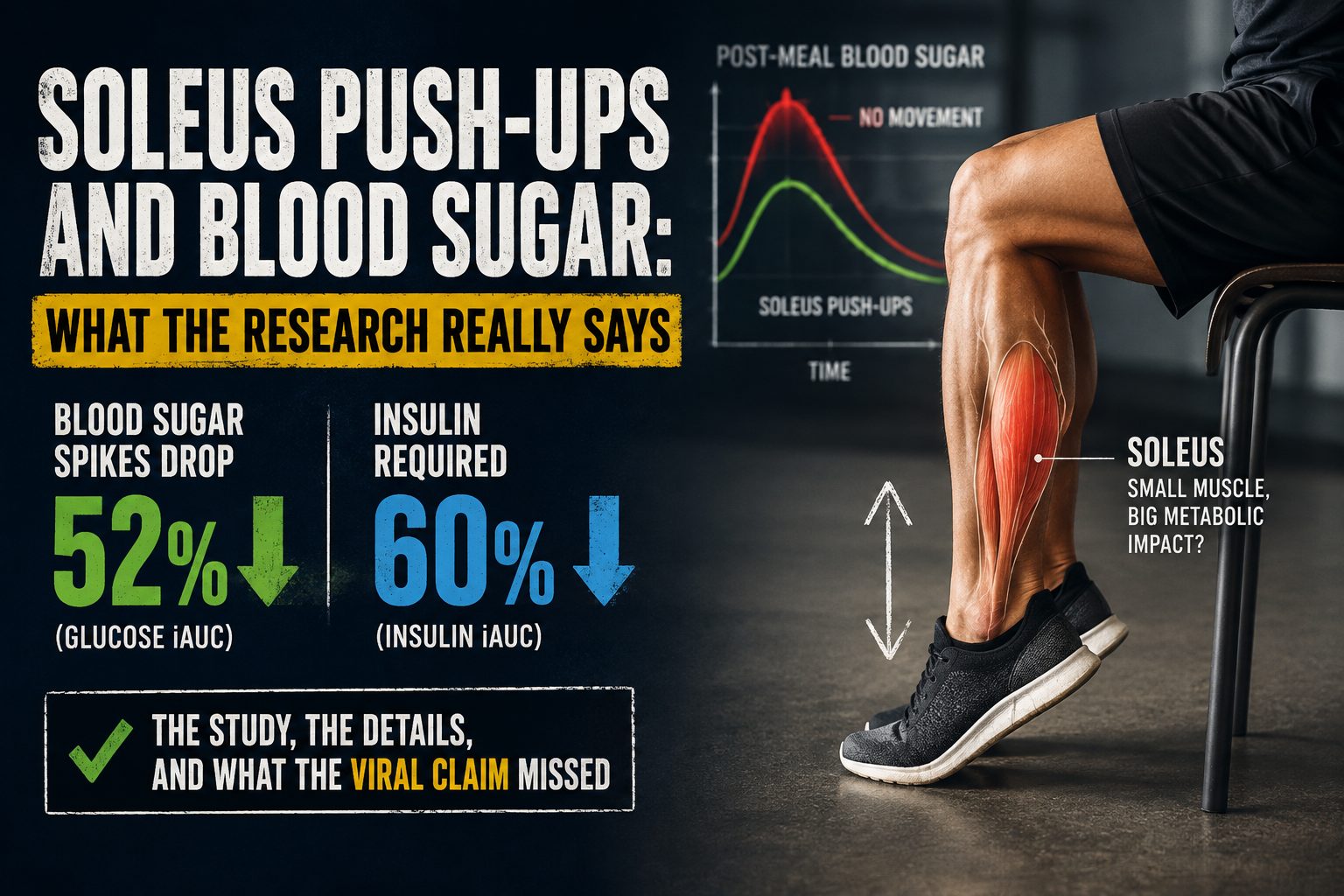
According to the video headline, blood-sugar spikes drop by 52% when you perform one tiny seated movement after eating. The accompanying graphic makes the intervention look almost offensively easy: sit in a chair, lift your heels up and down, and watch half the glucose spike disappear while your pancreas loosens its tie, pours a drink, and starts browsing retirement property in Boca Raton.
The graphic also claims that the movement reduces the insulin required to handle the meal by approximately 60%.
Those numbers sound like researchers found metformin hiding underneath a dining-room chair.
The good news is that the claim was not fabricated from powdered nonsense. The percentages came from a legitimate peer-reviewed experiment conducted by researchers at the University of Houston and published in iScience (Hamilton et al., 2022).
The bad news is that the viral translation stripped away nearly every experimental detail required to understand what those percentages mean. Participants did not casually perform a few heel raises after lunch, admire the pump, and return to scrolling through videos of strangers arguing about seed oils. They performed a deliberately engineered, soleus-dominant contraction protocol for three hours.
That detail is not garnish sitting beside the result.
It is the entire metabolic entrée.
The Claim
The video is titled:
“Blood Sugar Spikes Drop 52% If You Do THIS After Eating.”
The associated graphic states that seated heel lifts reduce the post-meal blood-sugar spike by 52%, decrease the insulin needed to manage the meal by approximately 60%, and can supposedly be performed after every meal for powerful results.
The source paper did report reductions of up to approximately 52% in glucose incremental area under the curve and 60% in insulin incremental area under the curve during a three-hour oral glucose-tolerance test (Hamilton et al., 2022).
That sentence, however, contains several pieces of scientific machinery that the viral version quietly hauled to a remote field and buried.
The investigators did not show that blood glucose was 52% lower at every time point. They did not establish that peak glucose always fell by 52%, nor did they show that a few minutes of ordinary heel bouncing reproduces the result. The insulin figure also did not represent a directly calculated therapeutic requirement, medication dose, or precise percentage reduction in pancreatic workload.
The study measured the integrated glucose and insulin responses produced during a specific acute laboratory protocol.
That is still interesting.
It simply is not the same claim as:
Raise your heels after dinner and delete half the carbohydrates.
The physiology survived peer review. The translation was later dragged through the internet behind a truck.
The Original Study
Hamilton, Hamilton, and Zderic (2022) developed a specialized seated movement called the soleus push-up, or SPU.
Superficially, the movement resembles a seated calf raise. The participant remains seated with the knee flexed, keeps the forefoot in contact with the floor, lifts the heel, and then lowers it again.
Calling the SPU “just a seated calf raise,” however, is like describing a Formula One car as a machine with four tires. The statement is technically true while being almost completely useless.
The investigators were not merely asking participants to bounce their heels at whatever tempo boredom happened to produce. They developed a particular contraction strategy intended to elevate oxidative metabolism in the soleus while limiting fatigue and reducing gastrocnemius involvement (Hamilton et al., 2022).
The objective was to turn a small, highly oxidative muscle into a sustained consumer of circulating fuel while the rest of the body remained parked in a chair.
This was not a conventional strength-training set. There was no meaningful external load, no proximity-to-failure target, and no dramatic final repetition accompanied by the facial expression of a man trying to pass a billiard ball.
The soleus was supposed to remain metabolically active for hours.
That duration is inseparable from the result.
Why the Soleus?
The soleus lies underneath the gastrocnemius and contributes heavily to plantar flexion, postural control, and locomotion. It contains a high proportion of slow-twitch, oxidative fibers and is unusually resistant to fatigue.
That makes the muscle well suited to prolonged low-force activity. The researchers were interested in whether this small muscle could be driven at a sufficiently high local metabolic rate to influence whole-body glucose and lipid handling without requiring conventional exercise involving large amounts of muscle mass (Hamilton et al., 2022).
The soleus represents only a small fraction of total body mass, which is precisely why the finding attracted attention. A tiny muscle should not appear capable of substantially altering whole-body postprandial metabolism unless something unusual is happening.
The unusual feature was not the existence of plantar flexion. Humanity has been lifting its heels since the first nervous hominin looked over a tall hedge.
The unusual feature was the researchers’ ability to maintain elevated oxidative metabolism in the soleus for a prolonged period while keeping overall exertion low.
One heel lift burns approximately enough energy to irritate a calorie tracker.
Thousands of repeated contractions sustained across the glucose-exposure window are a different physiological event.
The investigators were effectively asking whether an oxidative muscle could be turned into a slow, persistent metabolic drain connected directly to the circulation. Instead of allowing the soleus to sit underneath the gastrocnemius like an abandoned mitochondrial warehouse, they placed it on a three-hour shift.
What Did the Participants Actually Do?
The glucose-regulation portion of the study used a 75-g oral glucose tolerance test, commonly abbreviated as OGTT.
Following an overnight fast, participants consumed a drink containing 75 g of glucose. Researchers then measured glucose, insulin, and related metabolic responses over a three-hour period under different experimental conditions (Hamilton et al., 2022).
During the control condition, participants remained seated and inactive.
During the active conditions, they performed the soleus push-up throughout the entire 180-minute post-glucose period.
The duration was therefore:
180 minutes = 3 hours
The subjects were not told to perform heel raises for five minutes and then return to passive sitting. The contractions continued during nearly the entire period in which the glucose challenge was being absorbed, circulated, and cleared.
Fifteen participants completed a condition that raised total energy expenditure to approximately 1.3 metabolic equivalents, or METs. Ten of those participants also completed a higher-intensity SPU condition at approximately 1.7 METs (Hamilton et al., 2022).
One MET approximates resting metabolic expenditure. Consequently, 1.3 to 1.7 METs still represents very low whole-body exertion. Nobody was sprinting through the laboratory while graduate students fired blood-sampling equipment at them from behind overturned desks.
They remained seated.
The soleus, however, was repeatedly contracting for three hours.
The higher-intensity SPU condition produced the largest changes in glucose and insulin responses, indicating that the metabolic demand created by the movement mattered. Merely moving the ankle was not necessarily sufficient. The recruitment pattern, contraction intensity, cadence, duration, and resulting oxidative demand were all parts of the intervention (Hamilton et al., 2022).
Once those components are removed, the study has been replaced by a meme wearing safety goggles.
What Does “52% Lower Blood Sugar” Actually Mean?
This is the point where the headline takes a statistical result, loads it into a stolen shopping cart, and sends it down a hill.
The investigators did not report that every blood-glucose measurement was reduced by 52%. They reported that the glucose incremental area under the curve (iAUC) was reduced by approximately 52% during the most effective soleus push-up condition compared with inactive sitting (Hamilton et al., 2022).
Incremental area under the curve represents the accumulated elevation in glucose above baseline across a specified period.
Conceptually:
Glucose iAUC = ∫0180[ G(t)−G0] dt
In this equation:
- G(t) represents glucose concentration at a particular time;
- G0 represents baseline glucose;
- and the integral represents the accumulated elevation above baseline throughout the 180-minute test.
In real experimental analysis, the area is generally estimated using the trapezoidal method because no one wants to place a miniature calculus professor inside every blood sample.
The relative reduction can be expressed as:
Relative reduction = (iAUCsitting − iAUCSPU) / iAUCsitting × 100
A 52% reduction in glucose iAUC means that the total accumulated glucose excursion above baseline across the three-hour period was approximately 52% smaller during the most effective SPU condition.
That is not equivalent to a 52% reduction in every individual glucose value.
Consider two glucose curves. One rises sharply, remains elevated for a long time, and slowly returns toward baseline. The other rises less, reaches a lower peak, or returns toward baseline sooner. The total area beneath the second curve may be 52% smaller even though no single measurement is exactly 52% lower.
The area summarizes the entire post-glucose journey.
It is not one glucose reading wearing a cape.
Hamilton et al. (2022) also reported substantial absolute differences in glucose concentrations during portions of the test, with values approximately 50 mg/dL lower during parts of the one- to two-hour period in the SPU condition compared with sedentary sitting.
That is already a meaningful acute effect. There is no scientific need to inflate it until the statistic blows through the roof and lands in a neighboring county.
The defensible statement is:
During a three-hour 75-g OGTT, sustained soleus push-ups reduced the integrated post-glucose excursion by as much as approximately 52% compared with uninterrupted sitting.
That wording describes the measured outcome.
“Blood sugar dropped by 52%” describes a different event.
Did Insulin “Needs” Drop by 60%?
The graphic’s second major claim is that the movement reduced the insulin needed to handle the meal by approximately 60%.
This figure also originated from a real result, but the wording performs several unauthorized medical cartwheels.
Hamilton et al. (2022) reported an approximately 60% reduction in insulin incremental area under the curve during the highest-intensity soleus push-up condition. They also assessed C-peptide, which is released alongside endogenous insulin and can provide information about pancreatic insulin secretion.
The lower insulin and C-peptide responses were consistent with reduced endogenous insulin secretion during the active condition (Hamilton et al., 2022).
However, the investigators did not directly measure “insulin needed,” as most viewers would interpret the phrase. They measured circulating insulin-related responses during an acute laboratory test rather than calculating therapeutic insulin doses, thereby authorizing people with diabetes to slash medication by 60% or proving that the pancreas performed precisely 60% less biological labor.
A technically defensible statement would be:
The soleus push-up condition reduced post-glucose insulin iAUC by approximately 60% compared with sedentary sitting.
A far less defensible statement would be:
Your body needs 60% less insulin after meals.
The first sentence reports the observed outcome.
The second sentence grows a fake mustache and begins practicing endocrinology from the storage room of a strip mall.
Lower circulating insulin, accompanied by a lower glucose excursion, may be favorable. Contracting skeletal muscle can increase glucose uptake through mechanisms that are not entirely dependent on insulin, allowing muscle to clear more circulating glucose without requiring the same insulin response.
That does not mean insulin iAUC, insulin sensitivity, pancreatic workload, medication requirements, and long-term glycemic control are interchangeable terms.
They are related concepts.
They are not identical plumbing fixtures that can be ripped out of one scientific bathroom and installed in another.
Why Could the Soleus Push-Up Lower Glucose?
Skeletal muscle contraction increases glucose uptake through signaling mechanisms that overlap only partially with the insulin signaling pathway.
Under resting conditions, insulin binds to its receptor and triggers a signaling cascade that promotes the translocation of glucose transporter type 4 (GLUT4) to the muscle cell membrane. More GLUT4 transporters at the membrane allow more glucose to move from the circulation into the muscle cell.
Muscle contraction can also promote GLUT4 translocation through pathways involving changes in cellular energy status, calcium signaling, mechanical stress, AMP-activated protein kinase, and additional contraction-sensitive molecular machinery.
In plain English, contraction creates another route through which muscle can become hungry for glucose.
This contraction-mediated uptake is especially important because it can remain partially functional even when insulin sensitivity is impaired. The pathways are not entirely independent, but they are sufficiently distinct that exercise and muscle contraction can improve glucose disposal without relying exclusively on a large insulin response.
The Hamilton et al. (2022) protocol was unusual because the researchers attempted to keep this contraction-related glucose demand elevated for hours without producing substantial fatigue.
Several factors likely contributed to the effect.
Prolonged Contractile Activity
Most exercise studies involve a discrete workout followed by recovery.
In this experiment, the soleus contractions continued throughout the glucose challenge. The muscle was still working while glucose was being absorbed from the gastrointestinal tract, released into the circulation, distributed throughout the body, and cleared into tissues.
The researchers did not briefly knock on the metabolic door and run away.
They leaned on the doorbell for three hours.
A short exercise bout may increase glucose uptake for a limited period. The SPU protocol instead attempted to sustain demand across much of the entire post-glucose window.
That temporal overlap is likely crucial.
Sustained Oxidative Metabolism
The soleus is built for prolonged oxidative activity.
Hamilton et al. (2022) showed that the SPU could substantially elevate local soleus oxygen consumption and maintain that elevation without the rapid fatigue typically associated with harder contractions.
This distinction matters because movement alone is not the relevant endpoint. The important question is how much metabolic work the muscle performs and which substrates it uses to support that work.
A loose, poorly recruited heel bounce may look similar from across the room while producing a completely different metabolic demand.
The body is annoyingly literal about these matters.
Increased Use of Circulating Substrates
The researchers reported that the soleus relied surprisingly little on its own stored glycogen during prolonged SPU activity, even after several hours (Hamilton et al., 2022).
That finding suggests the muscle may have been drawing heavily from circulating substrates, including blood glucose and lipids.
The soleus was not simply burning through a private glycogen trust fund stored inside the muscle.
It was reaching into the circulation and paying cash.
If a contracting oxidative muscle repeatedly pulls glucose from the bloodstream during a glucose challenge, the total glucose excursion should decrease. That mechanism is physiologically plausible and consistent with the observed response.
Low Whole-Body Intensity
The overall workload remained low despite the elevated local metabolism in the soleus.
Harder exercise can increase catecholamines, stimulate hepatic glucose production, and temporarily complicate the acute glucose response. None of this makes intense exercise undesirable; it merely means that the immediate blood-glucose response to hard exercise is not always a simple downward line.
The soleus push-up strategy attempted to raise muscular fuel use without producing a large whole-body stress response.
It was metabolic guerrilla warfare conducted beneath a desk.
Duration Matched the Glucose Exposure
After a person consumes 75 g of glucose, blood glucose and insulin remain elevated for an extended period.
The SPU contractions continued throughout that same period.
This synchronization between glucose appearance and muscular fuel demand may be one of the most important features of the protocol. A five-minute set produces a brief demand signal. A three-hour intervention repeatedly applies that demand while glucose is still entering the circulation.
Those are not equivalent doses.
Pretending otherwise is like claiming that standing beneath a shower for nine seconds produces the same result as taking a shower.
There was technically water involved, but the experiment has changed.
The Separate 4.5-Hour Experiment
The Hamilton et al. (2022) paper also contained a separate experiment in which ten participants performed soleus push-ups at approximately 2 METs for 270 minutes.
That duration equals:
270 minutes = 4.5 hours
This portion of the study primarily examined substrate metabolism, fatigue resistance, energy expenditure, and soleus-glycogen use.
The researchers evaluated metabolism after approximately 130 and 270 minutes of activity and found that the soleus could sustain elevated oxidative metabolism while relying relatively little on its own glycogen stores (Hamilton et al., 2022).
This 4.5-hour experiment is often blended into online descriptions of the glucose findings, but it should be kept separate from the three-hour OGTT protocol.
The famous 52% glucose-iAUC reduction came from the three-hour glucose-tolerance experiment.
The 4.5-hour protocol provided mechanistic information about how the soleus fueled prolonged contractions.
Both experiments involved enough repetitive movement to make the average viral-video viewer request diplomatic immunity from the chair.
Was the Finding Replicated?
A 2025 pilot study tested the soleus push-up concept in adults with prediabetes.
Elek et al. (2025) recruited ten participants who completed a sedentary two-hour OGTT and a second OGTT while performing soleus push-ups.
Once again, this was not a tiny movement snack performed between bites of dessert.
Participants performed the movement continuously throughout the full 120-minute test at a target cadence of approximately 60 repetitions per minute (Elek et al., 2025).
That target produces a theoretical total of:
60 repetitions/minute × 120 minutes = 7, 200 repetitions
Seven thousand two hundred repetitions is no longer a casual calf exercise.
It is a lower-leg labor dispute.
Participants were trained to perform approximately 0 to 45 degrees of plantar flexion while maintaining a knee position intended to reduce gastrocnemius contribution and emphasize the soleus. Some subjects received real-time electromyographic feedback to help confirm the desired activation pattern (Elek et al., 2025).
The average reduction in glucose iAUC was approximately 32%.
Participants using EMG feedback experienced an average reduction of approximately 37%, while those performing the movement without feedback averaged approximately 26%. Individual reductions ranged from roughly 10% to 47%, and the difference between the EMG-feedback and non-feedback groups was not statistically significant (Elek et al., 2025).
This pilot supports the central physiological idea: prolonged soleus-focused contractions can meaningfully reduce the glucose excursion produced by an OGTT.
It also drags several pieces of reality back into the room.
The average effect was smaller than 52%, responses varied considerably, the sample contained only ten people, and the subjects performed the movement for two continuous hours.
The replication does not prove that everyone gets a 52% reduction. It shows that the direction of the original finding survived another small acute experiment.
That is encouraging evidence.
It is not a universal metabolic warranty printed on the bottom of your shoe.
Does This Apply to a Normal Meal?
Possibly, but the original study did not use a normal mixed meal.
Participants consumed a standardized drink containing 75 g of glucose after an overnight fast (Hamilton et al., 2022).
An OGTT is useful because it creates a controlled glucose challenge. Researchers can compare experimental conditions without wrestling with differences in protein, fat, fiber, gastric emptying, food structure, meal volume, and the thousand other variables that arrive whenever humans chew actual food.
A glucose drink, however, is not chicken, rice, vegetables, olive oil, and a cookie.
Mixed meals alter digestion and metabolism through several mechanisms. Fat and fiber can slow gastric emptying and glucose appearance. Protein can stimulate insulin secretion while changing the overall glycemic response. Incretin hormones, amino acids, food structure, and digestive kinetics all complicate the shape of the postprandial curve.
Real life barges into the laboratory wearing muddy boots and refuses to behave like a glucose beverage.
The evidence therefore supports the conclusion that sustained soleus contractions can blunt the glucose and insulin responses to a standardized oral glucose load.
It does not establish that the precise same percentage reduction occurs after every breakfast, burrito, steak dinner, protein shake, or emergency gas-station pastry consumed beneath fluorescent lighting at 1:17 a.m.
The mechanism should still have relevance. Contracting muscle does not suddenly lose the ability to take up glucose because the carbohydrate arrived inside a sandwich.
The exact magnitude, however, cannot simply be copied and pasted from an OGTT into every mixed meal.
Does a Shorter Dose Work?
This is the question people actually care about.
Can five, ten, or fifteen minutes of seated heel raises after a meal produce a useful reduction in glucose?
The Hamilton et al. (2022) study does not answer that question because the intervention lasted three hours.
The Elek et al. (2025) pilot does not answer it either because participants continued for two hours.
Neither study directly compared five minutes, ten minutes, thirty minutes, one hour, two hours, and three hours. We therefore do not know the minimum effective dose from these experiments.
Shorter bouts may still provide some benefit. It is physiologically reasonable to expect that repeated muscle contractions would improve glucose uptake relative to remaining completely motionless. Repeated brief bouts distributed throughout the post-meal period may also work better than one isolated set.
Those ideas are plausible.
They remain extrapolations.
The internet handles extrapolation like a stolen rental car: it floors the accelerator, ignores every warning light, and returns the vehicle through the side wall of a laboratory.
The evidence currently supports the statement that prolonged soleus push-ups reduce glucose excursion. It does not support attaching the exact 52% figure to a five-minute protocol that was never tested.
That does not make five minutes useless.
It means the percentage cannot be smuggled across protocols in the trunk of a sedan.
Is This Better Than Walking?
The study did not establish that soleus push-ups are superior to post-meal walking.
That comparison matters because a broader body of literature supports light post-meal activity as a strategy for improving postprandial glucose control.
Walking recruits more total muscle mass, raises whole-body energy expenditure, and provides cardiovascular, musculoskeletal, and behavioral benefits extending beyond acute glucose disposal.
The appeal of the soleus push-up is different. It can be performed while seated and may therefore be useful during situations in which walking is impractical, including desk work, long meetings, travel, mobility limitations, or any corporate hostage situation involving a slide deck titled “Strategic Synergy Update.”
The soleus push-up does not need to defeat walking in single combat to justify its existence.
The more useful comparison is SPUs versus uninterrupted sitting.
When the alternatives are either activating the soleus or remaining motionless like a decorative office fern, repeated contraction is likely the more metabolically useful option.
Major Limitations
The findings are fascinating, but the evidence base is still small.
Small Samples
The original glucose experiment included 15 participants in one SPU condition and ten in the higher-intensity condition (Hamilton et al., 2022).
The 2025 pilot included ten adults with prediabetes (Elek et al., 2025).
Repeated-measures designs are valuable because each participant serves as their own control, reducing some between-person variability. They can detect acute physiological effects in relatively small samples.
They do not tell us how consistently the effect generalizes across large and diverse populations.
The available studies provide limited information about responses in older adults, highly trained athletes, sedentary individuals, people with obesity, people with type 2 diabetes, individuals taking glucose-lowering medication, or those with neuropathy and mobility restrictions.
Acute Outcomes
Both studies examined acute metabolic responses during a single laboratory session.
They did not determine whether daily SPU use over weeks or months improves hemoglobin A1c, fasting glucose, insulin sensitivity, body composition, diabetes progression, cardiovascular risk, or clinical outcomes.
An improved three-hour glucose curve may be beneficial.
It is not a long-term clinical trial wearing a tiny white coat.
Chronic adaptation also cannot be assumed from acute data. A strategy may work extremely well during one exposure yet produce smaller, larger, or different effects when repeated over time.
Laboratory Coaching
The intervention involved a deliberately developed technique.
Participants were not merely told to raise their heels however they pleased. The investigators paid attention to movement execution, soleus recruitment, cadence, range of motion, and metabolic intensity.
Elek et al. (2025) even examined the use of EMG feedback.
This creates an external-validity problem. A person at home may reproduce the visible movement without reproducing the metabolic stimulus.
Two exercises can look almost identical while recruiting different muscles, producing different force profiles, and generating very different oxygen consumption.
The eye is not a metabolic cart.
Extraordinary Duration
The protocols lasted two to three hours.
That is physiologically impressive and behaviorally inconvenient.
An intervention can be effective inside a laboratory while remaining about as attractive in daily life as a three-hour dental cleaning performed during a tax audit.
The duration raises obvious adherence questions. Even people who believe strongly in glucose control may not perform thousands of heel raises after every meal.
No Medication Implications
People using insulin or other glucose-lowering medications should not interpret the 60% insulin-iAUC reduction as permission to modify medication independently.
The investigators measured endogenous metabolic responses during an OGTT.
They did not conduct a therapeutic insulin-adjustment trial.
The difference is not bureaucratic nitpicking. It is the border separating physiology from an ambulance.
What the Evidence Supports
A scientifically defensible summary is:
In small, controlled acute studies, continuous soleus-dominant seated contractions performed throughout a two- to three-hour oral glucose-tolerance test reduced the integrated post-glucose blood-glucose excursion compared with uninterrupted sitting. The average reduction was approximately 32% in a 2025 pilot involving adults with prediabetes, while the original 2022 study reported reductions of up to approximately 52% under its highest-intensity condition (Elek et al., 2025; Hamilton et al., 2022).
A more precise description of the original experiment is:
During a three-hour 75-g oral glucose-tolerance test, sustained soleus push-ups performed at approximately 1.3 to 1.7 METs reduced glucose and insulin incremental area under the curve compared with inactive sitting, with the higher-intensity condition producing reductions of up to approximately 52% and 60%, respectively (Hamilton et al., 2022).
That wording is accurate.
It also contains too many syllables to be printed across a photograph of a smiling woman eating salad, which explains much of the current problem.
What the Evidence Does Not Support
The existing research does not demonstrate that two minutes of heel raises reduces glucose by 52%, that every blood-glucose reading falls by half, or that ordinary unsupervised calf raises perfectly reproduce the SPU technique.
It also does not establish that the same effect occurs after every mixed meal, that all individuals respond similarly, that the movement lowers hemoglobin A1c, or that it prevents diabetes.
The studies do not show that SPUs replace walking, resistance training, aerobic exercise, medication, or any other established intervention. Nor do they authorize a 60% reduction in therapeutic insulin while the pancreas spends the afternoon reclining in a beach chair and drinking something from a coconut.
The movement is not magic.
It is prolonged skeletal-muscle contraction.
The human body has always been inconveniently responsive to using muscle.
Practical Interpretation
There is an important idea buried beneath the headline rubble:
Interrupting prolonged sedentary time with muscle activity can improve postprandial glucose handling.
Skeletal muscle is a major site of glucose disposal. Activating it while glucose is entering the circulation is physiologically reasonable.
The soleus push-up may be especially useful during periods when walking is impossible or impractical. Repeated soleus contractions are likely more metabolically productive than allowing the lower leg to remain completely inactive for hours.
The hierarchy of evidence, however, needs to remain intact.
The strongest conclusion is that performing the researchers’ specific soleus push-up protocol continuously for two to three hours during an OGTT can substantially reduce glucose excursion compared with uninterrupted sitting (Elek et al., 2025; Hamilton et al., 2022).
A reasonable inference is that performing repeated soleus contractions during prolonged sitting may improve glucose handling relative to doing nothing.
The unsupported leap is claiming that a few casual heel raises after an ordinary meal will reliably reduce the glucose spike by 52%.
That last sentence is the one the algorithm wants.
It is also the one the experiments did not test.
Verdict
The study is real, the glucose effect is real, and the headline is wearing someone else’s statistical pants.
Hamilton et al. (2022) found that a deliberately engineered soleus push-up protocol, performed continuously throughout a three-hour 75-g oral glucose-tolerance test, reduced glucose iAUC by as much as approximately 52% and insulin iAUC by approximately 60% compared with inactive sitting.
Elek et al. (2025) later reported an average glucose-iAUC reduction of approximately 32% in ten adults with prediabetes who performed the movement continuously for two hours.
Those are compelling acute physiological findings.
The dose, however, is the entire damn story.
The subjects did not perform one tiny set of heel raises after eating. They completed thousands of contractions across two to three hours while researchers coached the movement and measured the resulting metabolic response.
The experiment did not show that brief heel lifting erases half a blood-sugar spike. It showed that a prolonged, specifically executed soleus-contraction protocol can substantially reduce the integrated glucose response to a standardized oral glucose load compared with uninterrupted sitting.
The first version sells videos.
The second version describes the science.
One is a metabolic campfire story told beneath the algorithmic moon. The other survived peer review.
The practical lesson is not that the soleus contains an ancient glucose-exorcism button hidden beneath the gastrocnemius. The useful lesson is that muscle contraction matters, prolonged sitting carries metabolic consequences, and even a small oxidative muscle can affect whole-body fuel handling when it is recruited correctly and forced to work long enough.
Perform soleus contractions when you are trapped in a chair. Walk after meals when possible. Lift weights. Do aerobic work. Build a body capable of disposing of glucose through more than one pathway.
Most importantly, whenever a headline promises a 52% physiological transformation from one microscopic trick, ask the question social media hopes you are too busy chewing to consider:
What exactly did the subjects do, and for how damn long?
In this case, the answer is:
They performed the movement for three hours.
References
Azadi, B. (n.d.). Blood sugar spikes drop 52% if you do THIS after eating [Video]. YouTube.
Elek, D., Tóth, M., Sonkodi, B., Ács, P., Kovács, G. L., Tardi, P., & Melczer, C. (2025). The efficacy of soleus push-up in individuals with prediabetes: A pilot study. Sports, 13(3), Article 81. https://doi.org/10.3390/sports13030081
Hamilton, M. T., Hamilton, D. G., & Zderic, T. W. (2022). A potent physiological method to magnify and sustain soleus oxidative metabolism improves glucose and lipid regulation. iScience, 25(9), Article 104869. https://doi.org/10.1016/j.isci.2022.104869