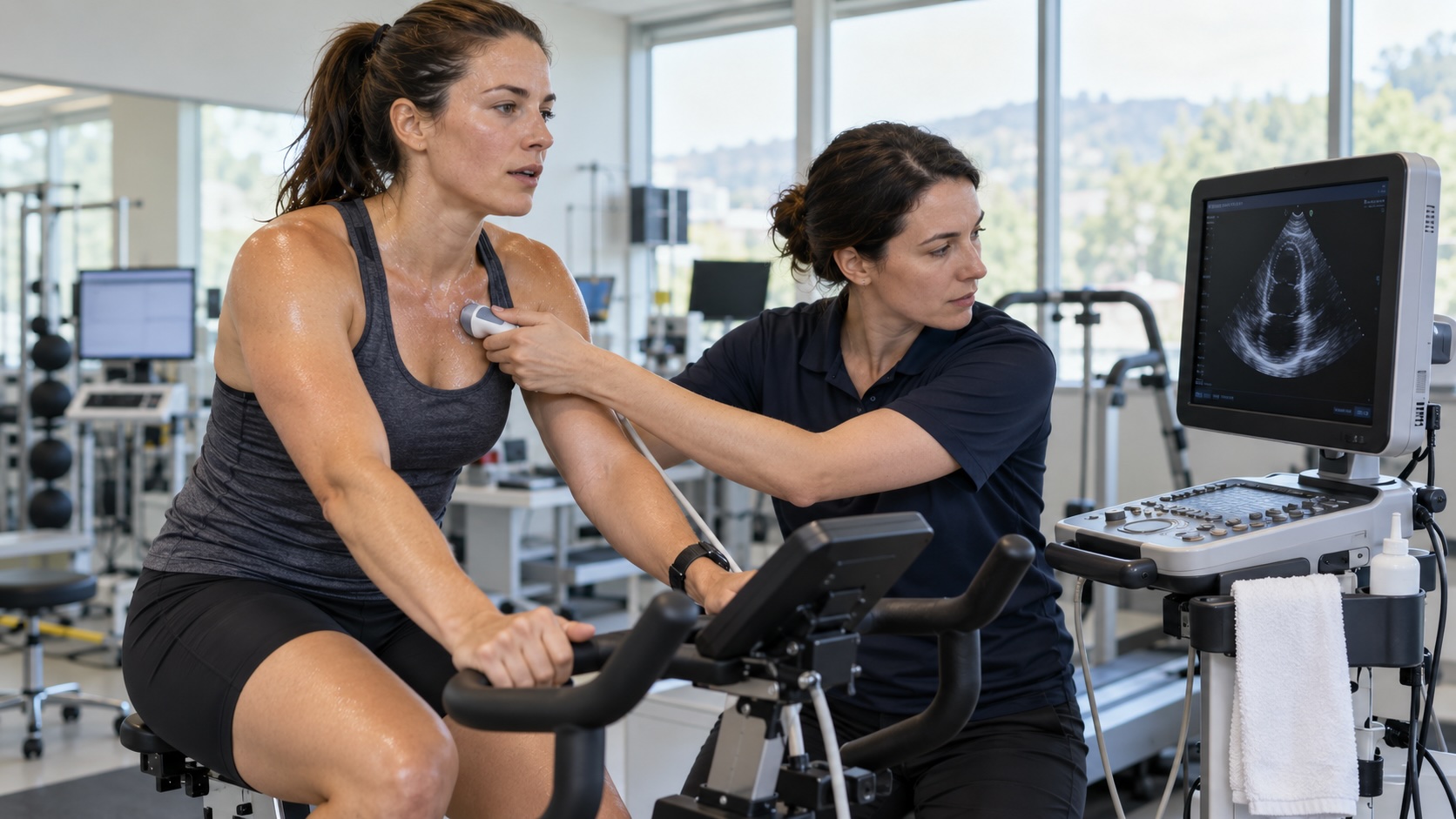
There’s a claim floating around the cardio universe that if you want to maximize stroke volume, you need to do Zone 2.
Grab both of your glutes and hold tight, because we are going down the nerd chute hard on this one.
I don’t believe a darn thing anyone claims about Zone 2 without checking it anymore, so I pulled a Full Nelson and spent waaaaay too many hours reviewing the data related to stroke volume.
Here we go!
Zone 2 Magic
Ah yes. The magical Zone 2, where mitochondria multiply, fat spontaneously combusts and your left ventricle becomes a fire hose…
…except there’s a rather inconvenient problem: the evidence does not establish Zone 2 as the one intensity that maximizes stroke volume.
Aerobic training at lower intensities can improve stroke volume over time.
That is a different question from whether stroke volume peaks while you are exercising in Zone 2.
First, What the Hell Is Zone 2, Bro?
There are three-zone, five-zone and seven-zone models.
Some use heart rate, others VO₂max or lactate thresholds. Their Zone 2 labels do not all describe the same intensity.
None of the studies below called its training condition “Zone 2.”
Any zone label is my translation, not the researchers’ terminology.
I tried to keep this as clean as possible, but it was a mess to sort out.
Your Stroke Volume Does Not Obey a Zone Chart
Stroke volume, or SV, is the amount of blood your heart ejects with each beat.
The familiar textbook story says it rises as exercise gets harder and then plateaus around 40–50% of VO₂max.
That happens in some people.
In others, including some trained athletes, it keeps rising toward maximal exercise.
The literature shows plateauing, continued increases and sometimes declines at high intensities. Vella and Robergs, 2005, Vieira et al., 2016.
Your left ventricle did not get the memo about an Instagram zone boundary.
Let’s Unleash the Norwegian 4×4
Helgerud et al. (2007) assigned 40 moderately trained men to four running protocols, three days per week for eight weeks, with total work matched across groups.
The reported changes in stroke volume during a high-intensity running test were:
| Training protocol | Prescribed intensity | Stroke-volume change |
|---|---|---|
| Long slow distance | 70% HRmax | −1.0% |
| Lactate threshold | 85% HRmax | +0.9% |
| 15/15 intervals | 90–95% HRmax | +9.4% |
| 4 × 4-minute intervals | 90–95% HRmax | +10.4% |
Stroke volume was measured in six men per group.
Both interval groups improved significantly from their own baselines. The lower-intensity groups did not.
Here is the crucial fine print: the researchers did not find a statistically significant difference between groups for stroke-volume change.
They did find between-group differences in VO₂max.
So these SV numbers challenge the “only easy work moves SV” claim, but they do not prove intervals are superior for SV. Read the Helgerud study.
And 85% HRmax is no leisurely spin around the block.
Moderate Cardio Still Earns Its Keep
In the HERITAGE Family Study, 631 previously sedentary adults completed 20 weeks of cycling.
Sessions progressed from a heart rate associated with 55% of VO₂max for 30 minutes to one associated with 75% for 50 minutes.
Their stroke volume increased during standardized submaximal exercise. Wilmore et al., 2001.
Spina et al. (1992) also found that endurance training attenuated the drop in stroke volume at higher exercise intensities seen before training in young sedentary participants. That program included both continuous running and interval training. Read the study.
Those findings support sustained aerobic training.
They do not give one zone exclusive ownership of your left ventricle.
And the intensity that produces the highest SV during a workout need not be the intensity that causes the largest long-term adaptation.
Different questions.
Different experiments.
The Resting Heart Rate Trap
“My resting heart rate dropped, so my stroke volume must be up, right?”
Maybe.
“Aaaah, cat poop, not another ramble,” I hear you say.
Yep, strap in!
Cardiac output equals heart rate multiplied by stroke volume.
CO = HR × SV
If resting cardiac output stayed exactly the same, a lower heart rate would imply a higher stroke volume…
…but you have not measured resting cardiac output or established that it stayed fixed.
Autonomic regulation, sinus node adaptations, sleep, heat, hydration and medication can affect the reading.
Resting heart rate alone is not a stroke-volume measurement.
And before you roll in the entire physiology lab: a metabolic cart measures VO₂, not stroke volume.
By Fick’s equation:
VO₂ = heart rate × stroke volume × arterial–venous oxygen difference
VO₂ and heart rate leave two unknowns.
A MOXY or other NIRS sensor reports local muscle oxygenation, not whole-body oxygen extraction.
A resting Butterfly ultrasound scan does not tell you your peak SV halfway through a lung-searing row.
I spent hours trying to figure out how I could measure this in my own lab.
The setup I found involved a very expensive piece of equipment that would require some serious household budget negotiations.
Love you, Jodie!
Physiology is a crime scene.
One equation does not identify the suspect.
What Do You Do With This?
Step 1 — Easier Aerobic Work
Use easier aerobic work to accumulate volume at a cost you can recover from.
If your specific goal is improving stroke volume, the training still needs to provide enough stimulus for the person doing it.
My rough coaching guess is that Zone 3 in some five-zone models may be a useful starting point when targeting SV adaptations.
But that is a guess, not an established physiological floor.
I’ve joked that I give Zone 2 a 35% chance of being intense enough in most people to produce SV adaptations.
That is a pure guess I pulled out of my a$$, not a measured probability.
The research above does not establish a universal minimum zone or tell us what percentage of people will respond to a particular Zone 2 prescription.
Step 2 — Harder Intervals
Add harder intervals when they fit your goal and training week.
Training status, available time, recovery and lifting workload all matter more than pledging allegiance to one zone.
I wish I could tell you that you always need to do only Zone 2 work for SV adaptations, but that pesky data is not in agreement.
This is also another strike against making Zone 2 the entire cardio strategy for meatheads.
Want practical cardio programming without pretending one zone owns your left ventricle?